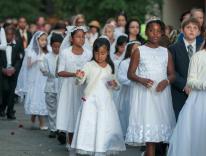
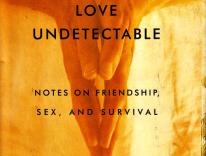
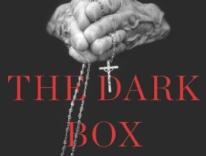
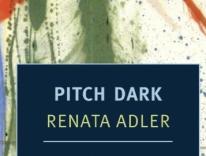
Sexual misdeeds, false identities, cult worship, theft, and murder; if this astonishing tale were not true, it could be the work of an accomplished mystery writer.
Francis Fukuyama's new book examines the rise and decline of the American political system in the broader history of democratic process, intelligently & enjoyably.
Written with the school’s cooperation, this history recounts the story of Regis High School warts-and-all, including the intrigues surrounding its founding.
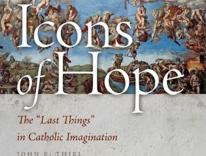
John E. Thiel's theological writing has always combined poise and a sense of urgency, and this intricately argued treatise on eternal life is no exception.
Almost every poem in Joshua Mehigan's collection contains a striking formal moment, where he uses meter or rhyme or line break to do something surprising.
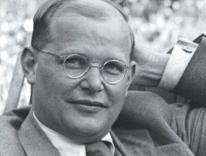
A rich and detailed account of Bonhoeffer’s immensely eventful life—the personal, intellectual, and spiritual journey that ended in a Nazi concentration camp.
Alison is trying to administer a radical corrective to how the faith is often presented, and he backs it up with a sophistication that usually justify his excesses.
In trying to make sense of recurring “strange” episodes of altered consciousness in her life—similar to those of mystics—atheist Barbara Ehrenreich discovers limits.
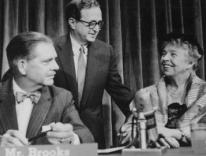
Solon Simmons sifts through 'Meet the Press's' archive to show how sharply Washington’s conversation over economic equality has changed over seven decades.
Jennifer Senior’s 'All Joy and No Fun' is more serious than its playful cover implies. Why do people have children at all now that having them is not a necessity?
Rabbi Abraham Joshua Heschel was one of the most eloquent religious figures of the twentieth century—a “jeweler of words,” in the estimation of one colleague.
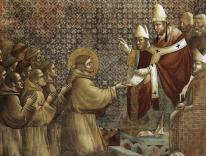
As Donal Cooper and Janet Robson show in this fascinating study, the Basilica of St. Francis in Assisi played a crucial part in promoting Francis and his mission.
The Second Vatican Council isn’t over yet, in the view of Robert P. Imbelli, who notes that the “reception,” and thus the event of the council, is continuing today.
With humor at the fore, 'Lost for Words' seems to arrive as a self-imposed respite from investigating the traumas of St. Aubyn's autobiographical Patrick Melrose.
The collapse of establishment Protestantism as the American civil religion, Bottum asserts, has left a deep void that sends ripples of unease through the culture.
All of us have our own imaginative lives that affect and are affected by our exterior worlds. The poet is someone who finds a language that expresses this truth.
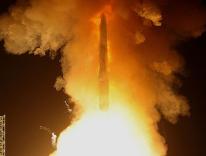
A frightening, journalistic take on nuclear-weapon history and mishap, and a frightening, philosophical critique of the existential dilemma of nuclear weapons.
Fest’s absorbing memoir is an unprecedented attempt to take American audiences deep into Hitler’s Germany from the point of view of Germans who rejected Hitler.
A book on four U.S. clerics who were involved in an early-twentieth-century theological controversy that sent Catholic intellectuals scrambling for cover.
Gates saw himself as a manager working to get things done. But managerial skills used in the service of getting the wrong things done is of little help to anybody.
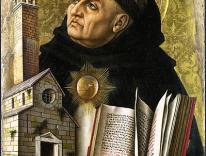
There are three key doctrines where Aquinas’s arguments lead to perplexing conclusions: immortality, creation, and the nature of God as both one and triune.
Four books on the failures of moral imagination and political will, spread across the political landscape, that doomed Europe to decades of totalitarian terror.
By 1982, although nominally still a Democrat, Michael Novak had become an enthusiast for Reaganomics and for every Republican administration to follow.
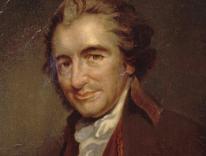
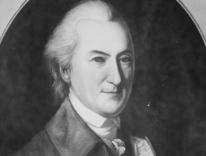
Yuval Levin reconstructs the conflict over Edmund Burke’s angry 'Reflections on the Revolution in France' and Thomas Paine’s incandescent reply, 'The Rights of Man.'
Imre Kertész is a concentration-camp survivor who keeps a distance from the slogans that remind us “never again.” His novels and short stories spell out these views.
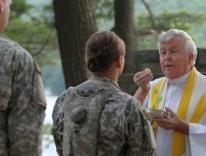
Hansen includes a diverse collection of denominational affiliations and explores some of the most compelling conundrums confronting today’s military chaplaincy.
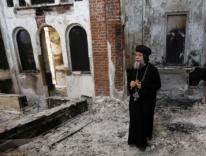
Though the number of Christians killed and persecuted every year is contested, Shortt clears away misconceptions that other religions are the source of the problem.
Pierpont presents a picture of Philip Roth’s works that contains necessary qualifications: there is no dutiful approval of every word the master has written.
Evangelicalism is still very much around, and understanding such a diverse movement is a formidable challenge. Molly Worthen is to be commended for helping meet it.
Hauerwas divides Approaching the End into three parts dealing respectively with eschatology, the church, and what he calls “the difficulty of reality.”