Writers engage biblical texts ranging from the Psalms to a single parable.Their essays are wildly heterogeneous in tone and method, kind of like the Bible itself.
Philip Jenkins sets out to demolish a popular theological myth that the second-century apocryphal writings were unknown until recently; he makes a convincing case.
Paul Misner's new book goes beyond social and labor movements in the church to deal with papal and episcopal action vis-à-vis the great powers between 1914 and 1965.
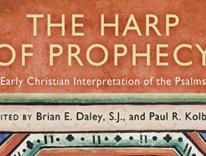
For scholars interested in the history of theology and biblical interpretation, these twelve short essays offer new approaches to Psalms, moral philosophy, and more.
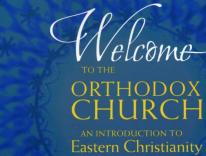
Mathewes-Green, a convert from the Episcopal tradition, focuses on Orthodoxy as a path to God and uses the actions and prayers of the liturgy as a basis for theology
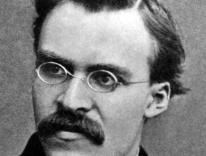
Editors Paul Reitter and Chad Wellmon contend that Nietzsche’s impassioned critique of 19th century education sheds light on the decline of education in the 21st.
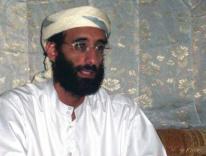
Scott Shane's telling of the U.S.-born Muslim preacher-turned-terrorist and his surveillance by the FBI reveals that the calculus for terrorism is political.
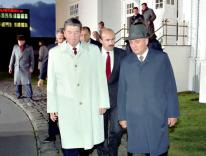
In his latest, Thomas Mallon turns real-life figures like Nixon, Reagan, and Nancy Reagan's astrologer into characters as skillfully as he creates fictional ones.
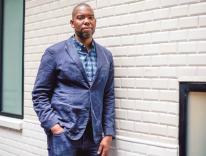
In Ta-Nehisi Coates’s interpretation of race in America, hope doesn't fit into the narrative—something James Baldwin, to whom he's compared, wouldn't leave out.
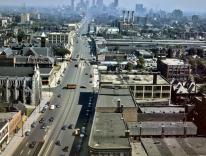
What fascinates Maraniss about Detroit more than its ruin is how central its story is to the broader course of U.S. history—Motown, the local Mob, the auto industry.
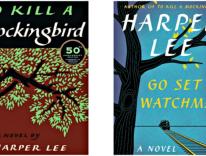
'Go Set Watchman' shows that though Atticus Finch defended a black man in court, he was still a man of his time—on the white citizens council, resisting integration.
John Boyne’s new novel pays attention to the circumstances of priestly life in real-world Catholic Ireland, asking: How does one be a good priest under suspicion?
Anahid Nersessian argues that Romanticism dramatizes the “desirability of constraint.” Her book on how British Romantics imagined "utopia" powerfully does the same.
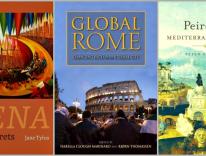
Historical reminders of how the Mediterranean connects Europe, Asia, and Africa at least as often as it separates the three continents from one another.
Girlhoods, boyhoods, childhoods, "freindships": Youth is the setting (and subject) in works by Jane Austen, J.M. Coetzee, Michael Ondaatje, and Leo Tolstoy.
These books offer two rewards: a lot of fascinating information, and an opportunity to think hard about history and being human. But they prompt some questions too.
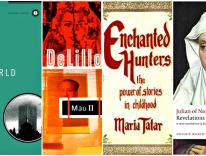
The case for "youthful credulity" when reading; Don DeLillo's moral but discomforting vision; a new translation of Julian of Norwich's 'Revelations of Divine Love.'
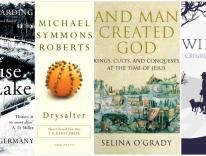
A biographical novel for Thomas Hardy fans; a theory on how Christianity came to dominate Europe; short poems; and the fascinating (true) tale of a house in Germany.
Donaldson's willingness to admit imperfections in his work and the mistakes he’s made in pursuit of his subjects makes him a winning guide to literary biography.
Mary Ziegler’s account of the “lost” history of Roe may surprise even the closest (and oldest) observers of the battles following the 1973 Supreme Court decision.
James Booth examines Philip Larkin’s life and work. Colm Tóibín writes on Elizabeth Bishop. James Wood looks at religious and secular modes of narration in novels.
John Norris's new biography of Pulitzer prize-winning political journalist (and Commonweal Catholic) Mary McGrory is engaging, carefully researched, and sympathetic.
An account of the sexual abuse scandal at the elite Horace Mann school, noteworthy for the contrast with common impressions of Catholic institutional environments.
In "Christian Human Rights," Samuel Moyn concedes that the modern human-rights movement is untethered from its Christian origins. Is this something to worry about?
You don’t need to be a thespian to appreciate James Shapiro's "Year of Lear"—a brilliant, meticulously researched history of social tensions that inspired the play.
While Franzen’s natural mode as writer is one of confident high spirits, in "Purity" his view of people is steeped in pessimism, and his characters are miserable.
Peter Mitchell's take on Charles Curran and the "dissident theologian" strike at Catholic University in 1967 presents a conspiracy so big it's literally incredible.
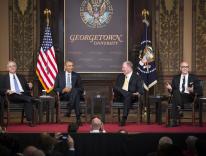
Why has there never been a culture of accountability in the American university? James Keenan, SJ believes the teachers of ethics should practice what they preach.
In this collection of essays, authors draw on “Theology of the Body" to present the Church as a place where women’s leadership can flourish. The results are mixed.
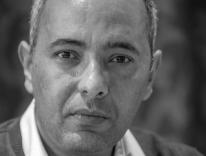
Narrated by the nameless victim's brother, Kamal Daoud's novel asks: Did Camus intend to use the Algerian murder victim in 'The Stranger' as a disposable prop?
Laura Swan does a good job of explaining both the beguines’ spiritual practices in the context of their own times and how their continuing legacy affects us today.
Brooks thinks character is what’s missing in our self-centered society, yet has written a self-help book for an age he believes values the self much too highly.
Anne Enright's new novel suggests something simple—family, for good or ill, keeps forming us even when we try to escape it—but her prose constantly surprises.
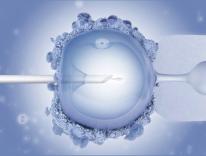
In her new book, Jane Maienschein lays out the history of embryonic science—going back to Aristotle—hoping to answer an old question: When does a human life begin?
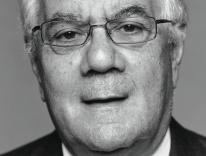
Amusing and engaging, Barney Frank's stories (from sixteen terms in Congress) tell what kinds of “inside politicking” informed the presidencies of LBJ through Obama.
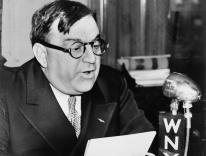
Paul Moses's history of Irish-Italian relations in 19th century New York delves into the causes for "race war" between the immigrant groups and how they overcame it.
Langdon Hammer's biography of poet and writer James Merrill is "wholly definitive" in scope, and threaded throughout with Merrill’s brilliant, always enlivening wit.
The pattern of income inequality is more than a social problem, Robert Putnam says; it's a social tragedy, most devastating in the lives of poor American children.
Many modern American thinkers have asked, often and with anxiety, "What is man?" In his latest book, Mark Greif thinks we've outgrown this—and it's a good thing.