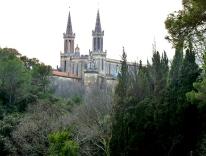
When we visited Frigolet last year, we asked Joël what makes for a vital religious community. “New men,” he replied. Not money, not administrative acumen, but men.
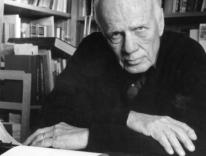
If today the world and the self are devalued, as Walker Percy has suggested, art—particularly the novel— can awaken the reader to their recovery from '4 p.m. blues.'
Reducing faith to political checklists can neither lift Christianity above the superficiality of bourgeois religion nor reverse the disaffiliation of the young.
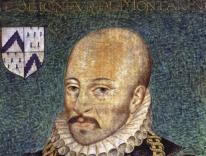
Does Montaigne resemble the contemporary essayist who writes about faith? The short answer is that he does not—at least not in easily recognizable ways.
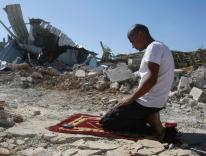
In Hebron I learned that the facts on the ground in the Palestinian-Israeli conflict tell a story Americans intent on "international diplomacy" don't want to hear.
While my husband snapped photos of the flag, I stood in silent debate with Big Ed. And then I spied another Confederate flag; an unwelcome sensation came over me.
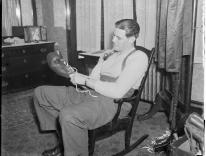
Chicago, 1932. The night before he would knock Ernie Schaaf unconscious, the second time a fighter would die from one of Max’s blows. We were standing at the bar.
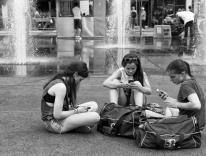
These idle moments when we used to be alone with our thoughts are being decimated by devices. A casual but crucial meditative dimension in our lives is disappearing.
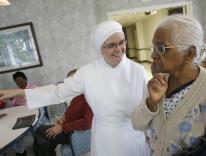
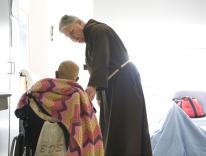
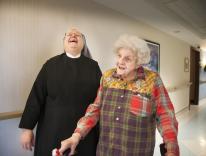
Often the way our society treats "senior citizens" assumes that as bodies age, individuality decreases. But aren't whiskers and white socks a sign of unique wisdom?
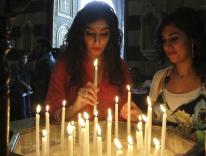
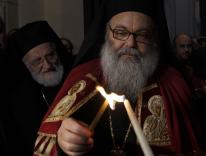
Worshipping with families of Antiochian Christians in Philadelphia, you are an interloper. At the coffee hour, they pile your plate with pastries—"you are new, yes?"
Despite hard work, sound planning, lifestyle adjustments, and unusually well-behaved Irish genes, I find myself—to paraphrase Yeats—“where all the ladders” end.
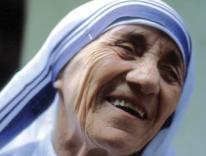
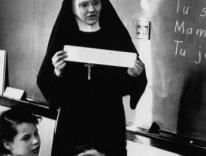
I spent hours into the night in my small convent room, praying that I would get through the next day's lessons without breaking down or bolting. Bolting from Edward.
A low voice emerged: “Welcome to my home. Please, sit.” My host and I shook hands, and I took the chair opposite. I remember the details because he was a terrorist.
On boarding I realized we’d committed to the wrong car: A subway preacher was in full roar. For a Catholic schoolgirl from Milwaukee, this was quite dramatic.
Relatives of Alzheimer's sufferers are often reminded that the human person is more than memory and mind. We don't easily believe this, until something happens.
Would we be silent at our monastery meals, or would we whisper? Would we hide in our cells or go off on chatty walks in the woods? Both/and, it turned out.
"It’s not you. Well, it’s not me either. It’s the ‘us’ that needs…space," we said in perfect, twinny unison. It was our biggest split since the egg divided.
He sat next to me. I talked about my favorite theologians, prayers, gospels. I showed him my rosary, and asked if he believed in God. And still the bus didn't come.
Msgr. Carlos Manuel de Céspedes y García-Menocal, faithful priest, seminary rector, and prolific writer who died January 3, was also a great Cuban patriot.
We moderns pay advanced planning counselors to avoid the fate of St. John of the Cross and to get us to our burial on time, but can we ever be sure it will work out?
In manipulating a mouse’s memory so that it recalls being shocked in a spot where it wasn’t, science has opened the door to the eventual recreation of our pasts.
For the Romans, 'luxuria' was the near-equivalent of Greek hubris. It has behind it the imagery of material excess leading to a diminished sense of cause and effect.
In the art of Diane Arbus, the plays of Shakespeare, or a poem by Mary Karr, my students touch something divine, whose utter familiarity begs to be reverenced.