This year seems unusual, both for the number and scale of protests across the world. What links them is the growing demand for greater income equality.
Marco Rubio's economics nominally invoke Catholic social teaching, but conveniently ignore the parts that are inconsistent with his conservative record and rhetoric.
The synod on the Amazon will be remembered as the moment that bishops gathered in Rome asked the pope to ordain married men in order better to serve the poor.
Studies show that the rich tend to be less empathetic and more selfish. Electoral politics, and policy change, is a promising way to take back what they’ve stolen.
Organized labor was once the backbone of American democracy. A new book argues that the future of collective bargaining requires adaptation to new economies.
For decades we’ve been assured that trade with China would lead to more liberty there, not less liberty here. The NBA example reveals the limits of this thesis.
Decades of neoliberalism have rendered the American left understandably wary of welfare benefits for all, not just the poor. But Scandinavia shows that it works.
Kathryn Tanner offers a pointed theological critique of finance capitalism, which inverts the Christian understanding of human dignity and the dignity of work.
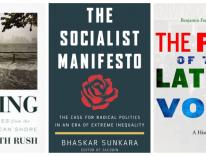
Global warming, the rise of the Latino vote, and, of course, millennial socialism. New books to keep an eye out for next time you browse the bookstore.
Democrats and Republicans both have proposals for paid family leave. So why can’t they agree on a set of policies, one that balances solidarity and subsidiarity?
Big business has a growing public relations problem. But the whims of wealthy philanthropists alone cannot bring about the economic justice envisioned by the gospel.
Personal data has become a valuable commodity. What if we were given ownership rights over our data—not only to retain control, but also to receive compensation?
The United States needs a vibrant, thoughtful democratic-socialist presence. One that knows what it stands for, and one with a tragic sense of its own history.
Hong Kongers are fighting China for their political survival. But the rest of the world, particularly the West, seems apathetic toward their precarity.
Commonweal writers have long engaged with the church’s stance on labor rights, worker justice, and income inequality. Here are the best pieces from our archives.
The first Democratic debates featured a flawed format. The progressive vision of Sanders and Warren set the tone, but Harris, Buttigieg, and Castro also stood out.
In the debates about democratic socialism, we need a new idea of utopia. The life and work of nineteenth-century socialist William Morris is a good place to start.
Most states do not support raising the minimum wage to fifteen dollars per hour. But both economic reasoning and Catholic social teaching support the idea.
The Sisters of St. Joseph of Brentwood are an unlikely group of Amazon shareholders, but they’re forcing a vote on the company’s facial recognition software.
As the EU parliamentary elections approach, it’s worth examining the confederation’s real structural flaws: its arcane rules work for some, but not for all.
Democratic socialism, increasingly appealing to young people today, extends democracy into the economic realm. The idea’s not new; we need to explore its history.
Augusto Del Noce argued that the true fault line of contemporary history ran between those who affirmed man’s religious dimension and those who denied it
Codetermination, or the practice of including workers on corporate boards, is not only deeply rooted in the Catholic tradition; it aids democracy in the workplace.
American antitrust policymakers and judges have let large firms stifle competition. Tim Wu, a "neo-Brandeisian," thinks the time has come to fight back.
As Donald Trump prepares to deliver the State of the Union address, we should recall that he bears a large share of blame for the divided state of the nation
A mark of our barbarous times has been a decades-long obsession with cutting taxes, exemplified most recently by the GOP bill signed into law one year ago
The protests of the Yellow Vest movement are rooted not in President Macron’s failure to explain his policies, but rather in their fundamental injustice