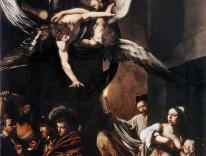
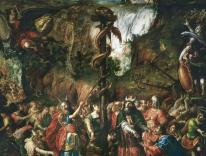
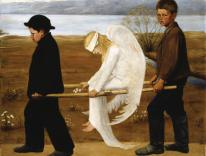
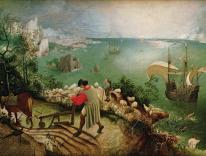
Visit art galleries and museums and one thing is obvious: There's no subject not being tackled by one or more artists. Well, maybe one subject: religion
The critic and novelist John Berger argues that “the future has been downsized”—restricted to the mercenary parameters of finance capital and digital technocracy.
In Mary, God’s unique creative act becomes human procreation and the divine takes on visible form. We might think of her as the first Christian artist.
If you were to judge plein-air painting by the societies that specialize in, and set rules for, painting outdoors, you might think it a highly fussy field of art.
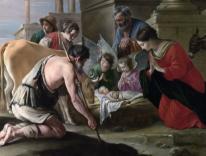
Sixty-five works on display in a recent exhibit reveal the Le Nains’ excellence in religious work and genre scenes, mythological allegory, and portraits.
Adam Sisman's new biography of le Carré—cartoonist, actor, mimic, linguist, expert skier,and spy—is intelligent, thoroughly researched, and tediously repetitive.
There is no release or relief in poet Dan Burt's story, just a stark and pervading sense of emotional sclerosis from the streets of Philly to the halls of Cambridge.
Barry’s new novel—featuring John Lennon as protagonist—meditates on place, grief, and longing, ranging across a century’s worth of literary and popular references.
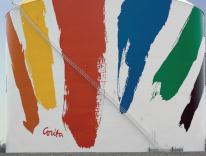
The changes of Vatican II and the turmoil of the civil-rights and anti-war movements made for heady days, and Sister Corita Kent’s art further exemplified the times.
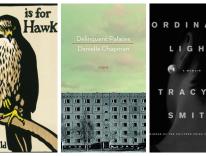
How to describe the almost-madness of loss? Macdonald uses hawk-taming, Smith "ordinary" poetry about death, and Chapman "Christian love of existence."
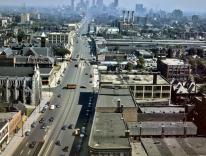
What fascinates Maraniss about Detroit more than its ruin is how central its story is to the broader course of U.S. history—Motown, the local Mob, the auto industry.
Anahid Nersessian argues that Romanticism dramatizes the “desirability of constraint.” Her book on how British Romantics imagined "utopia" powerfully does the same.
If today the world and the self are devalued, as Walker Percy has suggested, art—particularly the novel— can awaken the reader to their recovery from '4 p.m. blues.'
Judas takes hold of Christ, pressing himself on him: arm, beard, lips. A soldier in gleaming armor goes for Christ’s neck. A young man flees: John the Evangelist.
Paint. Paint the soft lines / of damp cheeks across a canvas. / Paint the deep eyes, the little / hand and the orb. / Splash some color along the curve / of her...
You don’t need to be a thespian to appreciate James Shapiro's "Year of Lear"—a brilliant, meticulously researched history of social tensions that inspired the play.
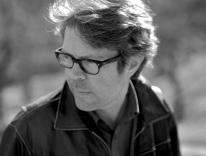
While Franzen’s natural mode as writer is one of confident high spirits, in "Purity" his view of people is steeped in pessimism, and his characters are miserable.
Spanning almost James Agee's entire lifetime, these letters between author and his priest cover alcohol, God, poetry, childhood, and a “mouthful of sweet potato.”
Narrated by the nameless victim's brother, Kamal Daoud's novel asks: Did Camus intend to use the Algerian murder victim in 'The Stranger' as a disposable prop?
Claudia Rankine’s 'Citizen' and Jeffery Renard Allen’s 'Song of the Shank' both take up the issue of race in America in jagged and beautiful poetry and prose.
Asleep, she has no idea she is old. // She’s running uphill, no lightfoot, but quite fast /
past the houses and driveways of family friends / toward the higher...
Readers write in on how academic, humanistic, and prophetic cultures should be balanced, when kids should be confirmed, and why nothing's better than the Eucharist.
Anne Enright's new novel suggests something simple—family, for good or ill, keeps forming us even when we try to escape it—but her prose constantly surprises.
Langdon Hammer's biography of poet and writer James Merrill is "wholly definitive" in scope, and threaded throughout with Merrill’s brilliant, always enlivening wit.
Many modern American thinkers have asked, often and with anxiety, "What is man?" In his latest book, Mark Greif thinks we've outgrown this—and it's a good thing.
In his final book, the late Peter Gay expands familiar notion of the Romantic rebellion against Enlightenment rationality, to the focus on artistic self-expression.
Unlike past Eurocentric taxonomies of world religions, the latest Norton anthology aims to let six major, living, international religions speak...in their own words.
Iranian author Azar Nafiri defends the value of canonical American literature—its imagination and humanity—against Common Core, market analyses, and Babbitt.