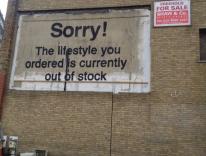
The "culture industry" testifies to the expansionist ambitions of the late capitalist system, which can now colonize fantasy and enjoyment as it once did countries.
Barry Crimmins is a funny, frightening man. His humor is so sharp it feels almost dangerous to laugh. There’s no telling when it could turn, or in what direction.
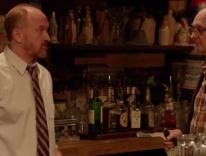
Everything about "Horace and Pete"—its seriocomic ambivalence, performance aesthetic, production values—seems calculated to knock viewers out of their comfort zone.
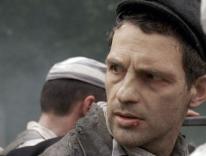
Writer-director László Nemes takes us into the Auschwitz death camp one day in late 1944. The camera immediately fastens on Saul Auslander and never lets go.
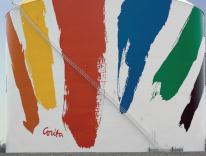
The changes of Vatican II and the turmoil of the civil-rights and anti-war movements made for heady days, and Sister Corita Kent’s art further exemplified the times.
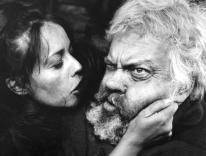
Just in time to relieve the post-Oscar doldrums comes the reappearance of Orson Welles’s "Chimes at Midnight," the 1966 adaptation of Shakespeare’s Henry IV plays.
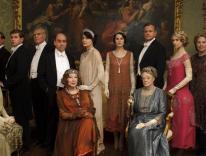
"Downton Abbey" has been vivid, suspenseful, and often funny, but it has always remained a soap opera with pretentions, a show obsessed with the passage of time.
"War and Peace" is called the greatest novel ever written, but it’s like sticking a “Kick me” sign on the book. Readers can’t help wanting to take issue with it.
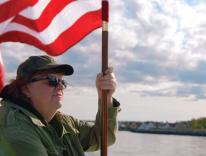
Michael Moore tours the social democracies of Europe, assembling a piecemeal progressive utopia and contrasting it with the bleakness on our side of the Atlantic.
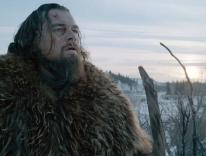
Very few historical films have achieved this degree of physical verisimilitude. The bad news? Verisimilitude may be 'The Revenant'’s only great achievement.
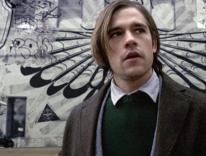
To judge by the pilot, the TV version of "The Magicians" will be a fast-paced and workmanlike distillation of Lev Grossman’s enthralling and often moving trilogy.
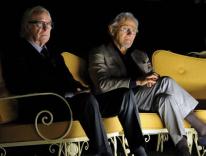
The title of Paolo Sorrentino's latest doesn’t refer to a fixed stage in life but to the mysterious inner spark—as much spiritual as biological—that keeps us going.
He flies only to scurry along another / reach of surf where he / pricks the cold for / prey smaller / than grains of prose. The freedom / to guess right is his...
Mighty planet Earth / orbits to order, its greenest blues / attractive, to make our / life-giving aerial envelope / lawful, obedient, singing. / It turns...
All six movies I watched between Christmas and New Year’s Day were about looking back: to historical eras; to the protagonists’ pasts; or, for us, to our own pasts.
Pope Francis kicked off the Jubilee Year of Mercy with the opening of the Holy Door at St. Peter’s. I started my observance with a brilliant black comedy from HBO.
There’s only song / because there are mountains, / because mountains distort / what we say, / and that’s / how song takes shape— / with words twisted / by hills...
Readers weight in on the debate started by Albert B. Hakim on universal salvation and damnation for the unjust, and fact-check our review of 'Spotlight.'
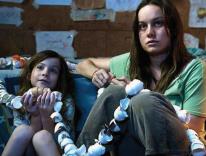
"Room" is a work of skill, with an interesting shift that says as much about the differences between literature and cinema as it does about the talents involved.
In a small way, the foreign residents / Are rounded up—the Spartans sit and comb / Their hair, watched by the Persians from their tents— / Rationing starts...
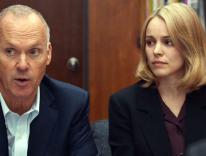
'Spotlight' portrays the Globe’s reporters as heroes, but theirs is a workaday heroism without flourishes or frills. 'Truth,' by contrast, is soaked in personality.
If today the world and the self are devalued, as Walker Percy has suggested, art—particularly the novel— can awaken the reader to their recovery from '4 p.m. blues.'
“the quality of mercy” / is a fierce and terrible beauty.../ it hungers in its waiting / then consumes our darkest brokenness / even as it invites us to its table...
Life teaches us that true gratitude is invoked spontaneously, by utterance, not by canned speech. Perhaps this is why I can’t easily summon memories of Thanksgiving.
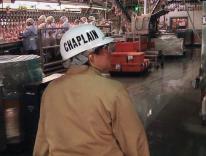
By focusing on cultural and institutional microcosms, a documentary paints a picture of an entire society whose various activities are all embedded with chaplains.
I will wear sweatshirts with bright appliqués / Of owls, and work for Head Start. Saturdays //
Will be the food bank; Sundays, church at ten. / Evenings I'll...
Arch after arch set in the brick, / Rosettes along them, pebble-thick; // Draped, helmed, armed figures, scribes with scrolls, / And eagles in their leafy holes:...
Paint. Paint the soft lines / of damp cheeks across a canvas. / Paint the deep eyes, the little / hand and the orb. / Splash some color along the curve / of her...
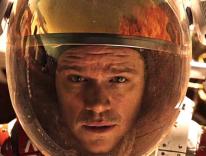
To hell with postmodern irony. Here are two earnest movies with straight-arrow heroes: "The Martian," with Matt Damon, and "Bridge of Spies," with Tom Hanks.
As I said, I’m a lawyer. Technically speaking, / is a head blown to pieces by a smart bomb a beheading? // Infinitely compressible, yet expandable time...