Despite occasionally sincere, sometimes ritualistic, expressions of communion with Rome, the effort to neuter Pope Francis’s message in the United States continues.
The bishops’ insistence on abortion as the preeminent political issue reveals their resistance to Pope Francis’s call to serve the common good in all its complexity.
The territory along the Syrian-Turkish border is the ancestral homeland of an ancient tradition of Aramaic-speaking Christianity. They’ve been betrayed before.
What do me mean when we discuss religion? Do we refer to an integrated ethnicity and culture? In these darkening times, the word’s origins matter more than ever.
A new play about a reunion of four friends, all conservative Catholics, is quietly heroic. It reveals the limits of rhetoric as it probes the nature of suffering.
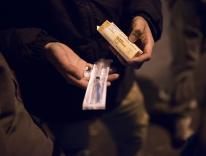
Should the church continue to oppose the safe, therapeutic injection of opioids? No, according to this ethical primer on the philosophy of harm reduction.
Ministerial Juridic Persons, mostly comprised of laypeople, have canonical authority for church ministries. That’s unprecedented, and potentially transformative.
At their general assembly meeting next week, the bishops have the opportunity restore trust in the wake of the abuse crisis. Here are some specific recommendations.
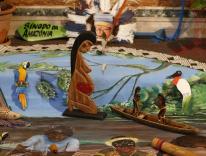
Rather than pagan nature-worship, perhaps the statue of a pregnant woman suggests that the Amazonian people are bringing the seeds of the gospel to fruition.
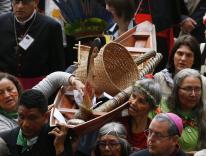
The synod on the Amazon will be remembered as the moment that bishops gathered in Rome asked the pope to ordain married men in order better to serve the poor.
As evidenced by his Notre Dame speech, Barr’s understanding of Christianity is essentially Pelagian: his idea of Catholic ‘micro-morality’ ignores the social gospel.
Did liberalism originate in a kind of theodicy? And is there any reason to suppose that egalitarian liberalism is or has to be theological? Not necessarily.
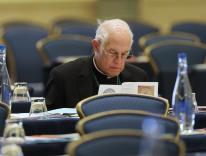
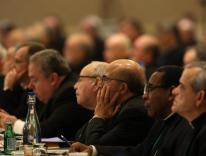
Before their semi-annual meeting in Baltimore, the U.S. bishops are traveling to Rome to meet for a rare meeting with Pope Francis. Here’s what you can expect.
Thousands of migrants are now camping along the border in Ciudad Juárez, enduring squalid conditions as they await responses from U.S. Customs and Border Protection.
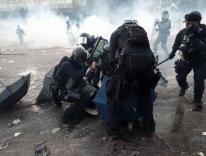
My visit to the besieged city included protests, tear gas, and arrests. It drove home the degree to which Hong Kong has become a militarized police state.
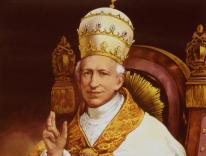
In this moment, where we find ourselves pushed relentlessly toward “either/or” positions, an 1890 encyclical by Leo XIII offers a helpful way of framing nationalism.
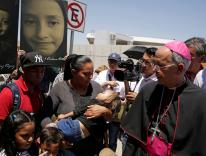
Words like ‘racism’ and ‘white supremacy’ make people uncomfortable. But as El Paso Bishop Mark Seitz points out in a new letter, we must reckon with them.
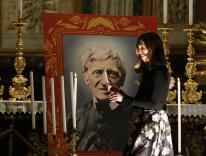
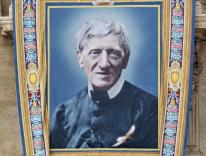
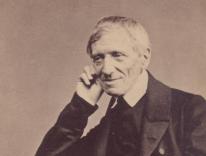
Newman’s problem was that the Catholics who admire his prose and the fineness of mind usually are not the sort of Catholics who pray for miracles in times of need.
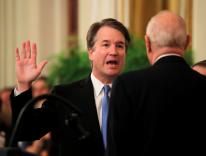
The church’s deplorable record on sexual abuse has provoked condemnation on both the left and the right. Why wasn’t Justice Kavanaugh subjected to similar scrutiny?
The sisters I met along the border know well the intractability of poverty, disease, and violence. That does not keep them from working to relieve them.
What matters at the Amazon synod is not the imperative of universal consistency across all regions of the church, but the pastoral welfare of the People of God.
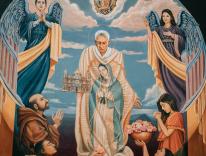
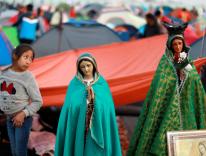
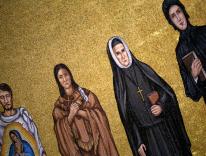
Guadalupe began as a paradoxical figure, both symbol of indigenous faith and tool of colonialist oppression. Now, she demands we listen to the poor and marginalized.
Best known for his autobiographical and educational works, John Henry Newman now has the distinction of being the only saint with two published novels to his credit.
How did mainstream American Christianity became intellectually respectable and modern? The critical study of post-biblical Christianity played a key role.
The first of a series by Fr. Incognitus, who has worked in Southwest parishes serving immigrants from Central America, Mexican Americans, and Euro-Americans.
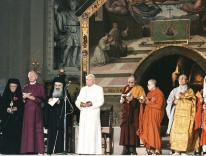
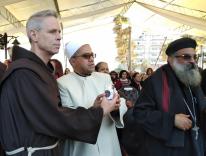
2019 marks the 800-year anniversary of St. Francis of Assisi’s meeting with Egypt’s Sultan Malik al-Kamil during the Fifth Crusade. The dialogue must continue.
There is a basic division in contemporary Jewish life, and in all communities that purport to interpret a religious tradition: that of self-expression and community.
Kathryn Tanner offers a pointed theological critique of finance capitalism, which inverts the Christian understanding of human dignity and the dignity of work.
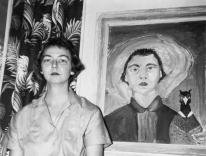
Poet and novelist Fanny Howe is an experimental writer’s experimental writer, the author of dozens of books, one who remains publicly, committedly Catholic.
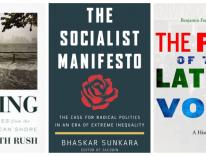
Global warming, the rise of the Latino vote, and, of course, millennial socialism. New books to keep an eye out for next time you browse the bookstore.
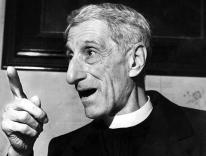
Is liberal democracy really so exhausted that there is no choice but to abandon it? The hopeful answer, articulated earlier by Italian priest Luigi Sturzo, is no.
Available for the first time in English translation, the letters of a young German couple whose love of God and each other sustained them against Nazi oppression.