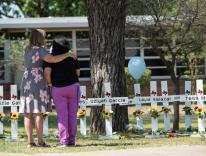
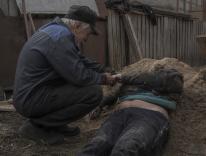
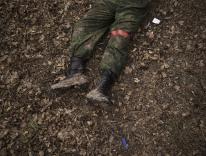
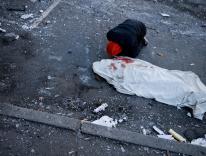
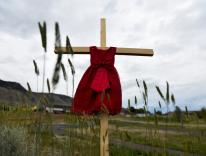
The invasion of Bucha may be over, but its residents’ lives are shattered and the horror continues as they mourn their dead and process the destruction.
Alzheimer’s causes great suffering for both those it afflicts and the people who love them—but our responses to it can provide a humanizing perspective.
“She was not patient. She was not kind. Edna was not the neighbor ready with a warm welcome when we bought the house on Harrison Street next door to hers.”
“We do what we are supposed to do, walk the stage, say our lines. But the reality is that, even if we hit our marks, many of our patients will not survive.”
Joe Biden’s Irish-Catholic background and personal experience of suffering have made him an eloquent and empathetic mourner for people across the political spectrum.
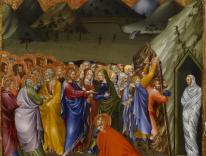
For cystic fibrosis patients, recent medical breakthroughs have offered a new life: like Lazarus, they are unwrapping their bandages and re-entering the world.
Some two decades ago, I took a cruise on the MS Zaandam. The Catholic rituals for the dead that I witnessed in Venezuela can help us process the death around us.
David Bentley Hart’s book makes the case for universal salvation, arguing that a belief in eternal damnation is morally repugnant and theologically insupportable.
Giving medical professionals some agency in end-of-life decisions can be consistent with church teaching. We just need to integrate the concept of futility.
“We might then think of our redeemed bodies almost like diamonds, simultaneously refracting different times of our lives as we turn in the light of God’s love.”
The short poems of Samuel Menashe are unique: self-contained epigrams, charms, wishes, prayers, descriptive one-shots, shapely units of quotable wisdom.
At the center of Malick’s film is Jägerstätter’s incomprehensible decision to give his life away, ostensibly benefiting no one. But such heroism ultimately wins.