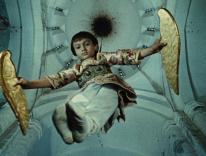
Rather than the politics of sainthood, Malick’s film mirrors the reality of things themselves. Like faith itself, they can’t be so much articulated as experienced.
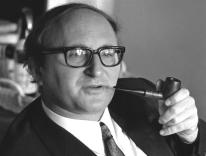
Despite the pivotal role he played in Vatican II, Benedict XVI has spent the rest of his career, particularly his emeritus papacy, distancing himself from it.
Does capitalism make us bad Christians? Eugene McCarraher thinks so. His new book, The Enchantments of Mammon, explains how money came to replace God in the modern era, seducing us with false promises of profit maximization.
By dragging Benedict into schemes like Cardinal Sarah’s book about celibacy, the anti-Francis faction reveals deep flaws in the current emeritus papacy.
In an old-growth forest, everything is connected. No individual plant or animal, and indeed no species, is an island. As Pope Francis warns, we should pay attention.
William Blake critiqued the Enlightenment, industrialization, and the expansion of the British empire. His work shines at the Tate as the shadows of Brexit loom.
Priestly formation and academic theology are increasingly cut off from the real lives of Catholics. That poses a real problem, one that theologians must address.
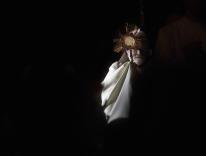
Again and again throughout the Mass, word and gesture proclaim the Real Presence. What explains the liberal Catholic reluctance to pursue the question?
The late German theologian Johann Baptist Metz believed theology was a culture of questions, not answers. Key to his theology was the unsettling figure of Christ.
Art. Fiction. Memoir. Even a graphic novel. Our critics compile a list of their favorite readings from 2019. They make great gift ideas for the Christmas season.
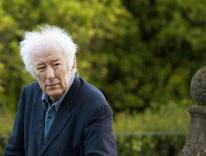
Heaney’s legacy and his continued popularity as a lyric poet rest on the twelve volumes from which this selection is chosen. What makes his work so alluring?
The Shakers, who arrived in America in 1774, are a religious community facing extinction. Their decline means nothing less than the end of an idea of heaven.
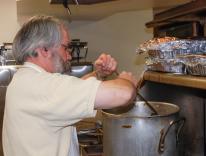
Thanksgiving is at once the most traditional of holidays and the most radical. Even the best things we do are contingent on support and help from others.
The territory along the Syrian-Turkish border is the ancestral homeland of an ancient tradition of Aramaic-speaking Christianity. They’ve been betrayed before.
What do me mean when we discuss religion? Do we refer to an integrated ethnicity and culture? In these darkening times, the word’s origins matter more than ever.
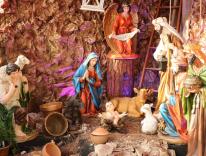
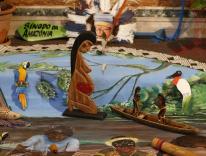
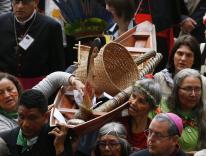
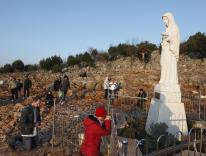
Rather than pagan nature-worship, perhaps the statue of a pregnant woman suggests that the Amazonian people are bringing the seeds of the gospel to fruition.
Did liberalism originate in a kind of theodicy? And is there any reason to suppose that egalitarian liberalism is or has to be theological? Not necessarily.
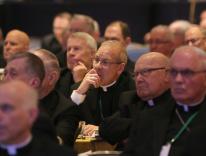
Before their semi-annual meeting in Baltimore, the U.S. bishops are traveling to Rome to meet for a rare meeting with Pope Francis. Here’s what you can expect.
What matters at the Amazon synod is not the imperative of universal consistency across all regions of the church, but the pastoral welfare of the People of God.
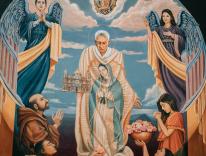
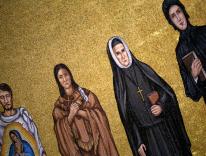
Guadalupe began as a paradoxical figure, both symbol of indigenous faith and tool of colonialist oppression. Now, she demands we listen to the poor and marginalized.
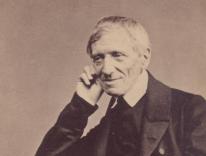
Best known for his autobiographical and educational works, John Henry Newman now has the distinction of being the only saint with two published novels to his credit.
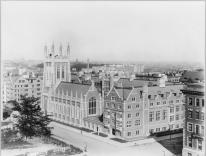
How did mainstream American Christianity became intellectually respectable and modern? The critical study of post-biblical Christianity played a key role.
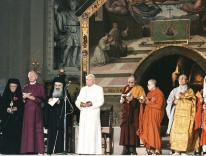
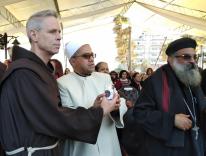
2019 marks the 800-year anniversary of St. Francis of Assisi’s meeting with Egypt’s Sultan Malik al-Kamil during the Fifth Crusade. The dialogue must continue.
There is a basic division in contemporary Jewish life, and in all communities that purport to interpret a religious tradition: that of self-expression and community.
Kathryn Tanner offers a pointed theological critique of finance capitalism, which inverts the Christian understanding of human dignity and the dignity of work.
Poet and novelist Fanny Howe is an experimental writer’s experimental writer, the author of dozens of books, one who remains publicly, committedly Catholic.
Is liberal democracy really so exhausted that there is no choice but to abandon it? The hopeful answer, articulated earlier by Italian priest Luigi Sturzo, is no.
Big business has a growing public relations problem. But the whims of wealthy philanthropists alone cannot bring about the economic justice envisioned by the gospel.
A new show at the Barnes in Philadelphia transports audiences into the heart of the Bill Viola’s pioneering inquiries into the phenomenon of visual perception.
Thomas Merton taught me to value self-denial, but a bout of depression forced me to question whether asceticism was the healthiest response to my life.
Soviet novelist Vasily Grossman is not often thought of as a religious thinker. But his Armenian travelogue shows a different, more numinous side of his work.