“Some days, although we cannot pray—because we are too busy, or because we are in too much pain, or simply because the words will not come—a prayer utters itself.”
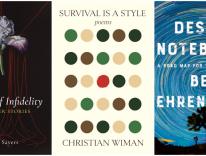
This month: surviving pain through poetry, surviving the climate apocalypse through new (and ancient) narratives, surviving the present through dystopian fiction.
We are / afraid that our parents will see us one day on television: / limbs heaped over each other, syrup-drenched, becoming pixels / that flit across the screen.
This is what I want to do with my late seventies, / honor the sky, scatter stained glass on the sidewalk, // follow the path their hues take us, you beside me.
The end-of-summer book rush is here: Jane Austen and the Brontës reimagined, poetry lauding birdsong and lamenting Twitter, and new novels by familiar authors.
A new, polyphonic collection with poems by more than a hundred Latinx writers responds to the vexed problem of identity with expansiveness, not reductionism.
T.S. Eliot’s letters to Emily Hale, recently unsealed, reveal the extent of their thirty-year epistolary romance, and Hale’s undeniable influence on his poetry.
Many of us are familiar with the absurdity-unto-death that is working remotely. Forget the zoom-and-gloom: put down your devices and pick up these new books.
The collection ‘Oblivion Banjo’ is a major work of American poetry by a poet who draws the reader into the inner workings of his imagination as few others do.
The selves that constitute the poet Lawrence Joseph are particularly numerous and peculiarly unlikely: he’s a Catholic, a leftist, an Arab-American, and a lawyer.
In 'Softness of Bodies,' the story of a flighty young poet in Berlin pivots from comedy to drama, from shoplifted shoes to darker issues of money and violence.