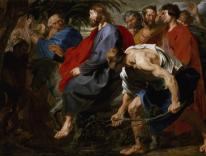
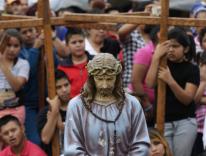
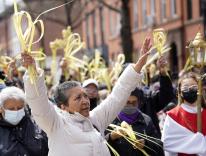
We don’t know for certain what kind of branches were used to welcome Jesus in Jerusalem. What matters most is that Jesus came home, and his return was a victory.
"This Laetare Sunday, then, I do want to focus on God’s love and my sins in light of God’s love, but not to the point of apathy, and instead to the point of further struggle."
On this episode, Irish poet and theologian Pádraig Ó Tuama testifies to the peace and spiritual freedom he found by laying down “the burden of belief.”
“Denial of the self is a traditional Christian spiritual practice that has its benefits, but this Lent I feel moved to a radical acceptance of the self.”
On this episode, the poet reads several poems from his new book, and then joins senior editor Matthew Boudway for a conversation about overcoming despair.
Philosopher Emmanuel Falque asks what Christians might now say that could actually matter to their post-Christian contemporaries in the academy or the arts.
One central problem for Christians now is how to reconcile two of the beatitudes in our lives as citizens—how to be peacemakers while also thirsting for justice.
The work of Louis Bouyer—one of the twentieth century’s greatest theologians—illuminates the full Christological richness of the Second Vatican Council.
The testimonies of witnesses to impossible events vivify the past. They allow us a glimpse of the world as some of those who lived long ago actually saw it.
We are locked up in our own little worlds, trying not to get hurt too much or screw things up, and we have our backs to the fireworks going on all around us.
“In a high-tech, evidence-driven world of contemporary medicine, it was a dream that led a physician to conclude that my wife was dying. How was that possible?”
Thieves, bandits, terrorists, freedom fighters, or revolutionaries: who were the ‘thieves’ crucified with Jesus? It depends on who’s labeled, and doing the labeling.
A faithful response to God’s call to evangelize is to sharpen our faces and our communities like flint—not as weapons, but as tools of creation and sustainability.
During Lent, we work to move with more determination toward our place of ultimate belonging. We have heard stories of that kingdom that cannot be un-heard.
From 2020: Pope Francis addresses the English-speaking world as the coronavirus pandemic now reaches the United States, Australia, and the United Kingdom.
Becoming a Christian is like the process of moving from childhood to adulthood. The realities of both are much more complex than the caricatures presented to us.
Remembering the deceased is an act of hope. Sharing our faith and experiences together can pull us out of the darkness and into the beauty of Jesus’ life.
“Even before Ash Wednesday, our lifestyle was rather Lenten. A kind of full-time fasting: vigilance when we’d like to rest, discipline when we’d like to indulge.”
“The Advent season prepares us to see the incarnation with the Passion in mind. God is all-powerful and in the incarnation is all-vulnerable. Both things are true.”