The boldest part of Magnifica humanitas, Pope Leo XIV’s first encyclical, is about war, not artificial intelligence. In the fifth and final section of the encyclical, Leo writes: “Today, more than ever, without prejudice to the right to self-defense in the strictest sense, it is important to reaffirm that the ‘just war’ theory, which has all too often been used to justify any kind of war, is now outdated.” The pope is arguing that just-war theory—a theological tradition that began with St. Augustine and was later systematized by St. Thomas Aquinas in the Summa Theologiae—no longer applies in our age of proxy wars, nuclear weapons, and autonomous drones.
Leo has a point. The principles of just-war theory may have been clear enough when they were first formulated and for centuries thereafter, but today war involves increasingly ambiguous situations. There are regional conflicts between nation-states nestled within larger struggles between superpowers, or tit-for-tat contests involving stateless entities like terrorist organizations or separatist groups. Moreover, the cataclysmic possibility of nuclear war looms over every major contemporary conflict and makes war an ever-riskier prospect—so much so that preventing a nation from developing such weapons is now considered by many a justification for a preemptive strike.
In the Summa, Aquinas lays down three conditions for a just war. The first is that only the right sovereign authority can legitimately declare war (i.e., the state, as opposed to, say, a private individual); second, the cause of the war must be just (i.e., it must redress an attack or some other serious injustice); and third, those waging war must have a rightful intention (i.e., they must want to do good and avoid evil). Public theologians and Catholic talking heads invoke just-war theory whenever the United States embarks on a new military adventure. But our wars rarely meet its standards.
Consider Aquinas’ first principle: proper authority. While the Constitution still says that only Congress has the power to declare war, in practice the executive branch has long usurped that power. So is the president the proper authority or not? It all depends on which talking head is doing the analysis. Moreover, every pope since at least John XXIII has maintained that humanitarian interventions—wars waged to prevent genocide, for example—can be legitimately declared only by the United Nations. For example, in 2002, then-cardinal Joseph Ratzinger said that the United Nations was the only legitimate authority that could declare war on Iraq in order to disarm Saddam Hussein. But the United Nations has been in decline since at least the turn of the century.
Similarly, the return of Great Power politics—of a global contest between the superpowers China, Russia, and the United States—complicates the notion of right intention. Consider the war in Ukraine. Ukrainians have every right to defend their homeland from Russian occupation. Their intention, in other words, is good. But it is also the case that Russia and the United States have used this war as a proxy for a larger conflict, one that came close to unleashing nuclear war on at least one occasion. Thus, a defensive war fought with good intentions could become, thanks to nuclear weapons, a war that nobody can win and that would put the whole world at risk.
Of course, as the encyclical suggests, AI does have something to do with all this. Today AI is being incorporated into weapons systems through the work of companies like Palantir and Anduril, which use data-management software to develop targeting systems and other tools of warfare. The most striking development in AI-driven warfare has emerged during the war in Ukraine: autonomous drones—that is, drones that can select targets and fire missiles independently of human input. About those weapons, Leo’s encyclical makes a few “non-negotiable” demands: “All systems used in a war setting must guarantee the possibility of retracing and reconstructing decision-making processes”; “the decision to use lethal force cannot be delegated to opaque or automated processes”; and, finally, “it is imperative to establish a shared framework…in order to curb the technological arms race.”
You might like: Santiago Ramos on world government and the Church
But the pope couches those demands within a larger imperative that he directs to all people of good will, to create what he calls a “civilization of love.” This term—coined by Pope Paul VI—denotes a “social order based on justice and charity.” Crucial to such an order is an end to war. Leo rejects the idea that war is an “inevitable part of human nature.” Instead, we should imagine and build a world where war is no longer an instrument of politics. In this, Pope Leo is consistent with the last several popes, all of whom spoke out against war in categorical terms.
How do we build a “civilization of love”? Here the pope combines a traditional support for a foreign policy of “multilateralism” and dialogue with a personal appeal to all readers of the encyclical to “choose whether to fuel the mentality of force (even if only through indifference, cynicism, lies or hatred), or to preserve the mindset of peace (with truth, moderation, closeness and care)” within in their daily lives. What would this mean for a Catholic who works for, say, Palantir? Or for one who consults for the State Department or happens to be vice president of the United States? The encyclical is designed to prick the conscience. “What am I doing to work for peace and against force?” is the question the pope wants each of us to ask ourselves—even if the question leads to a career change.
But Leo does not mean to suggest that we should contribute to the civilization of love only on a personal level. He supports—as have all previous popes since at least Pius XII—the building (and rebuilding) of international institutions that may serve as tribunals of international law and help resolve conflicts between nations. As AI becomes more sophisticated and more integral to defense systems, there will likely be a need for some sort of arms-control treaty, especially between China and the United States, though it is still too soon to say what such a treaty might look like.
In 2022, after Pope Francis suggested that just-war theory was outdated, George Weigel wrote:
The claim [that just war theory is outdated] is dangerous theologically, because the just war way of thinking is based on the natural moral law…. The truths of the natural moral law are true perennially and are not changed by political or technological circumstances, although the implications of those truths will evolve over time.
Today, similar criticisms are being leveled against Leo: to wit, that he is abandoning a perennial element in Catholic teaching.
But as Edward Feser has pointed out, Leo’s critique of just-war theory, far from being a theological novelty, has roots in the early postwar period before Vatican II. In fact, in 1949 Cardinal Alfredo Ottaviani, a very conservative cleric generally skeptical of the reforms of the Second Vatican Council, wrote that “modern wars can never fulfil those conditions which…govern—theoretically—a just and lawful war.”
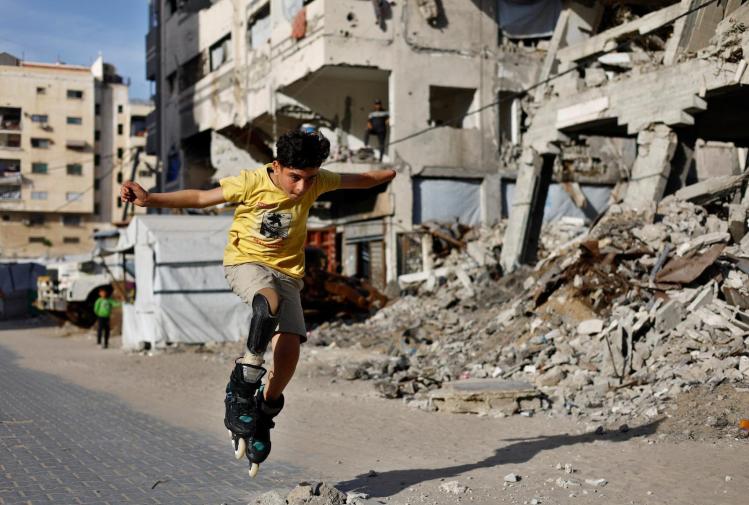
Leo is reading the signs of the times. He sees that “war is back in vogue.” He sees Putin’s brazen invasion of Ukraine and Trump’s illegal intervention in Venezuela and destructive stalemate with Iran. He sees that Gaza has become, in the words of Cardinal Pizzaballa, “a disaster.” He sees more countries pursuing nuclear weapons while nonproliferation treaties expire. Moreover, he foresees the growing temptation to look to war as a source of purpose and meaning. Our own Secretary of War speaks of war in theological terms and has approved army recruitment ads that use the recitation of the Lord’s Prayer as a soundtrack.
Given this grim scenario, the pope supports the rebuilding of international institutions that can lower the risk of armed conflict. If the United States and Russia are engaged in “grey zone” conflicts or proxy warfare, both of which could potentially lead to all-out war and even to the destruction of humanity as a whole, then it behooves us to spend less time trying to justify those conflicts according to arcane philosophical criteria and more time reinforcing the organizations and treaties that could prevent them and build a lasting peace. That can be done without compromising any country’s ability to defend itself militarily.
There is a tendency among proponents of just-war theory to dismiss the antiwar messages of the past five popes by labeling them “prophetic.” In this context, “prophetic” seems to mean “You may ignore it in good conscience.” This tendency has reemerged with the U.S. war in Iran. After Pope Leo condemned the war, Fr. Robert Sirico of the Acton Institute wrote that, while the pope “has both the right and the duty to speak prophetically on matters of war and peace,” nevertheless “Catholics are not obliged to treat every prudential judgment of the Pope on foreign policy or crime as infallible.” This is true as far as it goes. But Catholics are surely obliged to treat both a pope’s prudential judgment about any particular war and his prophetic statements about war in general very seriously indeed. Here, the question of infallibility is a red herring.
In any case, it is not the popes and the extravagance of their prophetic discourse that have made just-war theory irrelevant. Much of the blame for that belongs to those defenders of just-war theory who have used it to justify every major U.S. military intervention in recent history. Weigel, for example, has supported the wars in Vietnam, Iraq, and Libya (criticizing the Obama administration not for its involvement there but for “indecisiveness, multilateralism, and lack of strategic vision”), and defended Harry Truman’s decision to drop atomic bombs on the Japanese cities of Hiroshima and Nagasaki (while admitting that the decision probably violated “the canons of just-war theory”). Nor has Weigel condemned the Iran War, though he warns the White House hasn’t answered “the crucial just-war question” about a viable order in the Persian Gulf.
If just-war theory can always be invoked to justify American military action, then can we still regard it as a rigorous theory? And if world leaders—including the leader of the United States—are not even interested in providing a moral justification for their wars, why should Catholic intellectuals bend over backwards to provide one?
Leo wants a world where war is seen as something we should try to avoid or end whenever possible. One can describe this position as merely “prophetic,” but Leo clearly thinks it is more realistic than the position of those who tell us that the only way to create peace is to prepare for war. The arms race has its own implicit “prophecy.” The stockpiled weapons say: One day, you will need us! It can be a self-fulfilling prophecy, as Pope John Paul II once put it in a speech before the United Nations:
The continual preparations for war demonstrated by the production of ever more numerous, powerful and sophisticated weapons in various countries show that there is a desire to be ready for war, and being ready means being able to start it; it also means taking the risk that sometime, somewhere, somehow, someone can set in motion the terrible mechanism of general destruction.
Instead, what Leo wants is for men and women of good will to contribute to an opposite trend, one that builds societies and institutions that promote peace.
We welcome your comments about this article. Please send your response to [email protected].