When the pandemic began, Albanian philosopher Lea Ypi decided to use her time in lockdown to try something new. Instead of the big academic book about the meaning of freedom that she had been planning to write, she composed a memoir about growing up during the collapse of Communism in Albania. “Mostly written from a closet in Berlin,” as she would later put it, her book Free: Coming of Age in the End of History was her attempt “to muse about my grandmother’s words: ‘When it’s difficult to see clearly into the future, you have to think about what you can learn from the past.’” Free became a bestseller, and now we have the follow-up: a unique blend of fiction and family history titled Indignity: A Life Reimagined.
Ypi made the right choice: these beautiful books are more compelling, and will reach a wider audience, than any scholarly work on the same themes. Through the implications of narrative rather than philosophical argument, both books confront the famous idea referenced in Free’s subtitle: Francis Fukuyama’s “End of History.” The End of History is a stumbling block for contemporary political thinkers because it’s a political theory about the end of political theories. Fukuyama argued that, with the fall of Communism, humanity had finally discovered its best political system (liberal democracy), and its optimal economic system (free-market capitalism). Countries could still experiment within a narrow range of political options—left-leaning social democracy, say, or the quasi libertarianism of the United States. But dreams of revolution and utopia had reached their expiration date.
Against Fukuyama, Ypi’s work suggests that the End of History is not an endpoint, but an impasse, a moment within which we cannot imagine a better future. In the late 1980s and early ’90s, Ypi witnessed firsthand the political convulsions that inspired Fukuyama’s epiphany. But she refuses to believe that the world after 1989 is superior to the world that existed before it. The fall of Communism was fundamentally ambiguous, at least as far as Albania is concerned. The liberalization of the Albanian economy led to civil war after a dozen or so Ponzi schemes wrecked the economy, leaving over half the population without savings.
In Ypi’s experience, the end of history also meant the end of noble forms of life that developed under the shadow of Communist tyranny: neighborhood solidarity, even among the party snitches; serious investments in education, despite an ideological state-imposed curriculum. In Free, Ypi concludes: “My world is as far from freedom as the one my parents tried to escape. Both fall short of the ideal.” In Indignity, she writes of her native Tirana as “the capital of remorse,” cursed with “a capitalist hex after the communist malediction.” Lest anyone accuse her of naïveté or ignorance about the full depravity of the system her parents were trying to escape, it should be noted that, under Enver Hoxha’s regime, Ypi’s grandfather was jailed and tortured for more than a decade, while her grandmother was forced into hard labor. She knows what she’s talking about.
Ypi’s grandmother’s advice about learning from the past when the future is obscure appears in both of her books, and in both Ypi searches for a future beyond the present End of History. In Free, she criticizes the current system for having an inadequate understanding of freedom. The Communists had one definition of freedom, and the capitalists another. Neither definition is suitable for a just society, but it is difficult to imagine a better definition emerging any time soon.
When Ypi was a child, she was a loyal Communist who believed that socialism was required for true freedom, while “in capitalism, people claimed to be free and equal, but this was only on paper, because only the rich could take advantage of the rights available.” After the fall of Communism, socialism came to be seen as the enemy of freedom, which was redefined as “fighting corruption, promoting free enterprise, respecting private property, encouraging individual initiative.” But beyond the relative merits of these rival conceptions of freedom, what bothers Ypi is that Albanians were immediately coerced into accepting the new post-Communist system. “The world had acquired a definitive shape before anyone could understand what that shape was,” she says. “Moral imperatives and personal convictions mattered very little.”
The lack of moral agency and the feeling of being swept up by political tides offend Ypi’s deepest convictions, which are rooted in the work of Immanuel Kant. In Free, Ypi calls herself a Marxist, but in Indignity she shows herself to be an inveterate Kantian. For Kant, human dignity is grounded in free will and moral choice. As Ypi puts it, “dignity lies in trying to act with a moral purpose.” To be stripped of our freedom is to be stripped of our capacity to choose the good and, therefore, to be deprived of our dignity.
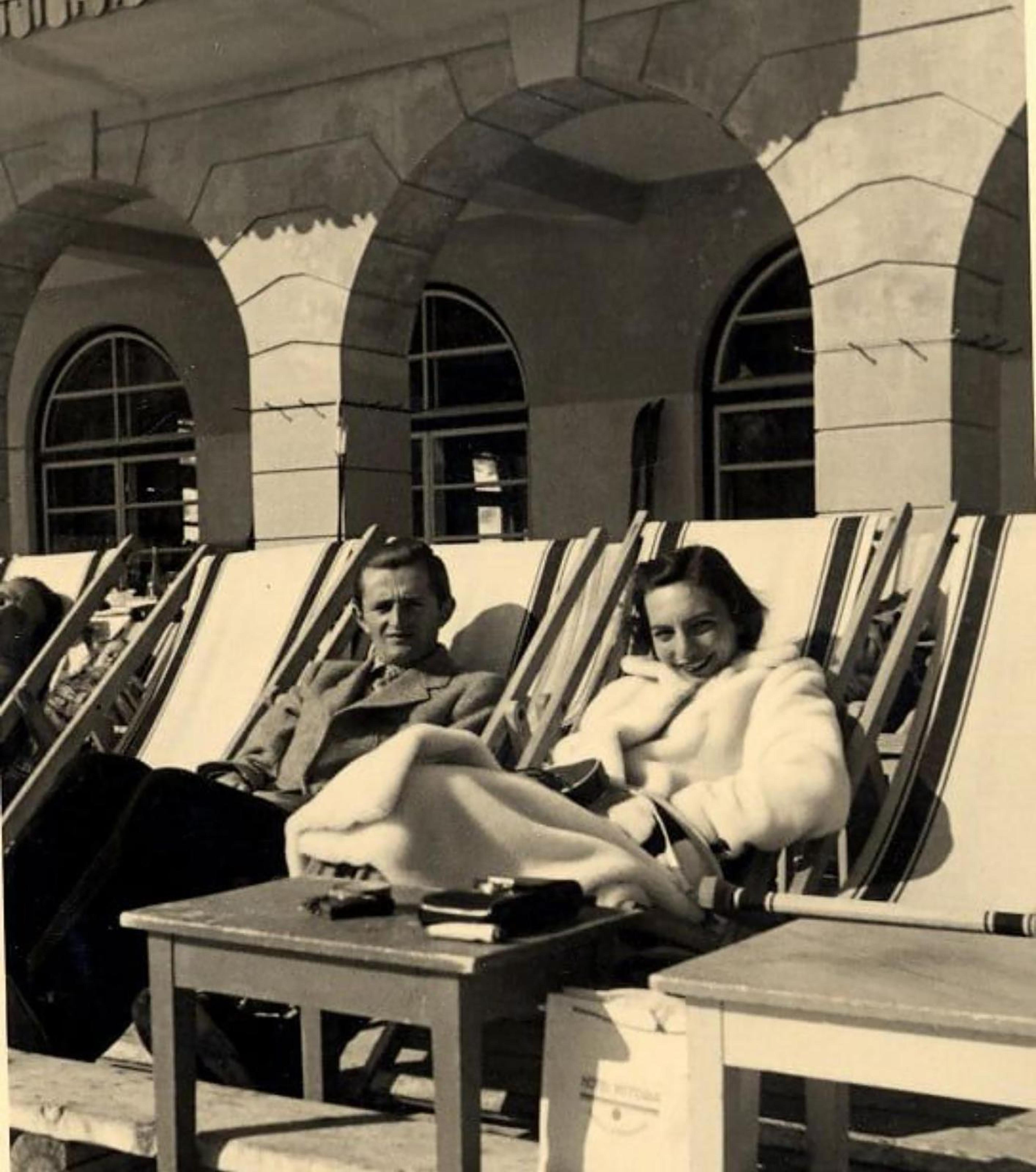
In Indignity, Ypi criticizes post-Communist Europe for inadequately protecting the dignity of history’s victims. The story begins when a photograph of Ypi’s grandparents emerges on Facebook:
Within hours of being shared, it went viral across Albania. A young, glamorous couple stare at the camera, while relaxing on sun loungers in front of a luxury hotel.… I did not need to read the caption online to recognize my grandparents, Leman and Asllan, in the photo.… The year was 1941. My grandmother spoke often fondly of those ten days spent learning to ski in the Dolomites. “I felt the happiest person alive,” she would say, “and Cortina was the happiest place in the world.” Yes, truly, she would insist, even though this was Italy, and it was the winter of 1941 and war raged all over Europe as never before.
Facebook commenters rushed in to speculate about the people in the photograph—and to judge them. One wrote, “The old woman was a real lady, she hailed from one of Albania’s most noble families. She carried herself with real dignity, and those communist monsters robbed her of it.” Another wrote: “It is evident from this photo that we are looking at a pro-Enlightenment, secular, European elite.… The punishment continues to this day because our elites remain morally bankrupt.” Another: “The grandmother…was a bitch.” Another: “Perhaps not a bitch, but a communist spy. And before that, a fascist collaborator.”
Outraged by the internet trolls, Ypi searches for the origin of the photograph. Eventually, her search expands into an investigation of her grandparents’ life. But her book isn’t pure history: Ypi decided from the very beginning of her project that her recovery of their life would be an act of the imagination as well as one of research. “I want to approach [the archives] philosophically, even aesthetically.… I hate the rules we submit to simply because we have no other choice—I prefer the use of judgment, the free play between feeling and reason.”
This “free play” involves drawing from the unredacted Communist archives, interviewing family members, visiting her ancestral home in Greece, and collecting old photographs. Ypi takes this raw historical data—what she calls, in Kantian fashion, “the historical a priori”—and embellishes it into a sort of nonfiction novel, including an autofictional account of Ypi herself conducting archive research, recreations of Ypi’s family’s past, passages from old letters and articles written by her grandparents, and excerpts from reports by the Communist secret police. Ypi also manages to interweave all that with illuminating philosophical asides. Take, for example, this passage where she compares Communist surveillance with the contemporary automated version:
Perhaps [my grandmother’s] humanity mattered more to the system tracking her preferences than I do to the one tracking mine. She’s surveilled by her peers. They observe her, they make a note of her movements, they meticulously record her location. They must care about what she thinks, specifically, in the way no company will ever care about me, specifically.
From this mixture of history, fantasy, and philosophy, Ypi concocts a narrative that addresses current political debates about the status of refugees, the relative merits of empires and nations, the relative wickedness of fascism and communism, etc. If her characters tend toward a certain flatness, it’s because they often become, for pages at a time, mouthpieces for a particular idea. Ypi wants to emphasize that ideas can be just as important to a person’s identity as any of the impersonal forces of history, such as war, poverty, or displacement. But because those impersonal forces are constantly threatening Ypi’s characters, the stakes of the drama are always high, and the story is almost a page-turner, notwithstanding all the Big Ideas.
The story begins in the present, with an autofictional chapter set inside the Albanian historical archive. From there it jumps back to the death of Ypi’s great-great-grandfather, a high-ranking dignitary in the Ottoman Empire. We then read about the childhood and adolescence of her grandmother, Leman, in the Greek city of Salonica. The breakup of the Ottoman Empire meant that Ypi’s family, which was ethnically Albanian, would eventually have to leave Greece. In the wake of a beloved aunt’s suicide, Leman chooses to move to Albania, which is where she meets Ypi’s grandfather, Asllan.
As the narrative shifts to the tumultuous interwar years, Ypi traces the ideological evolution within the hearts of her characters who, in spite of the historical forces bearing down on them, remain free. Leman remains an independent-minded protofeminist throughout. Taught by her aunt to revere the French Revolution, Leman was admirably detached from her aristocratic privileges and gave them all up for a new life in Albania. But although she was sensitive to the plight of the working class from a young age, she never became a Communist. Eventually, she married Asllan, a social democrat who wanted to fight for the Republican side in the Spanish Civil War. Only last-minute intervention from his father kept him from crossing the border into Spain.
That father, Xhafer Ypi, is a major figure in Albanian history. He was prime minister during the Italian occupation and refused to fight a war against the Fascist invaders. In the Communist era, Xhafer was considered a traitor; his stock hasn’t risen much since. One of the best scenes in the book depicts a confrontation between Asllan and Xhafer, after Xhafer gives the order for Albanian forces to stand down. “That speech of yours in the Assembly, where you accused the Albanian gendarmes who died defending the country of being bandits, that speech still nauseates me,” says Asllan. “You’ve lost all dignity, and you’re even proud of it.”
“Dignity?” the old man replied calmly. Asllan could hear the subtle mockery of the seasoned politician in his voice. “Dignity, you say?… Perhaps basic maths never features in your dignity calculations. Have you ever pondered the size of Italy on a map? And have you ever considered that, even in the improbable event of defeating the Italian army, behind Mussolini there is Hitler? Does your dignity demand that we send the last few hundred men we have to the slaughter, and then surrender to suffer the same fate, just with more blood on our hands?”
Xhafer affirms his dignity—that is, his agency—in the very act of rejecting moral reflection. “I’m not interested in philosophical questions,” he tells Asllan. “For me, dignity is just stopping the fire from spreading.”
After the war, Albania’s fate was decided by the 1945 parliamentary elections, in which only candidates from the Democratic Front—a Communist-led coalition—were allowed to participate. Shortly thereafter, Enver Hoxha formally deposed the Albanian monarchy and established a Communist state. By then, Xhafer had been assassinated. His son Asllan, Ypi’s grandfather, would soon be imprisoned for eighteen years, and Leman would be forced into internal exile.
Both of Ypi’s books end in suspense, having raised questions they do not answer. The present era is a “long transition to democracy, that stretches and stretches like the elastic in an old pair of pants,” as a government bureaucrat puts it in Indignity. In Free, Ypi describes the mentality of a World Bank official consulted in the 1990s by the Albanian government about “structural reforms”:
The only distinction he accepted was that between societies in transition and those that had already transitioned.… Of course, he had a vague sense of the destination. But catching up mattered more than explaining where one was heading.
The human cost of transition—the layoffs, the loosening of social bonds—make the ambiguity of that “destination” more intolerable with each passing year. Why make sacrifices for a purposeless system? A country needs deeper sources of meaning and motivation.
Ypi is looking for something deeper, too. She wants to bear witness to her grandparents’ dignity. “The dead exist only insofar as we are conscious of them in some form,” she writes near the end of the book. The present system is one in which the dead have little or no voice. The truth about their lives is, in the best-case scenario, scattered in dusty archives. The trolls judge them arbitrarily. A better future would be one that can recognize and respect the dignity not only of the living, but also of the dead. Ypi is doing her best to show what that might look like: “There is no harmony, no reconciliation,” she writes. “[My grandmother] left me to search for the truth, to explain, to say a few words to posterity on her behalf.” Only art can provide a measure of dignity for the dead: “Indignity defied through imagination” is how Ypi describes her project.
As I finished reading Indignity, I thought of Woody Allen’s famous quip: “I don’t want to achieve immortality through my work; I want to achieve immortality through not dying.” To write a beautiful, probing work about Leman and Asllan Ypi is a noble achievement. But no work of history or of art—or, as in this case, of the two braided together—can redress the injustices suffered by those who are now dead. They will remain dead, no matter whether or how we remember them. Their time in prison and hard labor will never be paid back in full, at least not by us, not by history.
For the most part, Ypi refrains from metaphysical speculation, and her personal and political hopes appear to be circumscribed by the materialism of Marx. She has nothing to say about the longing for eternity and transcendence, which are fundamentally religious concepts (though the word “redemptive” does make a surprising appearance on the final page of Indignity). For this reader, the lack of any metaphysical hope in Ypi’s books leaves them with a gaping hole, not least because she professes to be a Kantian. Consider the German philosopher Theodor Adorno’s reflections on Kant’s philosophy: “That no reforms within the world sufficed to do justice to the dead, that none of them touched upon the wrong of death—this is what moves Kantian reason to hope against reason. The secret of his philosophy is the unthinkability of despair.” For Adorno, a true desire for justice must entail a desire for justice for those who are already dead. And justice for the dead implies their redemption—perhaps even their resurrection.
Strict secularism appears to be declining everywhere, and metaphysical longings are increasingly mainstream once again. Of course, many religious believers continue to hope for life after death for their own religious reasons. But increasingly, nonbelievers are searching for technological ways to conquer death and be released from the old constraints of history. Maybe the End of History seems inadequate not just because it forecloses new political possibilities but because, with its implicit secularism, which Ypi shares, it deprives us of the metaphysical hope required to do justice to the dead.
Free
Coming of Age at the End of History
Lea Ypi
W. W. Norton & Company
$17.95 | 304 pp.
Indignity
A Life Reimagined
Lea Ypi
Farrar, Straus and Giroux
$29 | 368 pp.
We welcome your comments about this article. Please send your response to [email protected].