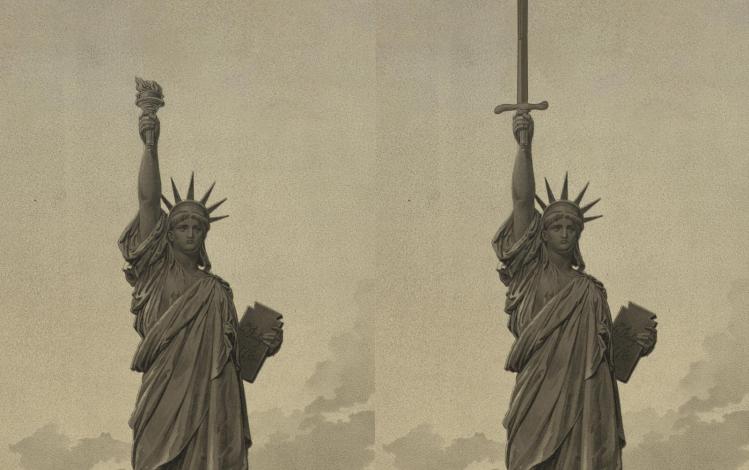
One hundred and forty years ago this year, the Statue of Liberty was officially dedicated in New York Harbor—and immediately became known worldwide as America’s defining symbol, a beacon of hope to immigrants nearing these shores. Its torch has long illuminated the path to liberty, promising refuge and opportunity. Yet in Franz Kafka’s novel Amerika (1927), the young immigrant Karl Rossmann glimpses the beckoning lights of New York and spots something far different: the Statue of Liberty holding a sword, not a torch. This stark inversion transforms the mythic Promised Land into a precarious netherworld.
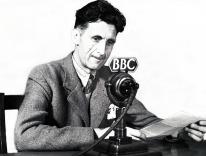
This opening scene in Kafka’s novel is uncannily relevant to today’s fraught political landscape. As cities across America now wrestle with the entangled issues of immigration and identity, millions of citizens and foreign residents fear that Kafka’s vision of Lady Liberty was all too clear, that the United States has become the land of the fearsome blade rather than the affirming flame. Has the immigrant experience during the era of Donald Trump turned from one of welcome to terror? Is America—or rather “Amerika”—now ruled by a regime that rolls the Kafkaesque and the Orwellian into one?
The first English translation of Amerika in 1938 ignored Kafka’s “sword” and replaced it with the word “torch”—blithely overriding Kafka’s explicit wording. Apparently the translators, Willa and Edwin Muir, believed that the ailing Kafka had simply made a mistake. They did not seem to appreciate how much their small “correction” changed the book’s meaning.
It’s worth reflecting on the significance of Kafka’s Amerika for present-day America because one can scarcely imagine a more chilling example of “the bloody crossroads where literature and politics meet” (Lionel Trilling’s famous phrase in The Liberal Imagination). I believe that Kafka’s imagery in Amerika—distorted through translation and revived in recent political rhetoric—offers a powerful lens through which to examine America’s shifting identity under Donald Trump.
Left unfinished at Kafka’s death in 1924, Amerika follows Karl Rossmann, a European immigrant navigating a bewildering and often antagonistic America. Karl sees the Statue of Liberty holding a sword in the novel’s early pages. Most commentators hold that Kafka, a consummate artist who prized nuance and ambiguity, intended the image to be a sign that Karl is approaching a land more intimidating than inviting. The brandished sword subverts the idealized vision of America as a harbor of safety and instead portrays it as a terrifying war zone. It is a metaphor for America’s social and political reality as Kafka must have perceived it at a time when antiforeigner sentiment raged in the wake of World War I, with “hundred percent Americanism” in the air and the Ku Klux Klan on the march. Rossmann encounters a land where newcomers are wary, freedom is conditional, and authority can be oppressive.
The husband-and-wife team who translated Kafka from German sought to domesticate Kafka’s complex and dark symbolism to fit the expectations of their English-speaking audience, as Michael Hofmann argues in the introduction to his own masterful retranslation, Amerika: The Man Who Disappeared (1996). To Willa and Edwin Muir, the sword seemed out of place, too discordant with the widely accepted image of America as the land of liberty. Their substitution inverted Kafka’s critique, turning a menacing symbol back into the comforting emblem of freedom. This translation choice shaped American readers’ understanding of Kafka’s work for decades and effectively blunted the book’s ironic edge. The Muirs’ version also reflected a broader translation philosophy prevalent at the time, one that prioritized familiarity and accessibility over strict textual fidelity.
The Muirs were not alone. L’Amérique, a 1946 French edition of the novel translated by Alexandre Vialatte and published by Gallimard, replaced Kafka’s abrupt and bare German style, which used the imperfect tense, with a smooth and graceful French style that employed a more conventional literary tense (passé simple), thereby softening and aestheticizing the bureaucratic “Kafkaesque” world of the novel. Equally telling was the choice of the title L’Amérique, which reflected the standard French orthography for “America” rather than the vaguely ominous “Amerika” (with a “k”). The effect was to assimilate Kafka to the French humanist tradition. Vialatte himself was a distinguished French novelist and man of letters, and in L’Amérique he presented to a grateful, pro-American French public something much more like a “version” than an outright “translation” of Kafka’s novel.
L’Amérique proved enormously popular with French readers and went through several editions in the 1950s and ’60s. It serves as a textbook example of what the French literary sociologist Robert Escarpit termed “creative treason” in his influential Cold War treatise, Sociologie de la littérature (1958). Vialatte’s L’Amérique illustrated a process whereby a translation (traduction) gives “new life” to a work by rendering it accessible to foreign-language audiences incapable of reading the original—but only at the high price of the betrayal (trahison) of some important aspect of the original.
William Faulkner, who received the Nobel Prize for Literature at the Cold War’s height in 1950, was also altered by French translators toward similar ends. His style was recast into classical French cadences. French critics celebrated him as an “innovative” stylist and as a visionary whose fiction showcased humanist literary values. Though they represented very different kinds of high modernism, Kafka and Faulkner were both exalted in France as examples of Western artistic superiority during the ideologically embattled era that followed World War II. The darkness and despair of Kafka’s Amerika was lightened and domesticated into an elegant French humanist idiom in order to make his vision hospitable to mid-twentieth-century middlebrow norms. In Cold War France, cultural officials wanted to avoid providing ammunition to America’s Stalinist adversaries. Unlike the Muirs, however, Vialatte and Gallimard did not overtly distort Kafka’s Amerika by changing his image of a sword-wielding Statue of Liberty. Still, Vialatte’s influential translation softened Kafka’s critique of an alienated modern West by ennobling his style and defanging his title.
Today, Kafka’s vision of America as either a land of the sword or a place of uninviting alienation possesses a new relevance amid ICE raids in the middle of the night and the extrajudicial execution of more than 160 alleged drug smugglers in the Caribbean Sea. Critics of the Trump administration argue that its immigration policies—and the way they are enforced—have become not only unjust but cruel. Kafka’s sword-wielding Lady Liberty seems like an all-too-fitting symbol of what the country has become in Trump’s second term.
Trump administration officials insist that legal immigrants are still welcome in the United States. Trump himself has said, “We want people to come into our country, but they have to come in legally and properly vetted, and in a manner that serves the national interest.” Secretary of State Marco Rubio has gone even further, claiming that he represents “the pro–legal immigration party”: “There is no one who is more pro–legal immigration in this country than I am, because my parents were immigrants.”
But critics of the Trump administration counter that mass-deportation policies and the crackdown on law-abiding undocumented immigrants, along with the high-decibel “no tolerance” rhetoric, have left the rest of the world with the impression of an “Amerika” that is guarded, militarized, and hostile to foreigners—especially nonwhite foreigners. On this view, the Trump administration may still embrace a familiar and reassuring symbol—the torch of liberty—but it enforces a xenophobic policy with the sword. The insistence on the traditional image of the Statue of Liberty as a beacon of freedom serves a political purpose: maintaining the image of American openness while legitimizing a regime of exclusion.
In short, what looks like a rather academic matter of alternative translations actually marks “the bloody crossroads” where America’s identity and values are being decided. Will the United States be a country that welcomes the stranger, honoring the ideals inscribed on the Statue of Liberty’s pedestal? Or will it be a garrison state, where the Statue of Liberty stands as an ironic anachronism, a reminder of all that America no longer is?
Amerika warns us of a nation where freedom is tense with anxiety and alienation, a nation wary of outsiders. To avoid that fate, we will have to change course. The good news is that there’s still time to do so. The bad news is that it’s much harder to change draconian immigration policies than to change a “k” to a “c”—and much harder to change what America means than to change the meaning of Amerika.
We welcome your comments about this article. Please send your response to [email protected].