My father was born in County Donegal in 1925. He would have turned one hundred on May 30 of last year. As I think about my father, who passed away at the age of eighty-eight, I marvel at the distant world of Ireland a century ago.
It’s fascinating how quickly history starts to move—especially in remote areas like County Donegal—after inching along at glacial speed for hundreds of years. Here I am, a writer who has lived to see the advent of Star Trek–type smartphones, ChatGPT, and self-driving cars, with a father whose boyhood passed in medieval conditions very similar to those of his great-great-great-grandfather. Indeed, the world he grew up in was utterly different from ours today. The sense of radical disjunction is hard to think about, even harder to describe. But a colleague recently asked me to tell his students about the Ireland of my parents’ youth, and I felt strangely privileged to speak about their world, whose last vestiges I observed decades ago as a boy: the vanished world of rural Ireland.
You might like: John Rodden remembers the ‘St. Patrick’s Day dispensation’
My father came from a family of fifteen children. In the 1920s, Ireland was very poor. Theirs was more a shack than a house—not at all a picturesque thatched cottage but a two-room hovel. One room was used to shelter the cow, the horse, and some chickens during the winter—the smell was terrible. There was no running water, no bathroom. To use the “toilet,” you had to walk thirty meters outside and squat over a hole. There was no mirror in the house until my father was a teenager. If you wanted to look good for the monthly church dance, he told me, you asked your brother if you were presentable. The girls did the same with their sisters.
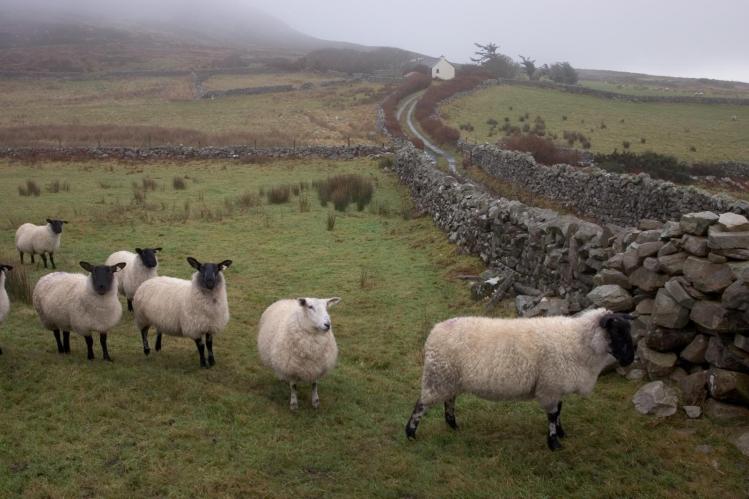
There were only two bicycles for the whole family. They shared them. There were never enough boys’ shoes. If it was your turn to have shoes, my father said, you went to school that day. If not, you stayed home and worked in the fields. You milked the cow. You learned to plow behind the horse. You planted potatoes. You fed the sheep. If it was a good year, the family might have a few cattle, but they were not for the family to eat. A poor Catholic family did not eat meat—except at Christmas and Easter. They waited until the cattle were fat enough to bring to market. Selling them, my father said, meant survival.
At thirteen or fourteen, boys were sent away to work on other farms. You were sold like cattle: the price you fetched depended on your height, your weight, your build. At the auction in a large neighboring village, farmers from the Protestant North—where families were smaller or had no sons—came to hire Donegal boys. Selling us, my father said, meant survival.
My father was sold at the age fourteen. His father, my grandfather, received six pounds—about thirty dollars. A good sum, my father always said. His older brother Eddie, shorter and a bit scrawny, had only brought four pounds and ten shillings two years earlier.
So off he went to Northern Ireland, to live with and work for strangers who didn’t much like Catholics. For six months—a pound per month for the homefolk. From sunup until sundown, you worked. During the war, he said, summers were “double daylight savings”: two extra hours of sunlight. Sundown was at eleven. After the six months, he came home again briefly, only to be brought again to market and auctioned off elsewhere. This went on for years. For them, it was just life.
Before leaving for a new farm, my father was allowed to spend a couple weeks at home with the family. He told me about crying himself to sleep every night as the time at home wore down. He had felt an aching hole inside when he was away. It was wrenching agony to leave his parents, his siblings, and his grandmother—especially ‘Granny,’ who had lived to eighty-two. He learned of her death in a letter. In winter, in the cold and dark, she had still gone out to the hole at night to relieve herself. More than once, my father added, a “wee un” fell into the hole at night. Yet for them, this too was just life.
There were no newspapers in the house. My father remembered that, like many in the village, his father hoped Hitler would win the war. Twice a month, his father walked to a neighboring farm—the only one in the area with a radio. The men would listen intently. Then he’d return home and share what he’d heard. The family would talk late into the evening about it.
You might like: ‘How the Irish Changed Penance’
Why did they want Hitler to win? Why would Irish villagers, devout and impoverished, vaguely hope for a Nazi victory? I know it sounds shocking. But one must remember that nobody was educated or knew very much about the political scene. In many ways, the world of rural Ireland in the first half of the twentieth century was closer to that of the Middle Ages than to that of today. What the villagers did know was this: Britain had oppressed Ireland for more than eight hundred years, long before (and after) the potato famine a century earlier—the tragedy that had led to mass starvation and emigration, and which had reduced Ireland’s population from eight million to fewer than three million within a dozen years. Memories of the Black and Tans were still vivid. Britain was therefore the enemy of Ireland. Germany and Hitler were the enemy’s enemy.
My mother’s family was smaller: “only” seven children. Her mother died while giving birth to the seventh child at the age of thirty-four. If she had survived, she too might have gone on to have at least a dozen children. At that time, a woman who had delivered a baby would return to the fields after a week. She brought the baby with her and breastfed while she worked.
Apart from Northern Ireland—the official name for the six-county region that remained part of the United Kingdom—Ireland was very Catholic. Catholicism was the official religion, enshrined in the national constitution. There was no abortion or contraception. Everything was very strict. The village priest was like a little god. No one questioned him. It seemed as if he decided who went to heaven and who went to hell.
My father left school in the sixth grade after the equivalent of three years of “schooling.” My mother went to the eighth grade. Her father saw that she was intelligent and allowed her to learn typing and shorthand afterward in a course. Then she worked as a secretary in a nearby town. She continued working until I was born.
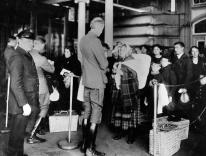
We emigrated to the United States in the 1950s. But I remember the old Ireland, and everything I’m telling you I either glimpsed myself or heard firsthand from my parents and their siblings, some of whom are still alive.
Fortunately, the practice of selling boys at market—known politely as “indentured servitude”—had ended by the 1950s. Rural poverty was still very present in some locales, however, and remnants of the old ways lingered. Most people still rode bicycles up and down the roadways. There were no TVs or telephones. You milked the cow, churned the butter, tended the sheep, and cut the peat out of the bog to put in the kitchen furnace. By then, there was usually an outhouse, even if indoor plumbing and a proper bathroom hadn’t yet arrived everywhere.
My parents loved “home.” Even after fifty years in America, they casually referred to Ireland as “home” until their dying days. But they did not romanticize it. And even as their beloved Donegal eventually embraced the modern world, my parents remained deeply grateful to have arrived in America, “the Promised Land.”
Years later, on a visit to the family in Donegal when I was twenty, I was with my grandfather—my father’s father. He was very old then. When I rose to leave, he had tears in his eyes. We both knew that we would never see each other again. He hugged me hard. Then, reaching into a paper bag, he presented me with a special gift. It was a pair of old shoes. My grandfather said: “Take these, Johnny. You might need them someday…for school.”
We welcome your comments about this article. Please send your response to [email protected].