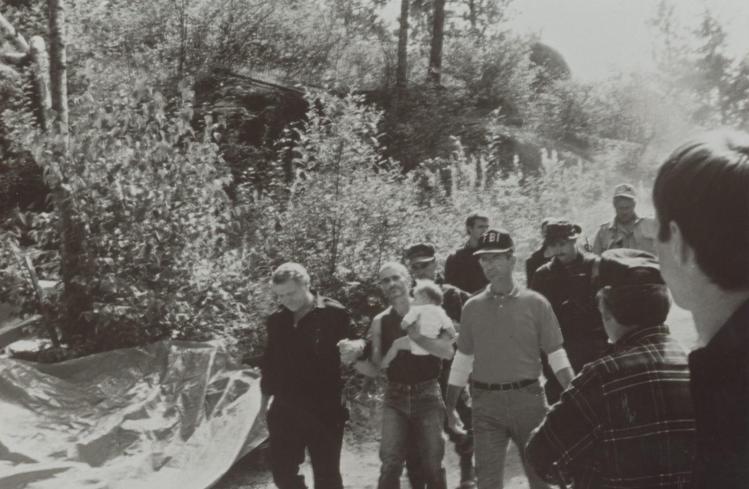
If the “short twentieth century” ended with the 1991 collapse of communism, a “long twenty-first century” was already well underway by 1993. There was the February bombing of the World Trade Center in Manhattan, which left six dead and hundreds injured, and foreshadowed the atrocities to come eight years later. Out west, another terrorist was busy planning a new round of attacks and completing an antitechnology manifesto called “Industrial Society and Its Future.” Imagine what Ted Kaczynski, the Unabomber, would have said in April 1993 if he knew that a California tech startup named Nvidia would one day become the world’s richest company by making tiny chips so that tiny computers could infiltrate every facet of twenty-first-century life. The same month, a standoff with federal authorities at the Branch Davidian compound in Waco, Texas, ended with eighty members of the heavily armed separatist Christian group dead.
The tragedy in Waco was especially big news in Boise, Idaho, where another heavily armed separatist Christian was on trial following a different bloody standoff with the Feds—this one atop an isolated mountain called Ruby Ridge. “Since both sieges centered upon guns and apocalyptic faith they were instantly connected,” writes Chris Jennings in End of Days, his fascinating book about Randy and Vicki Weaver, the devout Idaho parents who lived at Ruby Ridge. They were either gun-nut zealots or patriot martyrs, depending on who you ask.
The violence at Waco and Ruby Ridge unfolded “in the historical doldrums between the collapse of the Soviet Union and 9/11,” Jennings writes, suggesting that “something new [was] being born.” If you mix this locked-and-loaded rural Christianity with 1990s tech innovations, then add in global terror plots abetted by open borders, you have the basic ingredients for the Trump presidency. “What Ruby Ridge portended,” Jennings writes, “was a slow moving ontological crack up—the fracturing of American reality itself.” What remains unclear is just how “un-fractured” America was before the early 1990s. And if it can ever actually be made whole.
End of Days can be seen as a sequel of sorts to Jennings’s first book, Paradise Now: The Story of American Utopianism (2016). “No moment in history or place on the globe has been more crowded with utopian longing and utopian experimentation than the United States in the middle of the 19th century,” wrote Jennings, adding, “The imminence of paradise seemed reasonable to reasonable people.”
What happened? When were these hopeful protohippies swept away by very unreasonable “Christian survivalists,” as the Weavers and many of their supporters proudly characterized themselves? In the wake of Vietnam and Watergate, the coastal smart set was nodding ominously at films like The Parallax View and Three Days of the Condor. This represented one kind of conspiracy-friendly, antiestablishment radicalism. But millions of flyover-country Christians were radicalized in a very different way. They devoured Hal Lindsey’s unlikely 1970s bestseller The Late Great Planet Earth, which linked contemporary events to frightening biblical prophecies in Daniel, Ezekiel, and the “gory fever dream” that is also “the epilogue of the most widely read book in human history,” as Jennings describes the Book of Revelation.
End of Days offers a concise history of America’s dispensational obsessions, starting with Anglo-Irish preacher John Nelson Darby (1800–1882), and then moving on to prominent pre-millenarians like Milton and Lyman Stewart, whose 1910s multivolume Fundamentals book project inflamed the culture wars that culminated in the Scopes trial.
To readers of George Marsden, Matthew Avery Sutton, Frances FitzGerald, and other scholars of American religion, all of this will be familiar enough. As will a powerful sense of frustration: Why do so many loud, proud, patriotic Christians have so little to say about love, the meek, the Sermon on the Mount, and all the rest? How to explain their disproportionate fascination with the Old Testament, and (in Jennings’s words) the “relatively small portion of the Bible’s 31,000 verses devoted to the end times”?
Jennings implies that Christians may inexorably and inevitably be drawn to apocalyptic narratives. But he also, counterintuitively, might have explored how America’s utopian impulses—which Jennings knows very well—contribute to this eschatological obsession. After all, when you finally discover that you can’t get back to any wondrous garden or make the country a paradise “again,” you need scapegoats—real-world stand-ins for a “many-horned Beast, a dragon, a blood-drinking Harlot,” and all those other monsters marching in Revelation’s “bewildering parade of images.”
End of Days is at its best when it explores the Weavers’ home life and the Pacific Northwest’s post-Vietnam ecosystem of anti-America Americans. Lest anyone assume things in the United States only started getting crazy around 2016, Jennings reminds us that devotees of The Late Great Planet Earth—with its “groovy youth pastor” vibes—turned their attention to an appalling phantasmagoria of rapture and race war called The Turner Diaries. William Pierce’s 1978 dystopian novel fuses Biblical literalism with a very contemporary, very angry strain of white supremacy that appealed to the neo-Nazis and fundamentalists who attended Aryan World Congress meetings at Hayden Lake, Idaho, a ninety-minute drive from the Weavers. Along with AM-radio preachers, Ayn Rand, and stacks of self-published books and pamphlets—nearly all of them relentlessly, depressingly antisemitic—The Turner Diaries fits right into “an underground canon of the conspiracist far right in the 1970s and ’80s,” Jennings writes. “Decades before the advent of Infowars, YouTube, or 4chan, this material…spread apocalyptic and conspiratorial ideas with astonishing efficiency.”
As early as 1983, according to Kathleen Belew’s valuable 2018 book Bring the War Home, a diverse coalition of armed right-wingers had “turn[ed] to Revolutionary war on the government.” In other words, nearly a decade before federal agents went to Ruby Ridge—ultimately leaving three people dead and seeming to confirm the right wing’s worst suspicions about federal power—a civil war was already underway.
Jennings’s narrative really gets going when a “stocky, balding” biker from New Jersey arrives in Idaho looking to buy a pair of sawed-off shotguns. Knowing where and how the Weavers’ story ends takes nothing away from Jennings’s engaging, propulsive narrative, which draws judiciously upon Belew’s book, Sara Weaver’s heartbreaking memoir, and Jess Walter’s Every Knee Shall Bow (1995). Though Jennings’s occasional shifts in tone from solemn to snarky can be jarring, he steers clear of smug editorializing and Deliverance-style snobbery. Conventional wisdom after Ruby Ridge and Waco had it that the feds wildly overreacted, which of course is true. At the same time, the “glacial pace and scale of the effort to get the fugitive Randall Weaver before a judge,” Jennings notes, “attests to a government…scrupulously devoted to its own codes.” Like the Mormon zealots in Jon Krakauer’s Under the Banner of Heaven, Randy Weaver claimed that he just wanted to be left alone, even as he made a public spectacle of himself, ran for office, and flagrantly broke laws.
Bungled federal farm policies surely contributed to the era’s white rural rage, though it’s hard to imagine prosaic legislation about grain prices or tax subsidies assuaging any substantial portion of Jennings’s “hardcore racists…end timesers, anti-communists, anti-Semites, weekend commandos, tax resisters and pissed off farmers.” What many of them really wanted, Jennings writes, was “to establish a white, fundamentalist caliphate in the…Northwest.” They even settled upon Idaho’s Kootenai County as the capital of this “Aryan utopia.”
More than three decades later, it’s only more painfully obvious “that some measure of shared reality is a civic necessity,” as Jennings writes. He adds:
Ruby Ridge illustrates what happens when a group of people live within myths that cannot be reconciled with life in an ever-changing society or the slow hard work of democratic governance…. For the Weavers, as with millions of other citizens, a conspiratorial interpretation of events extended naturally from their faith.
Maybe. On the other hand, hateful Christians weren’t the only ones imagining an Edenic world apart in the 1970s. A sci-fi fantasy novel called Ecotopia inspired legions of fans to envision an environmentally pristine commune—also in the Northwest—liberated from everyday American detritus and decay. As unlikely as it may seem, the extreme political adversaries—granola hippies and neo-Nazis—share more than a few attributes.
Consider Oklahoma City bomber Timothy McVeigh. Inspired by The Turner Diaries, enraged by Waco, Ruby Ridge, and the overall demise of white Christian America, McVeigh pulled off the deadliest act of terror on American soil. At least until jihadist enemies of white Christian America flew planes into the World Trade Center and Pentagon on September 11, 2001. It was this kind of demonic, globalist, anti-Christian savagery that inspired The Turner Diaries in the first place. Thus, the hero’s final, dramatic act of rebellion: flying a plane into the Pentagon.
End of Days
Ruby Ridge, the Apocalypse, and the Unmaking of America
Chris Jennings
Little, Brown and Company
$30 | 384 pp.
We welcome your comments about this article. Please send your response to [email protected].