Could there be a novelist more challenging for film adaptation than Thomas Pynchon? Pynchon’s rambling, rambunctious postmodern fables feature characters with cartoonish names, labyrinthine plots jerry-rigged from recycled pop-culture memes, dialogue that can read like a salad of non sequiturs, larky countercultural hijinks, and a constant tilting at conspiratorial networks, all in the service of a critique of vast and sinister systems—governmental, technological, corporate, digital—in which we are helplessly enmeshed. And then there’s Pynchon’s extravagant prose—those swarming dependent clauses, the baroque digressive doodling that bestows operatic drama on a passing description of, say, a bad pizza. Here is the pizza that Prairie Wheeler serves her father, Zoyd, at the Bodhi Dharma Pizza Temple in Pynchon’s 1990 novel, Vineland:
Its sauce was all but crunchy with fistfuls of herbs only marginally Italian and more appropriate in a cough remedy, the rennetless cheese reminded customers variously of bottled hollandaise or joint compound, and the options were all vegetables rigorously organic, whose high water content saturated, long before it baked through, a stone-ground twelve-grain crust with the lightness and digestibility of a manhole cover.
How can a filmmaker hope to capture the spirit of fiction steeped in irony at all levels, from the political to the lexical, and exploding with this kind of profusion? The New Yorker critic Anthony Lane once wittily commented that turning a Pynchon novel into a movie was like trying to cram the New York Philharmonic into a Ford Focus, and proposed that anyone even attempting to do it “deserves an award for valor.”
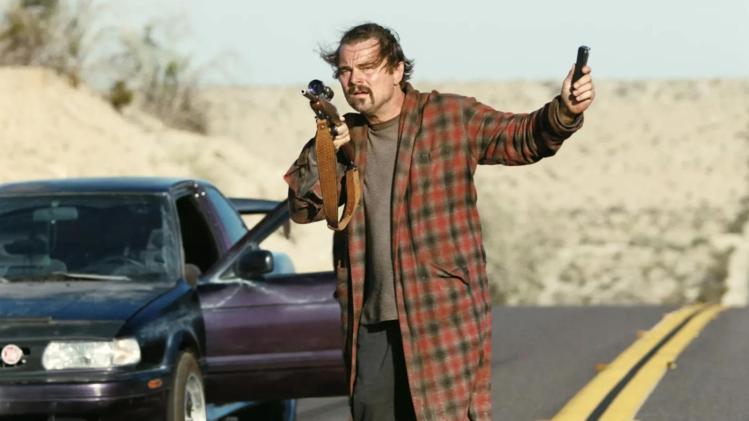
Yet if there’s an American director you’d expect to win that award, wouldn’t it be Paul Thomas Anderson? Anderson has long admired Pynchon as a novelist who “knows things that we do not,” and his movies are almost as cryptic and elusive as Pynchon’s fiction. One Battle After Another is based on Vineland, and it’s actually Anderson’s second go-round with the novelist. The first (and the only other Pynchon novel ever filmed by any director) was Inherent Vice (2014), a turgid neo-noir bogged down by endless gags and a plot convoluted enough to make Raymond Chandler blush. This time, Anderson wisely abjures point-for-point fidelity to his source, opting instead for a loose adaptation that blends his own material into Pynchon’s. Starting in the early 2000s and continuing to today, One Battle takes up the fates of former would-be revolutionaries who have gone underground. At its center is a white middle-aged stoner named Bob Ferguson (Leonardo DiCaprio), who’s living off the grid in the woods with his mixed-race teenage daughter, Willa (Chase Infiniti). Bob turns out to have a secret past; his real name is Pat Calhoun, a.k.a. Rocket Man, and two decades ago he and his Black girlfriend, Perfidia Beverly Hills (Teyana Taylor), were part of a leftist revolutionary group known as the French 75.
The first half-hour of the movie briskly charts the group’s triumphs back in its heyday. We see them liberating immigrants from a border detention facility and later pulling off bombings and robberies to fund and glorify their radical goals—“Free borders, free bodies, free choices, and free from fucking fear!” Perfidia yells at a zip-tied immigration guard. In the process they fall afoul of a no-nonsense U.S. marshal, Captain Steven J. Lockjaw (Sean Penn), who develops an obsessive attraction to Perfidia. Catching her red-handed during the planting of a bomb, he lets her get away after she agrees to meet him later at a motel; a year later, when she is arrested following a bank robbery, he offers to arrange for her release if she will rat out the other members of French 75. She does, and Lockjaw secrets her away in witness protection in a bland suburban development. But Perfidia soon escapes and flees to parts unknown. The remnants of French 75, meanwhile, furnish Rocket Man and his infant daughter Charlene with new identities and send them into the woods. This part of the movie ends with twin exiles—Perfidia somewhere in Mexico or South America and “Bob” in the woods with the little girl “Willa,” who may be his daughter…or may be Lockjaw’s.
The movie jumps ahead sixteen years. Willa is now a teenager and a bang-up martial-arts student at a ninja academy, possessing both her mother’s beauty and her fierce demeanor. Bob, meanwhile, has subsided into feckless lassitude; little remains of his revolutionary ardor beyond watching The Battle of Algiers or rebuking Willa’s high-school history teacher for not teaching that the Founding Fathers were slaveowners. Perpetually high, Bob is also paranoid. When a friend of Willa’s comes to pick her up, Bob pats the kid down at the door and aggressively questions him as Willa looks sadly on. “You know, nobody’s coming to get you,” she tells him, shaking her head.
But, of course, someone is coming to get him—namely, his old nemesis, Lockjaw. Now elevated to colonel for his success in the war on domestic terror, Lockjaw, we learn, has been offered membership in a secret society of wealthy right-wing white supremacists. Knowing that his long-ago dalliance with Perfidia could imperil his membership in a group dedicated to racial purity, Lockjaw determines to find the biracial teenager who may be his daughter and uses his position to mount a multifront police operation to flush Bob and Willa out. The film’s final hour is a blitzkrieg of action as the government’s move against the French 75 dovetails with roundups of undocumented immigrants, separating Bob and Willa in the chaos, plunging Willa into peril, and cuing up the ultimate disclosure of her paternity.
In the process of telling this profuse tale, Anderson creates moments of bravura filmmaking. Paired views of the Mexican border wall in the film’s opening scenes show it from a distance, snaking sinuously up a wild hillside, then up close at night, its steel ramparts glowing with multicolored light, mighty and sublime. There are two harrowing car chases, the second involving three vehicles—one driven by a hit man—engaged in a high-speed death race on a hilly stretch of California desert road. Michael Bauman’s VistaVision camera artfully intermixes long and short perspectives to create a rolling, vertiginous feeling that results in one of the most thrilling car chases in all cinema. And three-quarters of the way through the movie, we get the magic-carpet ride of one of Anderson’s signature extended narrative riffs, a twenty-four-minute montage of all players in the massive police action—migrants hiding above a store, massive street protests, Molotov cocktails, masked agents, waves of police advancing with shields and batons—all set to jangly, dissonant piano plunking that lends an aura of relentlessly mounting tension. No other director could have conceived and executed the climactic sequence of his movie this way, to such luxuriantly tense effect.
As for his take on American politics, Anderson keeps one eye fixed on the past, with nostalgia, and the other on the present, with alarm. Some of One Battle After Another has a distinctly anachronistic feeling. It’s worth recalling that by the time Vineland was published, the United States was already a quarter-century removed from the political and cultural strife that formed the novel’s zeitgeist. Folding its look back at Vietnam-era radicals into a father-daughter relationship, and setting it amid the political quiescence of the 1980s and the Reagan presidency, Pynchon treated those bygone conflicts with a kind of jazzy wistfulness. Anderson’s treatment pushes the whole thing forward yet another quarter-century, and viewers can be forgiven for feeling a bit bewildered about the time frame, especially in the film’s opening sequences: self-styled revolutionaries sit around a campfire spouting anticapitalist rhetoric, Rocket Man gives cheerful lessons in bomb-making, and a massively pregnant Perfidia disports herself on a desert shooting range, blasting wantonly away with a machine gun. It all seems way more 1970 than 2005.
The current-day segment of the movie contains no specific political references, but there’s no doubt that what’s being skewered is the amped-up, xenophobic security state of the United States under Donald Trump. Raids on meat-processing plants, a high-school dance, a store where migrants are hiding upstairs; official statements dripping with contempt for sanctuary cities; hooded abductees whisked away to unnamed detention centers; the abuse of state power in pursuit of personal agendas and vendettas—Anderson returns us to the Vietnam-era view of the evil of state force, Pynchon’s view, and of the military as wicked, absurd, and even sick, while updating it for today’s political checklist. “Each day is hand-to-hand combat in the struggle against uncontrolled immigration, isn’t it?” muses the head of Lockjaw’s right-wing group. “You want to save the planet, you start with immigration.” And: “Our goal is to find dangerous lunatics, haters, and punk trash, and do away with them.” Sound familiar? It could be Trump speaking about Portland. Anderson has had decades to think about making Pynchon’s novel into a movie, and one can guess why he chose this moment to finally do it.
One Battle After Another exudes a persistent ambiguity of tone, as if Anderson can’t decide what key he wants to sing in. His movie waffles weirdly between the urgent and the absurd. Much of it plays as terse drama—the grimly nervous members of the French 75 gathering to liberate detainees at the film’s outset, or, later, Bob’s narrow escape from his house through a tunnel thick with tear gas. And there are quietly affecting moments, like an early scene in which Bob begs a restless Perfidia to abandon their life of radicalism and stay with him and their infant daughter. (“We’re a family now,” he pleads.) Much of the movie employs a direct mode of storytelling that allows for menace or tenderness without the mitigation of irony.
But then there’s Lockjaw. Sean Penn plays him as a walking collection of twitches, hitches, and tics, his bulging muscles brocaded with popping veins (“Why is your T-shirt so tight?” asks Willa, provoking an apoplectic shriek of “I’m not gay!”), and his head sporting a ridiculous modified mohawk that he grossly plasters down by licking a comb (a nod to the villainous Bush-era neocon Paul Wolfowitz). Lockjaw carries a zone of parody around with him; every scene he’s in turns to farce, and the movie’s alternation of the affecting and the absurd may induce whiplash in a viewer.
Admittedly, this dichotomy is fundamental to Pynchon. However bleak the political view in his novels—“war in Vietnam, murder as an instrument of American politics, black neighborhoods torched to ashes and death,” he writes in Vineland—that bleakness is balanced, if not redeemed, by the irrepressible high spirits of the prose. Part of it is Pynchon’s incorrigible punning: a lawn-care company called “the Marquis de Sod,” for example, or Zoyd Wheeler and a friend complaining about creditors coming after their money—“more liens than the Tower of Pisa…more garnishes than a California burger.” And part of it is the black humor of his satire, as when Zoyd’s would-be son-in-law floats the idea for what’s described as “a chain of violence centers, each on the scale of a small theme park, including automatic-weapon firing ranges, paramilitary fantasy adventures, gift shops and food courts, and video game rooms for the kids.” The vision evokes the mordant horselaugh that is Pynchon’s default attitude to reality.
Anderson does his best to catch the spirit, and there are touches of madcap humor in his movie. After Bob is chased from his rural hideout by federal agents, he desperately attempts to reconnect with his old radical network, using a coded exchange that has to be repeated verbatim over the phone before he can be told the rendezvous place—only to have the call answered by a procedural stickler named “Comrade Josh,” who shows no leniency when Bob can only half-remember the script. This leads to a series of increasingly exasperated and hilarious exchanges as Bob, frantically fleeing the feds, continues to check in. “I did too many drugs, I fried my brain, and I can’t remember the damn greeting!” he rants at Comrade Josh. When the functionary continues to scold—“Maybe you should have studied the rebellion text a little harder”—Bob explodes, whereupon Comrade Josh archly reprimands him: “Okay, this doesn’t feel good, you’re violating my safety right now.” Turns out that wokeness has ruined even revolutionaries—surely a Pynchonesque perspective.
There are deeper affinities. Anderson’s strength as a director resides in the way he pays lavish attention to the surface of things, building a richly furnished cinematic world even as his deeper obsessions steer us toward important recognitions about human nature and the human predicament. Those recognitions tend to be less individual than collective. Characters that you identify with or sympathize with, or even fully understand, aren’t really the main attraction in Anderson’s movies. The baleful drama of There Will Be Blood repeatedly pits Daniel Day-Lewis’s rampaging oilman against Paul Dano’s pious preacher. Yet, however intense their confrontations, the two men’s interiors remain stubbornly opaque, and we come away from the film with an impression less of characters with depth than of faces, masks of attitude—Day Lewis’s gleaming, visionary, increasingly crazed rage, and Dano’s pious, pursed unctuousness. Anderson’s movies have a novelistic richness, yet his aim is toward the mythic rather than the realistic; characters are pieces on a chessboard, tiles in a mosaic, and the rewards of his films are almost always more cerebral than emotional.
This quality makes him a good fit with Pynchon. Like Lockjaw, Perfidia Beverly Hills is not a character with much depth, but a collection of postures and poses—a Black female superhero, running from the cops with machine-like power, a kind of Six Million Dollar Woman. Yet Anderson seems torn between preserving this cartoonish Pynchonesque absurdity and supplying a directness that lets us connect to human predicaments, whether the fear of migrants huddled in hiding or a father’s anguish in not knowing if his daughter is safe. I found that, for the most part, what I liked best about this movie were the least Pynchonesque parts. Then again (cards on the table!), I have always found reading Pynchon to be a slog. His slippery plots and endless pop-cultural and political riffing bring me back to the wearisome company of the droll, sarcastic hip kid in tenth grade who never stops mocking things, who lazily and gleefully thinks the whole world is absurd.
And so I find myself tempted to ignore the absurdity of One Battle After Another and focus on the heartwarming stuff. Anderson makes this surprisingly easy, drawing his movie to a close with Bob and Willa restored safely home, Lockjaw dead, and Bob bestowing on his daughter a heartfelt letter from Perfidia (“Maybe you’ll be the one who puts the world right”). After reading the letter, Willa heads off to Oakland to join a protest, as the soundtrack cues up the wholesome jubilation of Tom Petty’s “American Girl,” and Dad smilingly calls out, “Hey, be careful!” Thus does Anderson supply something very rare in either Pynchon’s work or his own: a happy ending.
Upon reflection, though, it won’t do to disregard the outlandishness that is Pynchon’s legacy to this movie. As with that paramilitary adventure park envisioned in Vineland, which thirty-five years ago might have seemed merely absurd but today seems all too prophetic, perhaps the scary thing about One Battle After Another is how far from a stretch some of the crazy stuff is. Like federal agents targeting a chicken-processing plant called “Chickin Lickin’” and soberly referring to it as “a criminal organization.” Or officers in fatigues breaking into a high-school dance to cuff and interrogate students. Or the extremely Pynchon-like depiction of the various police forces in the movie as obscenely militarized. Or the existence of secret right-wing groups serenely planning racist villainy. Is this self-indulgent dystopianism? It is hard to discount absurdity at a moment in U.S. history when we are governed by a president who issues a blockchain meme coin with his name and a dollar sign; rhapsodizes about converting ravaged war zones into luxury resorts; and staffs his government with women who look like models and behave like attack dogs, a health secretary who suffered a worm in his brain, speaks in an addled whisper, and believes that circumcision causes autism, or a secretary of defense (oops, secretary of war!) who gathers top military brass together and lectures them about warrior culture and appropriate male grooming.
Not to mention what everyday people are experiencing out there. Indeed, as I drove home from the theater, the local radio news was reporting an ICE raid at a car wash just a few towns away. “Frightened family members,” reported the correspondent, “say it was carried out by masked men in unmarked cars.” Not many years ago, that would have sounded like a line from Pynchon. It is a gauge of our current distress to say that we have made his fantastical doomfulness seem almost like realism.
We welcome your comments about this article. Please send your response to [email protected].