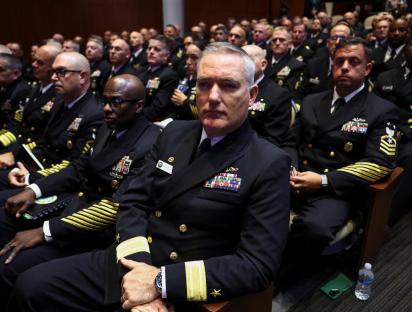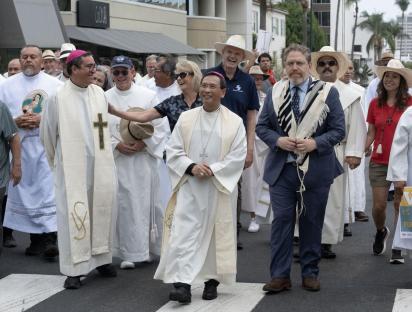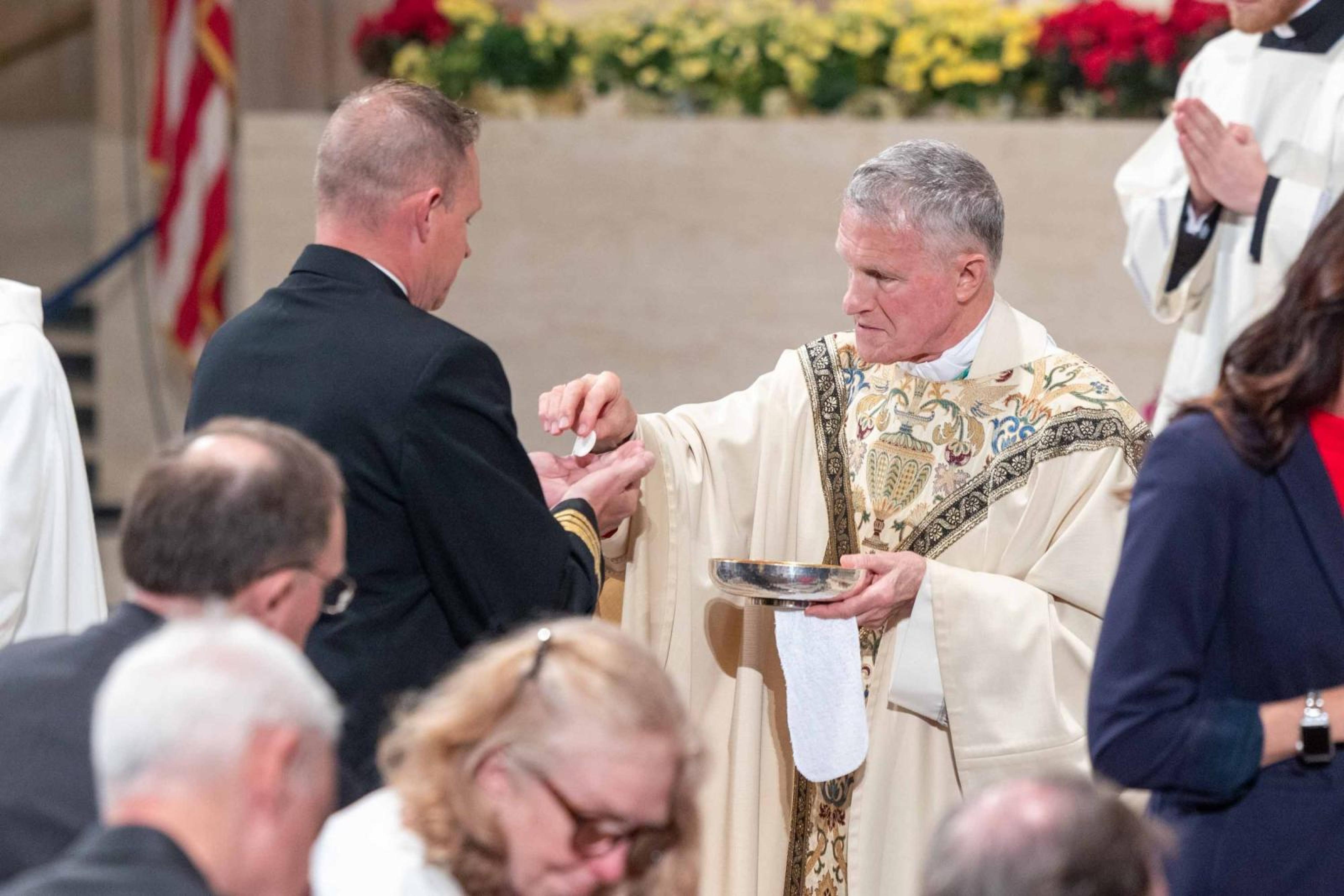
The first-ever Catholic Military Conference will provide three days of “formation, fellowship, and prayer centered in the Catholic Church’s Just War tradition” for Catholic service members and their families—even as the U.S. military conducts a war that Pope Leo XIV has labeled as unjust. But this inaugural event, held November 9-11 and sponsored by the nonterritorial Archdiocese for the Military Services, is unlikely to be a pep rally for the current administration and its policies. The conference’s plenary speaker is critical of the war in Iran, and Archbishop Timothy Broglio, who heads the military archdiocese, has publicly condemned recent actions by President Donald Trump and Secretary of Defense Peter Hegseth.
Last week, Broglio denounced Hegseth’s proposition to livestream the military execution of Fort Hood shooter Nidal Malik Hasan as a “public spectacle” that would imitate the barbarism of terrorists. He further said any Catholic soldier assigned to the firing squad was obliged to request to be excused from that duty. Trump later called off the planned livestream, perhaps in part because of widespread public outcry. Earlier this year, Broglio said it would be “morally acceptable” for Catholic service members to disobey an order to attack Greenland, on the basis that any such order would be unjust. He also labeled the administration’s assassinations of suspected drug traffickers at sea as the illegal and immoral intentional killing of noncombatants. Even his recent Red Mass homily emphasized the rule of law and praised all immigrants for contributing to “building up the nation.” Broglio is hardly a liberal, and his critiques of the Trump administration represent a rare, but growing, courage on the part of some Catholic bishops to transcend previous party favoritism.
Catholics represent about one-fifth of active-duty service members and are served by more than two hundred priest chaplains. The military archdiocese has no parishes; it ministers to 1.8 million Catholic service members and their families as well as to students at military academies, patients at veterans’ hospitals, and U.S. governmental personnel serving abroad. The planned three-day conference will feature Masses celebrated by Broglio and apostolic nuncio Archbishop Gabriele Caccia, eucharistic adoration and confession, and several workshops on discipleship. But much of the conference is devoted to analysis of the just-war tradition, an especially pertinent topic since Pope Leo XIV’s first full encyclical, Magnifica humanitas, raised concerns that just-war theory may be “outdated.”
Plenary speaker Joe Capizzi, an expert on the just-war tradition, doesn’t disagree with Pope Leo’s and Pope Francis’s concerns about the expansion of just-war theory. “I think what they’re both emphasizing is that the term has become a term of abuse now, that it’s appealed to by anybody in order to justify any military conflict,” Capizzi told me in a September 23 interview at the University of Notre Dame, where he heads the McGrath Institute for Church Life. “It’s also used by politicians to insulate their analysis from critiques.” Witness Russian president Vladimir Putin using the language of justified defense to rationalize actual aggression in Ukraine, or the 1989 U.S. invasion of Panama being labeled as “Operation Just Cause.”
The administration’s ignorance of the just-war tradition was evident in Trump’s and Vice President J. D. Vance’s “popesplaining” responses to Leo after he asserted that U.S. aggression in Iran is unjust. Trump called the pope “weak on crime” and falsely claimed he supported Iran having nuclear weapons. Vance warned Leo to be “careful when he talks about matters of theology.” Leo, of course, is an Augustinian priest and well educated on the ideas of Augustine, the first to formulate just-war theory. Capizzi agrees that Trump’s inability to name a precipitating cause in Iran “suggests to anybody looking at it, that, well, maybe we don’t have one.”
Capizzi is no pacifist. His 2015 book, Politics, Justice, and War: Christian Governance and the Ethics of Warfare, argued that state-directed force can be a moral act of peacemaking and a defense of the common good. But he has become increasingly concerned about the just-war tradition’s expansion, preferring to avoid the term “theory” because he believes it “reifies this notion of an apparatus by which one can seek permission to use lethal force.” Instead, he believes the tradition needs to be reclaimed as an exercise in practical thinking and moral analysis designed to limit and restrain lethal force to a very discrete purpose. A return to cautious moral reasoning is even more urgent now, when warfare involves “automated reasoning” and AI, the targeting of civilians, and a tribalism that “corresponds to a kind of brutality about the use of force,” Capizzi said.
The Catholic Military Conference falls the week after the midterm elections, in which the Iran War’s popularity—or lack of it—may play a role in GOP defeats. A recent poll found that 65 percent of U.S. adults believe the war was a mistake. Capizzi knows his audience of soldiers also feels overwhelmed by what’s happening in the world. “My job is not to wag my finger at people as a moral theologian. My job is to present the things I study and how I understand them to be true,” he said. Capizzi is hopeful that after decades of collapsing institutional authority, there seems to be an uptick of interest in Church leaders’ moral witness.
The conference’s schedule and list of speakers do not include any politicians, although they advertise “more speakers coming soon.” Not surprisingly, the event does not feature any representatives from the Catholic pacifist or nonviolence wing. Yet it seems to be organized to look critically but respectfully at current policies, without cheerleading for the current administration, à la the Catholic Prayer Breakfast. Despite papal concerns about the just-war tradition, Capizzi believes it’s still a worthy framework for analysis. “The reasoning associated with just-war thinking is unavoidable; even pacifists engage it often,” he said. “So it’s not going anywhere.”
We welcome your comments about this article. Please send your response to [email protected].