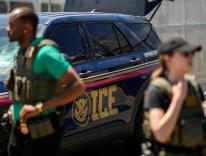
At least five U.S. Catholic bishops made public appearances last week to denounce the Trump administration’s immigration-enforcement operation, which has resulted in record numbers of people detained over the summer. A few others, and the U.S. bishops’ conference, released statements for the Vatican’s 112th World Day of Migrants and Refugees on Sunday, September 27. Those prophetic words from Church leaders come as the Trump administration has shifted its immigration-enforcement strategy from militarized invasions of cities to more insidious but equally aggressive tactics that include partnerships with local law-enforcement agencies. Immigrants with legal status or pending cases who have lived crime-free for decades in the United States are being rounded up like criminals, often without due process. Stephen Miller’s new target is migrant children.
Fittingly, the theme for the Church’s annual day of prayer and solidarity for migrants was “Even just one of these children,” referring to Jesus’ words in Matthew’s Gospel: “Whoever welcomes one such child in my name welcomes me.” Bishop Michael Pham of San Diego, who gained attention last year for showing up at his local courthouse to accompany migrants and asylum-seekers, urged the administration to stop detaining families and children, including unaccompanied children, and to cease family separation. Sending children to a country they have never known is “cruel,” and tearing parents from their children is “a moral stain on our great nation that is not easily removed,” Pham told a September 29 webinar sponsored by the Catholic Immigrant Prophetic Action Project, or Catholic IMMpact.
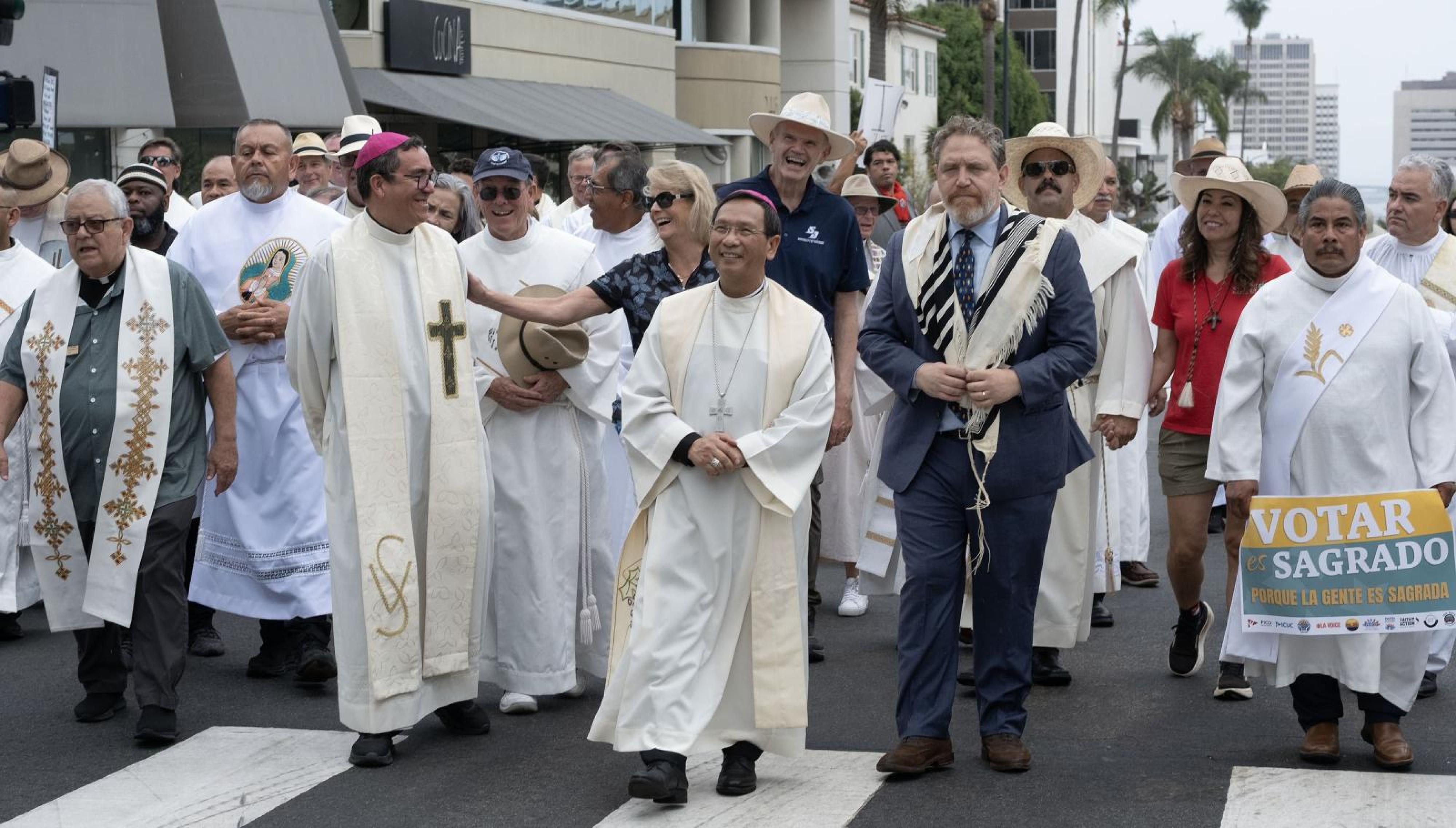
“In my view and the view of my fellow bishops, families must be kept together in our immigration system, regardless of their country of origin and their legal status,” he said. “From a Catholic perspective, it means that the family should be kept intact in the United States, with those who are undocumented members of the family being given a chance to regularize their legal status and earn their citizenship.” Two days earlier, Pham and Auxiliary Bishop Felipe Pulido led an interreligious procession of more than four thousand people around San Diego’s Balboa Park to proclaim “All are sacred” on World Day of Migrants and Refugees.
For Pham, the first U.S. bishop appointed by Pope Leo and the first Vietnamese-American to head a U.S. diocese, the issue of migration is personal. He fled Vietnam at the age of thirteen with his older sister and younger brother. “I know firsthand the fear and vulnerability that children who are torn away from their families and homeland feel,” he said. “At the same time, I also feel the gratitude from a nation welcoming me and providing me the support to find safety and opportunity—and the chance to become a U.S. citizen. It is why I feel strongly about the protection of migrant children, who are the most vulnerable of persons on the move, especially during this time of heightened enforcement in our country.”
Recent reports of children without legal representation being grilled by immigration judges have been chilling. Only one in four migrants, including unaccompanied children, had an attorney to assist them in court in August, according to the latest court data. That same month, there were more than fifty thousand arrests, with 70 percent of those detained never convicted of a crime. Even those with arrest records are often guilty of minor offenses such as traffic violations. Meanwhile, the number of individuals receiving asylum has fallen, with 94 percent of asylum cases denied in June—less than a quarter of the cases granted asylum three years ago.
Catholic IMMpact, a partnership between Hope Border Institute and the Center for Migration Studies of New York, has been conducting trainings around the country to educate ministers and leaders about Church teaching on migration and best practices for accompanying those affected by the mass-deportation policies. As part of a regional training hosted by the Diocese of Knoxville, Tennessee, and the Diocese of Lexington, Kentucky, bishops of both dioceses spoke forcefully against the current administration’s tactics and policies at a September 30 press conference outside the Knoxville cathedral. They were joined by Bishop Brian Lee Cole of the Episcopal Diocese of East Tennessee.
The Church “must be very clear and unambiguous at this time,” said Bishop John Stowe of Lexington. “Migrants and refugees are not an issue, are not a problem to be solved and a population to be managed. They are members of the one, human family. And Jesus makes it clear that he identifies with them.” He also countered the political rhetoric about migrants: “Immigrants and refugees are not criminals; they are not a drain on society. They built this country; they feed this country, they bury their dead in this country, and raise their children beneath the American flag. They worship in it, alongside the rest of us, every single Sunday.”
The key to fixing the immigration system, he said, was to recognize the dignity and basic human rights of every person. “We are not naive about the complexity of immigration policy, but we know the simple truth that complexity is not an excuse for cruelty,” he said. “Our migrant brothers and sisters have suffered enough. It’s time to end the cruelty. We won’t soften that message. We’ll keep saying it, because the Gospel calls us to mercy and justice.”
Bishop James Mark Beckman said he felt a “special obligation” to the Spanish-speaking members of his community who are suffering, since they welcomed him so warmly as bishop of East Tennessee. “We have a responsibility to care for the dignity of each and every human person and respect the rights and due process that are due to citizens and anyone who lives on U.S. soil,” he said at the press conference. “So today, let’s work together to build a world where everyone has a home.”
In the nation’s capital, Cardinal Robert McElroy urged Catholics to stop ignoring immigrants who are being unfairly targeted by the government. “For us as a nation, we can pass by no more,” he said, reflecting on the parable of the Good Samaritan during his homily for the World Day of Migrants and Refugees. “We must stop, recognize the evil that is being carried out in our name, and fight every dimension of it. We must seek to convert our political representatives from tolerating this evil or replace them.”
Before the Mass, a multilingual rosary was prayed in English, Spanish, Tagalog, Amharic, and Haitian Creole. In his remarks before the rosary, Auxiliary Bishop Robert Boxie noted that Jesus, Mary, and Joseph were refugees and thanked people for their support of their migrant brothers and sisters. “We keep in our hearts and prayers those who live in constant fear of detention and deportation,” he said. Auxiliary Bishop Juan Esposito and retired Auxiliary Bishop Roy Campbell Jr. also concelebrated the Mass.
This week, Cardinal Blase Cupich of Chicago celebrated Mass at a daylong teach-in focused on solidarity with migrants and refugees, telling attendees that advocacy for immigrants is “in its truest sense, an act of divine worship.” “We cannot pretend to worship God while remaining indifferent to the stranger,” he said, “because the God we worship is the God of justice who sets the displaced free.” And the Archdiocese of St. Louis, headed by Archbishop Mitchell Rozanski, filed a lawsuit against the federal government this week, alleging that detainees at an immigration facility in Missouri are being deprived of their right to receive the sacraments—becoming the first Catholic diocese (though not the first Catholic organization) to take to the courts to protect detainees’ religious liberty.
As courageous and inspirational as these individual bishops’ words and actions are, they represent a minority of the more than four hundred active and retired prelates in the United States. The last time the bishops met as a group for their fall plenary, in November 2025, they released a special message that raised concerns about Trump’s mass deportations. Widely praised as a rare example of unity among the usually divided conference, it was nonetheless measured and somewhat cautious. Since then, individual bishops and some small groups of prelates, from across the ideological spectrum, have continued to speak out. Just weeks from their November meeting, the agenda has not yet been released, although Archbishop Mitchell Rozanski of St. Louis has said the issue “will certainly be a major topic.”
We welcome your comments about this article. Please send your response to [email protected].