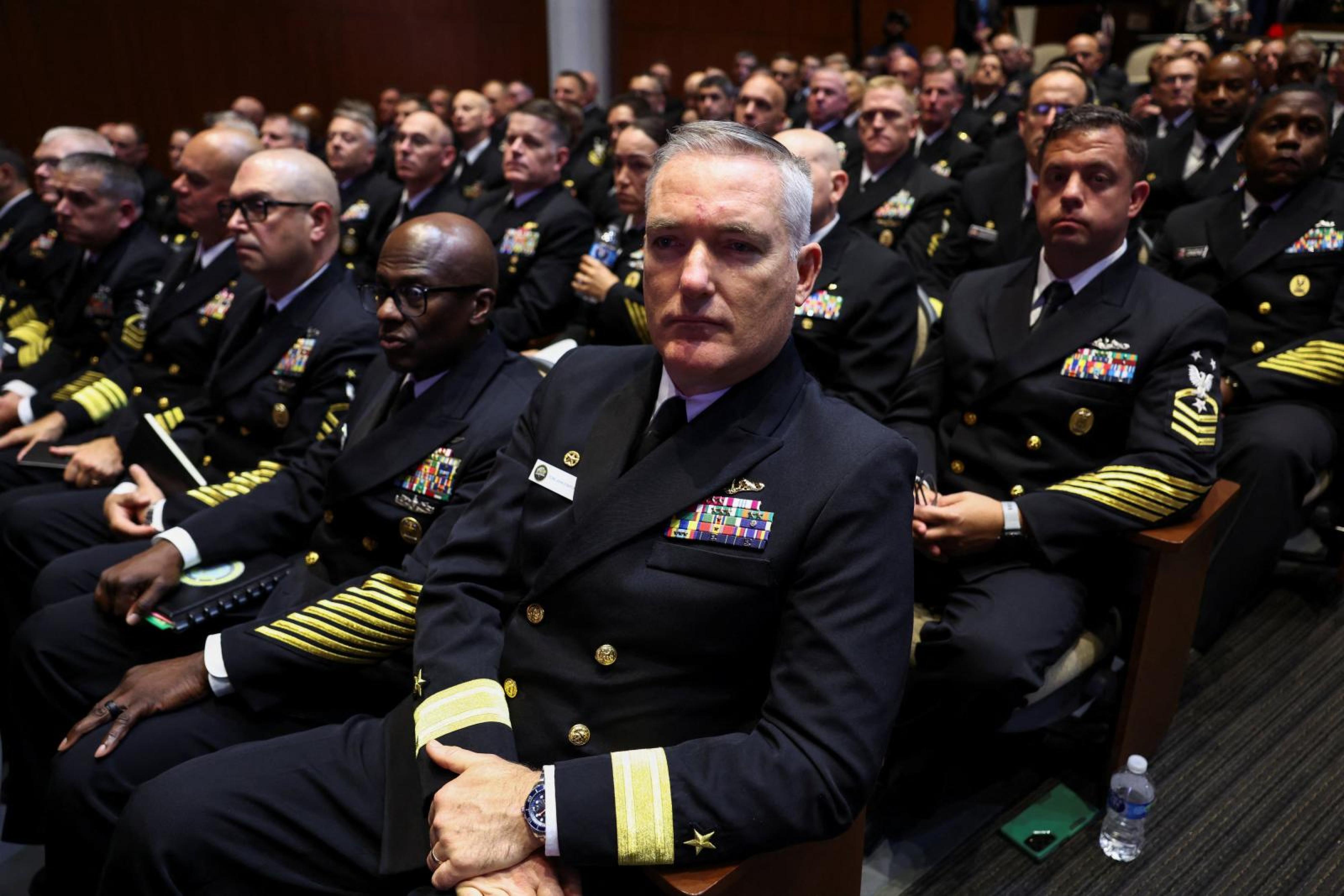
President Trump is playing Russian roulette with the world—waging hot war on Iran, legal and bureaucratic war on a free press, and generally treating allies as if they were enemies and enemies as if they were allies. At the same time, he has been playing a deadly game with the one institution that, he boasts, gives him the ability to act as he pleases: the American military. Since retaking office, he and Secretary of Defense Pete Hegseth have repeatedly jolted the armed forces by firing more than two dozen senior officers and officials, among them six four-star generals or admirals. In a boorish speech delivered at Marine Corps Base Quantico on September 30, Hegseth announced further imminent cuts amounting to a fifth of the top ranks, saying the administration wanted “no fatties, no trannies, no beardos, no weirdos, no wimps, no radicals—just warriors.”
Since it began in February 2025, the ongoing purge has elicited protests even among MAGA loyalists. Upon resigning his post at the end of August, Secretary of the Army Dan Driscoll is reported to have voiced “concerns with the administration surrounding Army transformation and readiness and Hegseth’s blocking those efforts specifically by firing the generals who were responsible.” Among the victims are Gen. Charles “C.Q.” Brown Jr., the second African American Chairman of the Joint Chiefs of Staff; Adm. Lisa Franchetti, the first woman to lead the Navy; Adm. Linda Fagan, the Commandant of the Coast Guard; Gen. Randy George, the Army Chief of Staff; and Gen. Christopher Donahue, who is revered as the last American soldier to leave Afghanistan in that chaotic and traumatic withdrawal of August 2021. The top lawyers for the Army, Navy, and Air Force were all removed in one sweep. Also targeting the middle ranks of the military hierarchy, Hegseth has blocked numerous promotions of officers who had sterling records and were due to move up.
While his role as commander-in-chief gives Trump broad latitude over personnel, the relentless purge has been condemned by the president’s opponents as a shameless attempt to politicize a traditionally apolitical institution. The military’s sole purpose is supposed to be national defense, and its proud ethos is one of selfless service to the country, not a cult of personality. Reasons for the removal of specific individuals are rarely given, yet it is widely understood that Trump and Hegseth are punishing targets for suspected disloyalty, support for diversity, service under already purged officers, or simply being Black or female.
These motives are consistent with the basic culture of the administration, as restated by Hegseth at Quantico. It holds that a “woke” emphasis on diversity, equity, and inclusion has weakened morale, and that military lawyers’ mandated role—as watchdogs charged with ensuring that everyone abides by the Uniform Code of Military Justice—hinders soldiers in battle. The secretary of defense’s answer to centuries of battle-learned tradition about the laws of war is his slogan, “Maximum lethality, not tepid legality. Violent effect, not politically correct.”
Listening to Hegseth, one could also conclude that there is no place for chaplains like Fr. Francis P. Duffy in the service. The legendary guardian angel of the Fighting 69th during World War I, Duffy opened his memoirs by stating “I am a very Irish, very Catholic, very American person, if anybody challenges my convictions. But normally and let alone, I am just plain human”—a remark favoring diversity in the armed forces if ever there was one.
As Iraq War veteran and award-winning author Phil Klay put it in a New York Times opinion essay right after Trump attacked Iran, “What these men don’t seem to realize, or care about, is that their language of brute force represents a fundamental break with American traditions around war going back to the Revolution.”
Despite the administration’s war on “wokeness,” the purge is a case study in MAGA political correctness. The real motive behind these actions, his critics charge, is to further Trump’s concentration of personal power. He and Hegseth are making political loyalty and ideological correctness, rather than purely professional qualifications, the criteria for holding positions of life-and-death responsibility. This could undermine military effectiveness and the rule of law, as well as democratic governance itself.
To justify the policies, Trump apologists have cited historical precedents like President Obama’s removal of Gen. Stanley McChrystal in Afghanistan, President Truman’s ouster of Gen. Douglas MacArthur in Korea, and Gen. George Marshall’s “plucking board,” which replaced a number of elderly generals on the eve of World War II. But those removals involved not loyalty or beliefs but issues of strategy, respect, and force readiness. And they did not include multiple indiscriminate firings at the highest level.
A more relevant—and more chilling—historical precedent is offered by Stalin’s military purges. In an extension of his “Great Purge” of the Soviet government and society that claimed hundreds of thousands of lives in the late 1930s, dictator Joseph Stalin set his sights on the Red Army, which stoked his paranoia for a number of reasons. Although its officers were all committed Communists, most were first and foremost military men, with a professional focus on modernization, innovation, and efficiency. They gave little thought to politics. It was this very quality that raised Stalin’s suspicions; he demanded that their primary focus should be personal loyalty to him. The fact that the institution had been founded by his defeated and exiled rival Leon Trotsky also consumed him.
The logic behind what followed—to the degree there was any—was set forth by Stalin’s henchman Vyacheslav Molotov in March 1937: “If we have wreckers in every branch of the economy, can we imagine that in one place alone, the War Department, there are none?” he thundered. “It will be examined very rigorously.” Mass arrests of almost the entire upper echelon of generals, colonels, and admirals followed, along with show trials where they were accused of being Trotskyists. Thousands of officers were executed or sent to Siberia, to be replaced with men whose chief qualification was the fervor they showed for Stalin’s cult of personality.
By the time the purges were over, the entire command structure of the Red Army had been severely disrupted; the most competent, skilled, and experienced officers had been eliminated; and, among the surviving officers, a climate of fear and dread crushed any will to engage in initiative or critical thinking. Having bled the Red Army white, Stalin thought he could evade the consequences of his folly by concluding a delusional nonaggression pact with Nazi Germany. Yet Adolf Hitler, knowing full well the eviscerated state of the armed forces to his east, attacked the Soviet Union in June 1941. His armies rolled over hundreds of thousands of square miles within weeks as a command-and-control structure that had been paralyzed by fear collapsed before the onslaught.
Trump’s purges are obviously nowhere near Stalin’s in their scope or brutality, but they similarly risk military preparedness. But, where Stalin tried to avoid war as he decimated his own ranks, Trump has launched a war of choice that has predictably failed. All this while the United States contends with numerous threats in a destabilized world—from Russian and Chinese aggression to Islamist terrorism. Trump’s evisceration of military leadership compounds problems like the depletion of missile stocks and low morale. A cruelly extended deployment led eight sailors in the USS Abraham Lincoln carrier strike group to attempt suicide.
To be sure, Trump is not Stalin, and the United States, a 250-year-old constitutional democracy, is not the Soviet Union. Yet sober military minds have warned of the danger of purges in any form: “Political interference in military leadership—especially dismissing generals and admirals based on ideological loyalty rather than competence—has repeatedly led to disastrous consequences,” retired Army Lt. Gen. Mark Hertling wrote in The Bulwark after the first round of firings. “Whether driven by paranoia, sectarianism, or a desire for greater personal control, politically motivated purges have a history of weakening armies, undermining national security, and, in the worst cases, leading to battlefield defeat.”
Fr. Duffy famously said that “men pass away, but institutions survive.” American institutions and the spirit that infuses them constitute the very identity of the nation going back to its founding in the Revolution. Along with our safety and that of our troops, it is that identity the Trump administration is currently putting in jeopardy.
We welcome your comments about this article. Please send your response to [email protected].