In his speech at the World Economic Forum in Davos in January 2026, Canadian prime minister Mark Carney referenced Czech dissident and former president Václav Havel and his 1978 essay The Power of the Powerless. Carney cited Havel’s story about a greengrocer who puts up a communist slogan (“Workers of the world, unite!”) in his shop window every day—not out of belief, but to avoid any trouble with the Party. Carney argued that the rules-based international order had become a “partially false” system sustained by performance. He called on middle powers and nations to “take their signs down,” stop living inside a lie, and find a new way forward amid shifting global dynamics.
Around that time, I made my first visit to Prague. I returned in October as a speaker at the annual Forum 2000 Conference, first held in 1996 as a joint initiative of Václav Havel, Japanese philanthropist Yohei Sasakawa, and Nobel Peace Prize laureate Elie Wiesel. The title of this year’s conference was “Reimagining the Power of the Powerless.” About five hundred participants (politicians, diplomats, activists, dissidents, journalists, and others) from some one hundred countries attended. Many were young activists from Asia, Africa, Latin America, and Central and Eastern Europe. For security reasons, the conference’s location was some years ago moved from the old city to a Communist-era conference center in Vyšehrad, on the right bank of the Vltava River in Prague—the better to protect not just luminaries (including, this year, Lech Wałęsa and the president of the Dominican Republic, Luis Rodolfo Abinader Corona) but also, this year, pro-democracy and human-rights activists from Tibet, Myanmar, and Belarus. The Forum 2000’s International Award for Courage and Responsibility was presented, in the opening ceremony, to the General Strike Coordination Body, along with three Burmese dissidents opposed to the military junta ruling Myanmar, one of whom faces a thirty-seven-year sentence for organizing a peaceful rally. Myanmar is one of the world’s leading suppliers of heavy rare-earth elements, which has led many countries to normalize relations with its oppressive junta government.
The mood this year was more somber than at previous gatherings, other participants told me. Several speakers acknowledged that the global fight against authoritarianism is only growing more challenging. There are fewer success stories to tell. The 2026 annual report on political rights and civil liberties from Freedom House tracked twenty consecutive years of decline in global freedom and noted the “growing shadow of autocracy,” with an increase in the number of authoritarian governments and greater repression worldwide. In 2027, presidential and parliamentary elections will take place in France, while parliamentary votes will be held in Estonia, Finland, Greece, Italy, Poland, Slovakia, and Spain. Populist and radical-right parties are expected to do well in many of those elections.
Panel discussions focused on the two main bad actors: Russia and China. There was a strong sense of empathy and support for Ukraine, given both its proximity (geographical and emotional) to Prague, and the history of the Soviet Union’s oppression of Czechoslovakia during the Cold War. Speakers from Ukraine and other European nations stressed the necessity of Russia’s withdrawal from the country and of strengthening democratic institutions in Europe by bolstering NATO and its defense capabilities. (During a lunch break, I overheard a group of young Czechs discussing what to pack in an emergency bag in case of invasion or attack.)
There was also a sense of ambivalence about the current posture of the United States. Though almost every democracy activist present expressed disgust with Donald Trump, they all know that few can risk losing the United States as a partner. Breaking up with America is something pro-Taiwan and pro-Tibet activists simply cannot afford. And the reliability of the U.S. was something Europe (especially Eastern Europe) never had to doubt. The efforts of Havel, Wiesel, and other founding members of Forum 2000 depended politically and morally on American leadership to shape a post–World War II international order that secured peace, protected democracy, and supported civil and political rights. Now, they have to live with the fact that Trump is openly supportive of Russia and Vladimir Putin and infatuated with other strongmen around the world.
This is a stark change from twenty years ago. One of the video messages played at the conference was from former president George W. Bush. Some of the participants were perplexed: How could the last Republican president before Trump be seen aligned with the mission and spirit of Forum 2000? Is it even possible to imagine a future in which the United States plays a role in fostering global democracy once Trump is gone? Is the damage irreversible? (One of Havel’s great friends and a supporter of Forum 2000 was Prague-born U.S. secretary of state Madeleine Albright, who in 1998 famously coined the definition of America as the “indispensable nation.” But right around the same time as the October meeting, other officials were gathered at the Warsaw Security Forum, where attendees received a sobering view from U.S. participants about the future of the transatlantic relationship. Democratic congressman Jim Himes warned that Europe shouldn’t delude itself into thinking that all will return to normal after Trump.)
Panels on Latin America also made frequent reference to the topic of American foreign policy and how the results of the November midterm elections might affect Venezuela, Cuba, the Dominican Republic, and Haiti. There was relatively little discussion about the U.S.-Israeli war on Iran, Israel’s actions in Gaza and the West Bank, or the overall situation in the Middle East; the issue of antisemitism was touched on only tangentially.
Receiving more attention was the issue of migration, thanks in part to the growing number of activists attending from the Global South. Prominent European speakers emphasized the need to think about immigration policy and border control in a way that would challenge xenophobic populism. It’s a tricky proposition: the old continent’s liberals find themselves stuck between an American-style civic nationalism—open to birthright citizenship, seeing immigration as necessary to a healthy economy—and the stark reality of anti-immigration sentiment in many European countries.
Technology was also on the agenda, including the role of ubiquitous surveillance technology in suppressing democracy and building autocracies and the need to monitor the global state of authoritarianism. Those topics have resonance in a place like Prague, where there are numerous landmarks to past systems of repression, whether from the Nazi occupation or the long era of Soviet control. There was also consensus about the need to govern artificial intelligence. A highlight of the conference was the interview of Israeli historian and science writer Yuval Noah Harari conducted by Robert Guest, deputy editor of The Economist. Harari sounded clear alarms about the role of AI in the breakdown of trust in democratic institutions, as well as AI applications that seek to eliminate authentic human interactions and take control of our attention. He emphasized the need for regulation. He also nodded to the Catholic Church and Pope Leo’s encyclical Magnifica humanitas as guides for how to deal with AI.
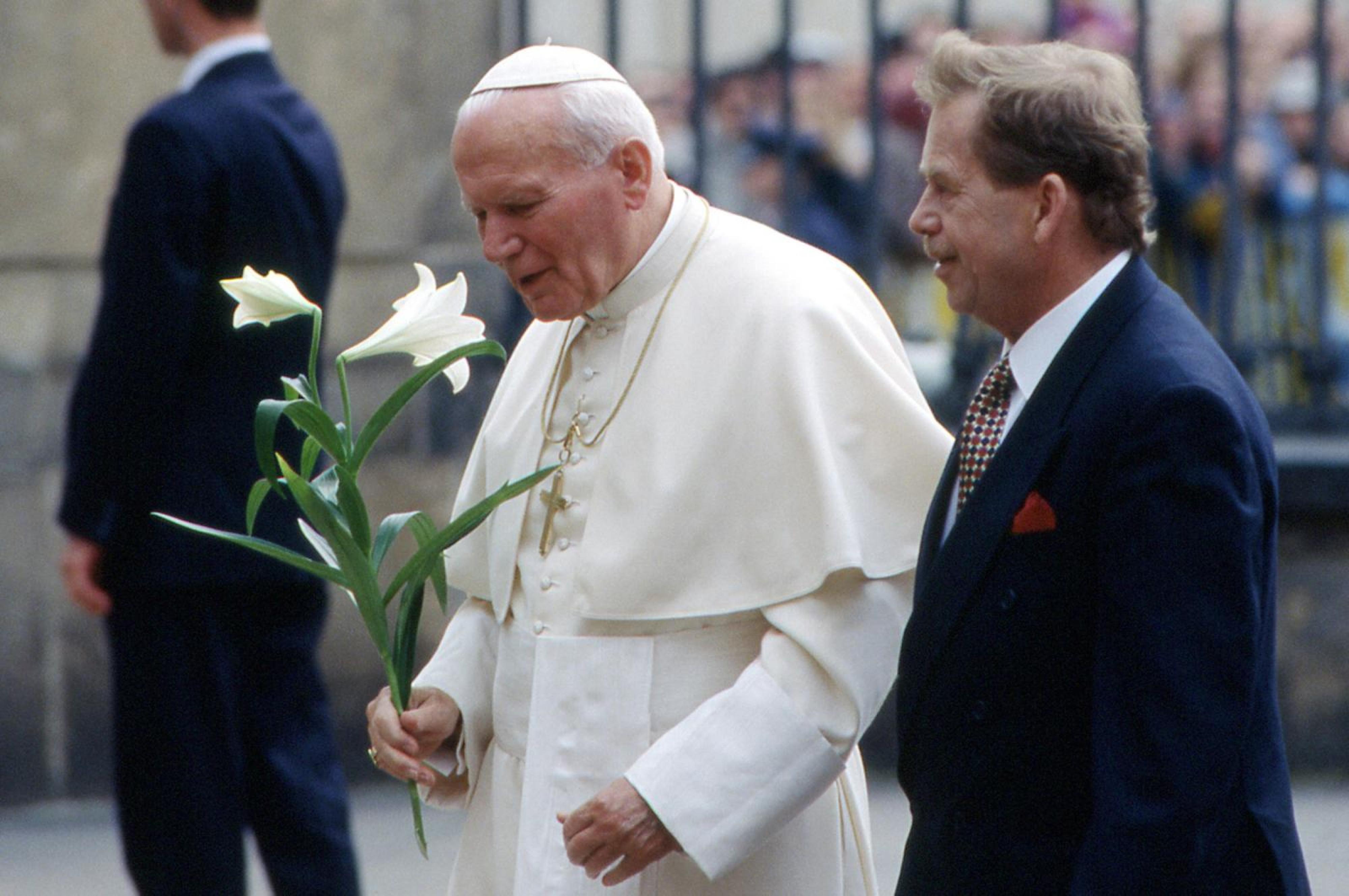
This struck me as interesting, given that post–Cold War liberalism has always been uncertain about the contribution of religious traditions, and of the Catholic Church specifically, in supporting democracy and human rights. But beginning with the pontificate of Francis and continuing into Leo’s, the potential power of the Church’s voice in supporting anti-authoritarian movements is becoming clearer. Grace Davie, the noted sociology of religion scholar, and Carl Gershman, founding president of the National Endowment for Democracy, both called for future Forum 2000 conferences to devote more attention to the role that spiritual and religious traditions can play in pro-democratic and anti-authoritarian activism. This would be consistent with the vision of Havel—a homo religiosus (“religious man”), in the words of Polish dissident and intellectual Adam Michnik. Havel viewed the political and social crises of the modern era as fundamentally spiritual and metaphysical rather than as purely structural or economic. That combination of the spiritual and philosophical in underpinning democratic society finds powerful symbolic expression in the sacristy of the chapel of Prague’s University Church in Klementinum, where a photo of Havel is prominently displayed at the same height as that of the pope. It should also be recalled that one of Havel’s external advisers after the 1989 Velvet Revolution was Fr. Tomáš Halík, now one of the most influential voices in European Catholicism.
Given the secularization of Europe and the de-Europeanization of Christianity (and Judaism), the question is how some of the basic tenets that helped align religion and democratic freedom in the Vatican II era can be restored. Next year is the fiftieth anniversary of Charta 77, which emerged out of the 1975 Helsinki Accords—where the Holy See made one of its most effective contributions in fighting totalitarianism and reconciling democracy and human rights. Havel was one of the primary authors and leading advocates of Charta 77. Helsinki remains a point of reference today, both for a Europe challenged by American complacency about Russia’s war in Ukraine and for Vatican diplomacy. With rising populisms exploiting cultural identity to propagate ethnonationalist narratives, the relationship between anti-authoritarian liberalism and religion requires rethinking. As in the Cold War, it seems that the Catholic Church and the Vatican could have a vital role to play—not just vis-à-vis America, Russia, and China, but also on the old continent itself. Still, there are complicating factors: the deep social and economic discontent roiling numerous countries, and how a less-Europe-centered Church can dialogue with a more secularized and multireligious Europe.
We welcome your comments about this article. Please send your response to [email protected].