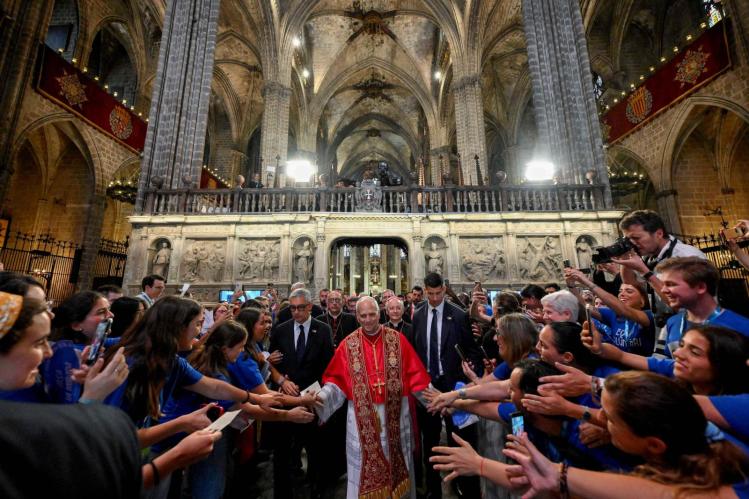
If the schedule imposed by the 2025 Jubilee made Pope Leo something of a “prisoner of the Vatican,” the first half of 2026 has provided much greater opportunity to travel. The summer promises more—namely, travel to key locations for the Church on the old continent. After returning from Spain, his first multiday European trip as pope, Leo headed for Sant’Angelo Lodigiano, Italy, the birthplace of St. Frances Cabrini, to be followed by Pavia, Italy, where the relics of St. Augustine are venerated. Then it’s on to Lampedusa on July 4, followed by Assisi on August 6 (for the eight-hundredth anniversary of the death of St. Francis); Rimini on August 22 (for the annual meeting of the Communion and Liberation movement); and, in late September, France.
The Spain trip carried a global message. Leo’s stops included Tenerife and Gran Canaria—symbols of Spain’s role in the migration of people from the Global South to Europe—as well as centers of Catholic Spain. For Leo, ever embodying Augustine’s realism, it was also an homage to Spanish Catholic culture: there was no evidence of contemptus mundi, the ascetic detachment from worldly matters, but rather an embrace of what he encountered.
Inevitably, the trip also carried some political messages. Leo’s seven days in Spain capped a six-month period marked by tensions with the Trump administration—an administration that Spain’s government has stood up to on a range of issues, from tariffs to the war the United States launched against Iran. But the situation is larger than Trump alone, indicative of Europe’s view in a potentially post-NATO world as it contemplates new relationships with China and India and faces threats from Putin’s Russia. Leo’s reconnection with Europe doesn’t employ the familiar language of “Christian roots,” but rather seeks to position the Catholic Church in opposition to neoimperial politics and the false, utopian promises of tech and AI leaders—situating what were once called “nonnegotiable” values (in regard to issues like sexual ethics, abortion, and gender) within a broader framework extendible to far-flung ideological horizons. We could hear this in Leo’s speech in Madrid, which exhibited both continuity and discontinuity with Benedict XVI’s 2011 speech to the Bundestag in Berlin:
It falls to me today to speak a calm and firm word to those who bear the grave responsibility of legally ordering social coexistence. This coexistence can be threatened by the throwaway culture, as Pope Francis so often warned (cf. Address to the Plenary Assembly of the Pontifical Academy for Life, 27 September 2021). In this sense, if life ceases to be recognized as a fundamental value, what future can our societies have? Can a community that casts into the shadows the unborn child, the elderly, the sick, those who suffer in silence, or those who depend entirely on the care of others be called fully just? The defense of human life is neither a partisan issue nor a confessional interest: it is a goal of civilization. Every human life must be recognized and safeguarded from conception to its natural end, in every circumstance of its existence. When this certainty is obscured, the most vulnerable are the first victims, and the law loses its deepest meaning: to serve and protect every person. For this reason, the moral greatness of a nation is manifested, above all, in its capacity to accompany, protect and love those lives that are most fragile.
Leo’s visit was also notable given the tensions in recent years over the sexual-abuse scandal. Political and media pressure for investigation and punishment has been much greater in Spain than in other European countries. Yet negotiations over the reparation agreement between the Church and the government didn’t overshadow the papal trip—a notable difference from Francis’s trips to Peru, Canada, Ireland, and Belgium. He received a seven-minute ovation even after framing the right of the Church to keep priest-penitent conversations confidential as a matter of freedom of religion, referencing the Helsinki Accords of 1975 (back then, a very important point in the fight against the oppression of the Church by Communism). The abuse crisis is still an open wound, and some victims and survivors remain skeptical. But Spanish politics and public opinion privileged the connection with the Vatican in this delicate moment for Europe; there seems to be trust in the new pope. Hours after the trip ended, the Vatican published new statutes for the Pontifical Commission for the Protection of Minors.
It was also clear from Leo’s remarks that the Church does not view Spain’s far-right Vox party favorably. The Spanish bishops had already expressed concerns about Vox directly to the Vatican during the past year, and Leo has demonstrated his intention to work with them and the country’s local churches (the next general election in Spain will be in May 2027). We will see more of this collaboration generally in the consistory of cardinals that Leo is holding at the end of June.
The trip revealed Leo’s focus on Europe’s central place in his vision of history: united in holding “social reality and history” together in their complexity, without fundamentalism or identity-driven narratives—including national ones. It’s a message aimed at both right-wing ethnocentric and nativist forces and leftist groups who issue blanket condemnations of the past. This was made clear in Leo’s June 6 speech in Madrid, where he met with Spain’s king and queen, civil authorities, and the diplomatic corps:
For the love of truth, I invite everyone to set aside the divisive and polarizing narratives of your societal reality and history, so as to overcome sterile simplifications through the fruitful appreciation of complexity. I see here a vocation particularly suited to Europe, in which Spain plays a unique and fundamental role. This is the gift that the “Old Continent” can offer the world if it wishes to remain young, for youth is found in those who feel they have a future and a mission that still have meaning. Appreciating and studying complexity, learning not to deny it but to embrace it as a blessing, and fleeing from identity-based approaches that seem to explain everything yet only fill the world with “ghosts” and enemies are the tasks of those who are heirs of a great history.
The Vatican has long seen European countries as guardians of multilateralism and bridges for reconciliation, and Leo expressed gratitude to Spain “for its faithful adherence to international law and multilateralism, which is reflected in an active commitment to peace and solidarity among peoples.” This multilateralism is important not only in international relations but also in the complex and conflicted realm of global Catholicism. Leo values peace and order, and Europe today has something to contribute to this Pax Vaticana that is much different from the Pax Americana put before Europe by J. D. Vance and Marco Rubio in the last eighteen months.
Leo also obviously differs from the U.S. administration on immigration. In Spain, he sent unequivocal signals of support for the plight of migrants and issued stern warnings about God’s judgment to the traffickers. But his appeal to the social doctrine of the Church was nuanced and bidirectional:
Integration does not mean erasing the history of those who arrive or demanding that they leave behind everything that is part of their memory. Nor does it mean creating parallel worlds, closed off from one another, where people live side by side without truly encountering one another. Integration is a reciprocal journey: those who arrive learn to inhabit a new land, and those who welcome them learn to expand their own homes without diluting their identity or closing their hearts to the encounter. To you, dear migrant brothers and sisters, a noble and necessary part of this journey belongs: to open yourselves with trust to the community that welcomes you, to learn its language, to respect its laws, to get to know its customs, to participate in communal life and to offer your gifts with gratitude.
He called for legal migration and integration, yet also noted the risks migrants face in pursuing “dreams that no one has the right to despise.” “Do not believe those who promise easy paradises in exchange for your body, money, silence or freedom,” he said. “Those false promises are ‘siren songs’; they are industries of death.” At the same time, Leo XIV reminded Catholics that a Catholic stance in support of migrants cannot be separated from evangelization and the Gospel:
I would like to ask Catholics for something else: that integration not be reduced to a social undertaking, however necessary that may be. Those who come to our parishes need bread, shelter, language assistance, work and protection. They also must find a community capable of offering paths to knowing Jesus Christ through the witness of life and word, while always respecting the conscience and freedom of each person. Evangelization is sharing, with respect and humility, the treasure that sustains our action and our hope. A Church that welcomes is also a Church that proclaims, offering Christ without imposing him and which, at the same time, receives the Gospel from the hands of the poor.
Some papal journeys have ushered in new eras, such as John Paul II’s trip to Poland in 1979 or to Denver in 1993. We don’t yet know whether Leo’s trip to Spain and his upcoming European visits will fall into this category. (The European reaction and the trajectory of this papacy will also depend on what happens in the United States in the coming months.) But compared to Francis—who studied for brief periods in Europe but limited his travels on the continent as pope, never visiting Spain—Leo XIV from Chicago definitely has Europe on his map. While it may no longer be the center of the world, it’s still the connection between the Americas, Africa, Asia, and the Middle East. Leo seems to recognize this: his trip to Spain was in part a request for Europe’s help, but also an offer of his own.
We welcome your comments about this article. Please send your response to [email protected].