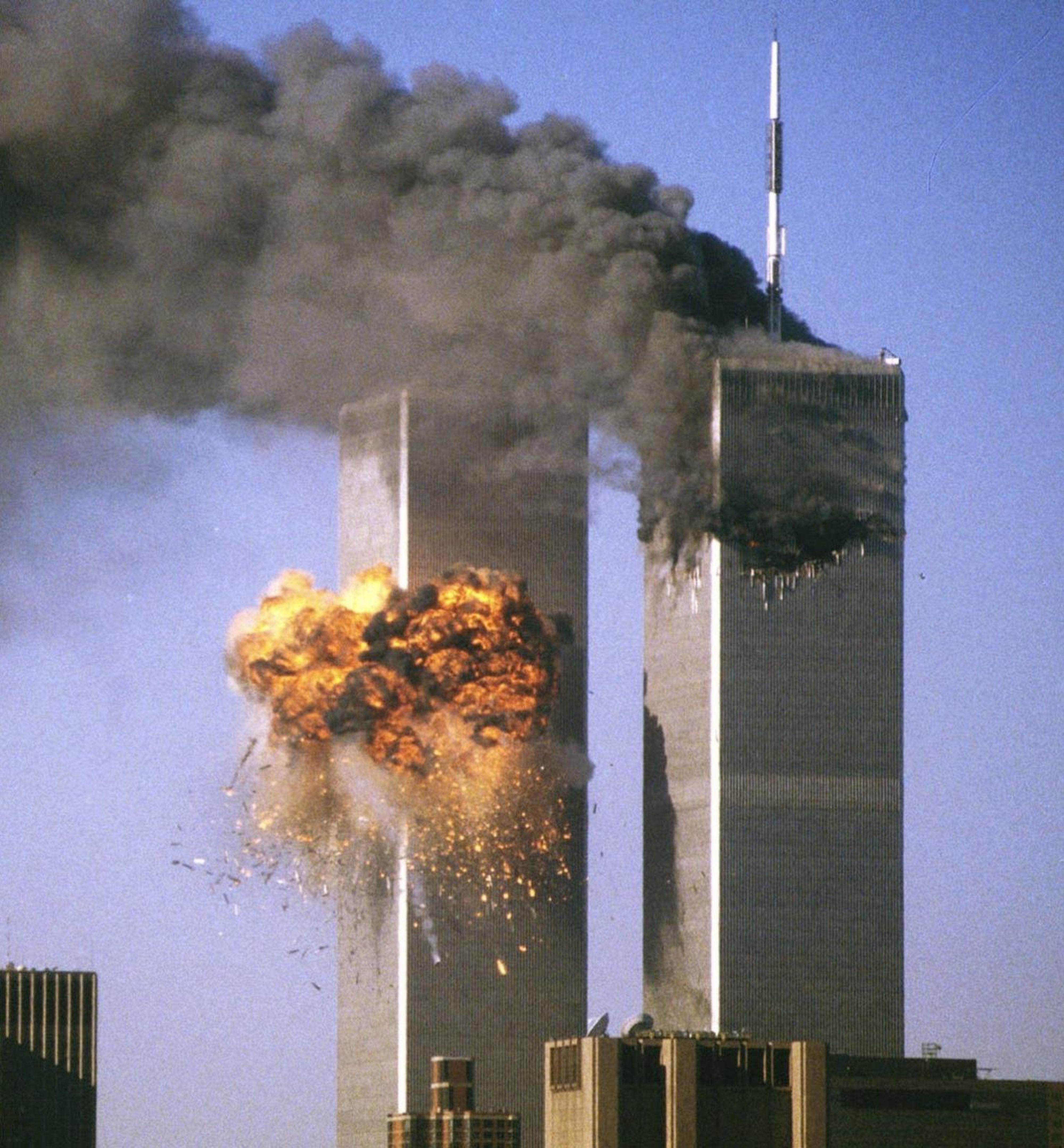
At 8:45 on the morning of September 11, 2001, I was alone in my office on the thirty-first floor of the midtown Manhattan building I commuted to every day from Brooklyn. I was starting up my computer when something cast a brief fluttering shadow over the desk and carpeting. My first thought was birds, though that seemed strange; I had never seen birds up here before, this high. The building itself was set at an angle to the cross-streets, East Thirty-Third and Park Avenue South, so that from my window there was a clear, unobstructed view southeast along the East River to the Manhattan and Brooklyn Bridges, and downtown to the towers of the World Trade Center. They dominated the sky, and by habit that’s where my eyes went, looking for a glimpse of whatever had passed in front of the bright late-summer sun. Inexplicably, there was a wedge-shaped gash in the north tower. I searched the still-quiet floor looking for someone who might be able to confirm what I was seeing. The woman I brought back to my window acknowledged what by then was a gaping hole ringed in wispy orange flame.
Around 9 a.m., coworkers began to arrive. Some gathered in my office to watch the now billowing smoke and theorize about the cause—a transformer explosion, a small plane—when a fireball erupted from the south tower. Obviously, something else was happening. A radio was turned on. Soon came reports about the Pentagon and a plane crash in Pennsylvania. For the next ninety minutes we stood at the window, about a dozen of us, watching the towers burn and then collapse. We decided to leave the building. Fighter jets screamed overhead as we crossed Midtown. Tanks rumbled along Fourteenth Street. After sheltering at a coworker’s apartment for the afternoon, fruitlessly trying to contact my wife on the overburdened landline phone network, I made my way back to Brooklyn on foot, joining the shocked, silent exodus across the Manhattan Bridge. The sky behind us was oily and black. It was dusk when I got to my neighborhood, where, downwind of the towers, the streets, trees, and stoops were coated in thick gray ash.
It’s been twenty-five years since the attacks of September 11. Within days, the date was being rendered as “9/11,” and soon the pair of “ones” became visual stand-ins for the towers—appearing in public murals, in the logos of victims’ advocacy and survivor-support groups, and outside local firehouses. The image was often accompanied by the words “never forget.” Those who experienced 9/11 surely haven’t forgotten; many, of course, still grieve to this day.
In the preface to her 2004 book Evil in Modern Thought: An Alternative History of Philosophy, Susan Neiman wrote that the attacks ensured the
nearly global perception that our ability to navigate the world was infinitely more precarious than it had been the day before.… For the first time in history, not space but time became shorthand. If naming a city—Lisbon or Auschwitz—was enough for earlier ages to record deepest shock and horror, the twenty-first century began by naming a date.
A quarter century after the attacks, half of the world’s current population is too young to remember them, as is a third of America’s. But the date remains indelible, and in various ways still casts its long shadow.
You might like: John Garvey on 9/11 and the Resurrection
It’s estimated that more than five hundred thousand people were in the exposure zone that day, including first responders, office workers, students, and residents. Dust from the towers has now been linked to multiple types of cancer and other illnesses, which have claimed far more lives than the attacks themselves—perhaps as many as nine thousand. Some fifty-two thousand more have been diagnosed with 9/11-related cancer. Ads for personal-injury attorneys offering help in accessing the federally funded Victim Compensation Fund, which has distributed more than $18 billion (including $1.5 billion in 2026), remain a staple on cable television. Former New York mayor Rudy Giuliani, whose national profile soared after 9/11, has been diagnosed with a 9/11-related restrictive airway disease, which exacerbated the case of viral pneumonia he suffered earlier this year. Newly released documents indicate that New Yorkers were misled about air quality in lower Manhattan for months after the World Trade Center was destroyed.
Could we have imagined then what else might follow as a result of the attacks? The passage of the Patriot Act in 2001, which vastly expanded the surveillance powers of the federal government and law-enforcement agencies. The establishment in 2003 of the sprawling Department of Homeland Security, which now seemingly exists solely to execute the Trump administration’s reckless and inhumane mass-deportation program, and which has cost U.S. taxpayers trillions of dollars over two decades (Trump is seeking another $118 billion for DHS in 2027). The so-called global war on terror, which included “legalization” of torture by the George W. Bush administration and its subsequent use by U.S. soldiers on detainees at Abu Ghraib in Iraq. The ongoing scandal of the Guantánamo Bay prison camp, where fifteen people—including alleged 9/11 mastermind Khalid Sheikh Mohammed—still await trial on terrorism charges after being held for more than two decades. (Under Guantánamo’s detention doctrine, according to The New York Times, the United States believes it can hold Mohammed forever, even without trial and conviction.) The directionless “forever wars” in Afghanistan and Iraq—enabled by Congress abdicating its war authorization powers—which cost the lives of untold numbers of innocent civilians and thousands of U.S. troops (with many more injured and traumatized), and helped Donald Trump, posing as an antiwar candidate, win the presidency. The degradation of our politics, the coarsening of public discourse, the attacks on democratic norms, the diminishment of America’s global standing, and the open corruption that have since marked Trump’s time in office—not to mention his own directionless war in Iran. Our ability to navigate the world seems to grow only more precarious over the years.
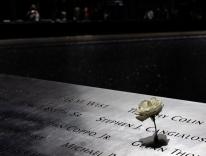
There have been numerous 9/11 memorial events in the runup to the anniversary. My diocesan paper even organized a walking pilgrimage consisting of stops “at several significant 9/11 memorials within Brooklyn” to mourn the lives lost and “share the stories of parishioners, students, families, and heroes affected by that day.” The highest-profile event will take place at the World Trade Center site, where, as in years past, the names of all of those who died will be read. It is meant to be a moment of unity. But Giuliani, twenty-five years removed from his heroics, has sought to ban current mayor Zohran Mamdani from attending the event. In a recent anti-Islam rant on Newsmax, he compared the Muslim mayor to Osama bin Laden and other terrorists. An online petition against Mamdani’s attendance has received more than one hundred thousand signatures.
Clearly, Islamophobia is another legacy of the attacks. Views of Muslims have become “more negative than they were immediately after 9/11,” according to Pew. Donald Trump—who in his 2016 campaign for president repeatedly lied about seeing “thousands of Muslims” celebrating the attacks and “dancing on rooftops”—will not be attending the New York event, though he has made his antipathy to Muslims abundantly apparent through both official and unofficial acts. In his place will be Vice President J. D. Vance, whose understanding of the world’s great religions can at times seem confused. He has downplayed the reality of Islamophobia in childish social-media posts about Mamdani, but lately he seems more preoccupied with Michigan’s Muslim senate candidate Abdul El-Sayed, calling him “very, very evil” and baselessly accusing him of “wanting to impose sharia law.” Back in 2001, as the World Trade Center site still smoldered, Giuliani, George W. Bush, and other Republican officeholders commendably reminded Americans not to condemn Muslims, with Bush pointedly stating that “the face of terror is not the true faith of Islam…. Islam is peace.” It was a fleeting moment, now recalled with something like doubt that it really happened.
Still, certain memories remain vivid—not just my view from the office or the walk home but the edgy, unsettled period afterward. This included, six months later, the sudden appearance in lower Manhattan of two ethereal, blue-tinged columns of light reaching toward the night sky. The Tribute in Light installation has since reappeared every year on the anniversary of 9/11 as a symbol of collective remembrance. From my Brooklyn street, just across the harbor from the site, it can loom as both an unwelcome reminder of the day and a foreboding presence in the void once occupied by the actual towers.
It has always been strange to look at from this angle—the opposite of my vantage high up in a midtown office on the morning of the attacks. There is the feeling not of history unfolding, but of falling helplessly back into it. It prompts thoughts of the lives lost, the regrettable choices made afterward, the seemingly obvious corrective courses that for some reason weren’t taken. Never forget the day, but also remember what has transpired in the days since.
We welcome your comments about this article. Please send your response to [email protected].