Vinayak Damodar Savarkar’s corpse was cremated on a warm Bombay afternoon in 1966. The eighty-three-year-old had starved himself to death. Up to three thousand uniformed teenagers in the paramilitary organization Rashtriya Swayamsevak Sangh, which was modeled after the Hitler Youth, surrounded their idol’s funeral pyre. Radical nationalism still sat on the fringe of Indian politics, commanding barely a dozen out of hundreds of members of parliament. The dead man himself had been a recluse since 1948, when one of his disciples murdered Mohandas Gandhi. Sixty years later, Indian prime minister Narendra Modi hails Savarkar—whom he refers to by the honorific Veer, or “brave”—as his chief intellectual influence. Janaki Bakhle’s Savarkar and the Making of Hindutva deftly explains the ideological foundations of this tectonic shift in the world’s largest democracy.
While Gandhi has been memorialized by countless biographers, Savarkar has received little Western attention. This is unfortunate. Western attempts to understand India remain mired in the idealism of a brighter era. Few understand the reality of Hindu nationalism and the depth of its separation from the Gandhian tradition. According to Bakhle, most Western scholarly writing on Savarkar “reads more like a Festschrift than a biography.” Bakhle’s own book offers a refreshingly critical eye. She wisely avoids the temptation to launch a polemic against Savarkar, and instead lets his errors speak for themselves. Bakhle’s command of Marathi, Savarkar’s mother tongue, allowed her to translate much of his work herself to understand “the full force of his prejudice.” She is able to deal with the breadth of Savarkar’s corpus, from poetry to polemic, not merely his Essentials of Hindutva, the focus of most other English-language scholarship.
Born in 1883, Savarkar grew up in the shadow of his elder brothers’ roles in anti-British revolutionary organizing in colonial India. He became a national hero at the age of twenty-seven when, arrested by the British for agitation, he attempted a miraculous escape from a Mediterranean prison ship. His daring earned him a prison cell in the faraway Andaman Islands and a secure place in the pantheon of Indian revolutionaries. While he was in prison, his writing gradually turned from an inclusive Indian patriotism toward an increasingly paranoid Hindu nationalism. Before prison, he had included Muslims and Hindus alike in a bold history of the Indian Mutiny of 1857, which he reimagined as a war of independence. After prison, his Essentials of Hindutva preached what Bakhle calls “steroidal rage” against India’s religious minorities, particularly Muslims. At one point, Savarkar bragged to American correspondent Tom Treanor that he regarded Indian Muslims “as a minority in the position of your Negroes.”
Bakhle argues that, after his release from prison in 1924, Savarkar became a “useful terrorist.” His advocacy for Indian independence was overshadowed by his hatred for minorities, and British authorities were all too happy to allow his writings to divide the independence movement. Yet, from the revolutionary movement of his youth, India’s freedom campaign had moved on to the nonviolence of Gandhi. Savarkar was obsessed with becoming a monumental figure of world history. Evidence adduced by Bakhle suggests that he ghostwrote the first biography of himself. When asked if he had ever read Marx, he replied by asking if Marx had ever read Savarkar. That wish for eminence would never be granted in his own lifetime. In his native Maharashtra, Savarkar is now remembered more for his opposition to the caste system than for his far-right politics. But Bakhle argues that Savarkar’s opposition emerged not from any principled commitment to equality but from a desire for sectional unity. Savarkar feared that Muslims’ emphasis on their lack of a caste system would seduce lower-caste Hindus toward Islam. He denounced “the disgrace resting on Brahmins for ceding their kingdom”—not for oppressing the lower castes.
Savarkar tried to reshape national memory by rewriting and radically simplifying Indian history. Though now Christian, I was raised in a strict Hindu family. In my youth, I was regaled with tales of Shivaji Maharaj, the seventeenth-century statesman who founded the Maratha Empire. In these tales, he figured as a liberator of India from Muslim occupation. The story came directly from Savarkar’s vituperative histories, which transformed Shivaji from a regional hero among the Marathi people to a national Hindu juggernaut. By the time he wrote his 1925 work Hindu Pad-Padashahi, Savarkar had turned all of Indian history into a Manichaean death-match between Hindus and Muslims.
This ideological “hijacking of history” was predicated on the assumption that, as Bakhle writes, “history was ultimately far more about the future than about the past.” Savarkar merged “history, poetry, and literature” to rally a militant Hindu community. Yet, Savarkar’s histories often distinguished themselves from typical nationalist broadsides by their willingness to engage in national criticism. He was willing, even eager, to denounce the alleged softness of India’s past leaders. When partition tore the British Raj in two, he cheered for the prospect of a less-Muslim India. Savarkar’s rage inspired a young Nathuram Godse to assassinate Mohandas Gandhi after the hero of independence fasted on behalf of Hindu and Muslim alike.
The dichotomy between Savarkar and Gandhi captures a tension at the heart of modern India. For all his religious nationalist pretensions, Savarkar was not a particularly observant Hindu. He practiced politics “under the guise of religion.” Gandhi, meanwhile, was genuinely devout and practiced his faith in peace. Bakhle argues that Savarkar’s literature placed “the figure of the nation” in the role of a goddess. Gandhi, meanwhile, offered ideals partially derived from his religion as a goal the nation could strive toward. While Gandhi offered his famous My Experiments with Truth, Savarkar felt no need to experiment with truth—he was convinced that he possessed it. Gandhi lived in public; Savarkar lurked in the shadows. Much of his obscure work was kept alive for decades by the cognoscenti of India’s far right. He became almost invisible to the Western-educated upper class that paid homage to Gandhi’s circle. He held on by establishing himself as a hero to the commoners of his native Maharashtra. Bakhle sees the strange dialectic as having led to “the enshrining of Savarkar as a secular God and of Gandhi as a national saint.”
Savarkar’s hatred extended beyond Muslims. In his view, Christians had “no permanent interest” in India. If they were expelled, they could be confident of finding a home elsewhere. A Hindu, to whom the land was sacred, could not survive forced exile. Savarkar’s few overtures to minorities were deceptive. Bakhle writes that he sought “exclusive focus on Hindu identity with the nation” and balked at the “slavish praise of Christianity” Gandhi offered in his defense of pacifism. He jeered at the success of the Catholic Church, describing the pope as a “toothless, ascetic, heirless, disarmed symbolic soldier.”
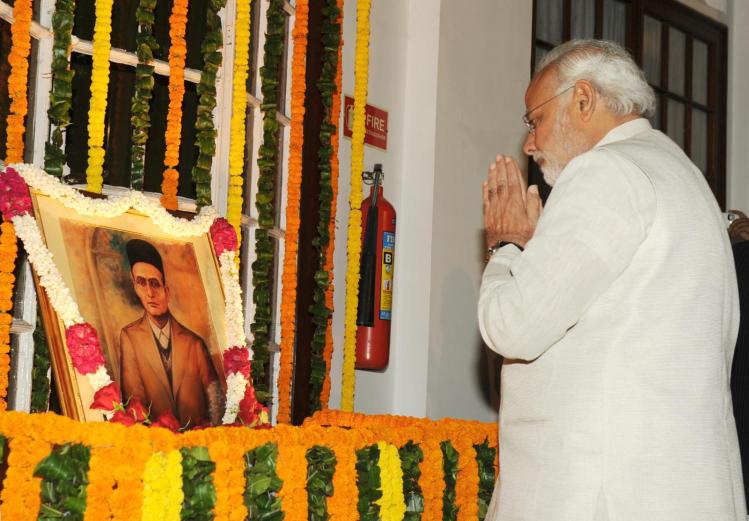
One of America’s most vocally Catholic politicians, Vice President J. D. Vance, celebrates Modi as a “great leader” and “special person.” Modi’s right-wing Bharatiya Janata Party, in power since 2014, can trace its political lineage directly to Savarkar. India’s rulers now venerate this reclusive radical as a past generation of Indian politicians once revered Gandhi. Modi holds Savarkar as “his muse, his greatest influence, his guiding star.” He and his followers are intent on replacing Gandhi with Savarkar as the preeminent national hero among the public at large. Bollywood, increasingly aligned with the Hindu hard right, rallied Modi’s voters weeks before national elections in 2024 with a hagiographical Savarkar biopic.
Savarkar’s last work, 1963’s Six Glorious Epochs of Indian History, depicted India as “a slumbering nation.” Held back by Muslims, Christians, and westernized liberal Hindus, India was in need of a great leader to reawaken its nationhood. Prime Minister Modi sees himself as that leader, sprung straight from Savarkar’s imagination, able to overturn Gandhi’s gospel of nonviolence and religious tolerance. For now, at least, Gandhi has lost, and Modi and Savarkar have won.
Savarkar and the Making of Hindutva
Janaki Bakhle
Princeton University Press
$29.95 | 520 pp.
We welcome your comments about this article. Please send your response to [email protected].