Like most countries, India has a National Building Code. It is an excellent document. Based on the principles of Universal Design, the code sets precise and exacting standards for safety, access, and public health. It is, in effect, the constitution for India’s construction industry, and compliance with it is mandatory for all new buildings, at least theoretically.
But the gulf between theory and practice is still wide. I recently attended a seminar on the National Building Code at which several participants were wheelchair users, one was blind, and another hard of hearing. One participant was inspired to attend by his wife, who is completely paralyzed. The meeting took place at a training center built by the Bureau of Indian Standards, but, amazingly, it didn’t conform to the National Building Code. No accessible washrooms, no designated spots for wheelchairs in the seminar room, no universal signage. Instead, in direct violation of the code, the floors were slippery, the lighting was poor, and the ramps were badly designed. The seats flipped closed before one was fully upright, and the acoustics were so bad that the hearing-impaired man needed to have almost everything repeated. The irony was staggering. This organization, after writing the actual book on non-negotiable standards for buildings in India, ignored most of them.
All of us were angry; none were surprised. To live in India means accepting risks and hazards the average American would find intolerable. My walk to work each morning includes crossing two streets in a relatively safe residential neighborhood. As my reflexes have gotten slower, this walk is increasingly stressful. Motorcycles, rickshaws, trucks, and buses speed by without concern for pedestrians (there are no sidewalks). Soon I will have to give up the exercise in favor of peace of mind. Disabled people with more serious impairments don’t get to make the choice—many feel imprisoned in their homes.
Access to public spaces—roads, schools, workplaces, parks—is fundamental to community participation. In the United States, wounded veterans returning from World War II refused to accept their disabled status quietly. They made demands for education, job training and—crucially—access. They began by requesting a very small thing: curb cuts in city sidewalks so their wheelchairs could access the sidewalk. City planners routinely denied such requests, saying, without irony, that they never saw disabled people on the streets, so why make provisions for them? The first documented instance of an official curb cut was in Kalamazoo, Michigan, in 1945. But one curb ramp couldn’t spark the kind of sweeping change that the problem demanded. Thirty years later, disabled activists got tired of pleading. In California, they literally took sledgehammers and broke curbs down themselves, then poured their own cement and created makeshift curb ramps. The time was right. As old systems were being questioned and movements for free speech, nonviolence, civil rights, and women’s emancipation gathered strength, the logic of accessibility took hold. Curb cuts became a standard feature of urban planning throughout the United States.
Life immediately became easier for everyone: parents pushing strollers, commuters and travelers with luggage, kids on skates, workers hauling equipment. Removing obstacles is just good design. Here in India, though enforcement was lacking, progressive disability groups and urban planners drafted regular updates to city and municipal codes around the country. By 2016, India’s National Building Code was updated to include universal design features and it has now become law in every state. The code, when followed, makes life much better for everyone. It helps you when you need to evacuate a building safely and quickly, or when you’re carrying groceries and have to open the door with your hip. It helps you when the floor is tiled with non-skid materials that keep you from slipping and falling. That last one you don’t even notice because it’s something that didn’t happen. That’s good design: unobtrusive, never in your face. You only notice it when it isn’t there.
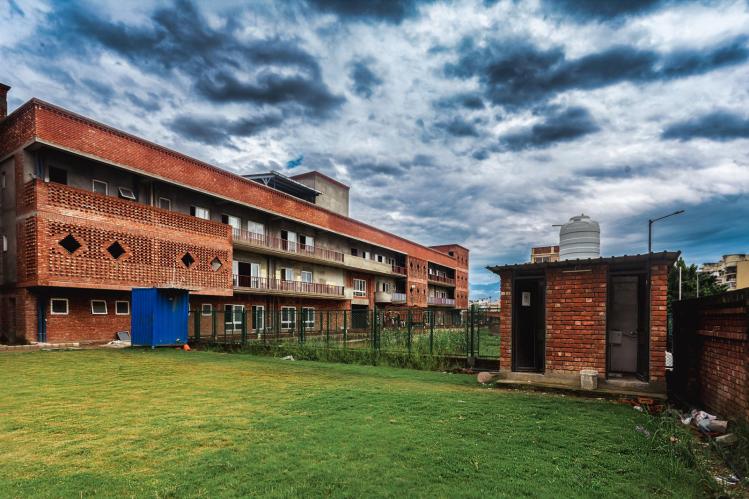
But good design goes further. When we intentionally plan and build for everyone, we find answers to questions we hadn’t even thought to ask. Latika, the organization for disabled children and adults I work with in India, is building a campus that experts believe will be the first in India to be constructed entirely on universal-design principles. We have embraced the National Building Code as a welcome guide to creating spaces that work for every single person. Doing so has given us new insights. Adhering scrupulously to the Building Code on worker safety, for example, we require everyone on the building site to wear helmets, reflective vests, and proper shoes. (On many Indian building sites, laborers not only have no gear, they come to work wearing flip-flops.) Since we visit the site often, we got helmets for ourselves, too. I’m ashamed to admit how long it took us to realize this same protection should be extended to the children for whom we are constructing this building, many of whom come to school every day on motorbikes. Not even one of them wore a helmet. They do now. We’ve made it a requirement of attendance at Latika. And it was the Building Code that made us realize it had to be done.
Ramps in India are mostly an embarrassment. Dangerously steep, they’re a waste of bricks and cement. Our ramp, built to the code’s requirement of a 1:20 slope, obviously costs money to construct correctly. Many use this fact to justify taking shortcuts or not providing a ramp at all. But their logic is flawed. It costs what it costs. No one would use the cost of indoor plumbing as an excuse for not providing it. Now that we’ve all experienced the comfort, convenience, and vastly improved public health it makes possible, it has become an essential feature of civilized living. Once ramps and other universal-design features become as common as flush toilets, we will build new expectations and routines around them; eventually, it will be difficult to imagine life without them.
Indeed, the combination of my experience as a frightened pedestrian and the sheer pleasure of walking on a well-designed ramp gave us the idea of offering the new campus as an ideal and safe place for our elderly neighbors to take their daily walks. Like malls in the United States, our “Strolling Seniors” club will open early in the morning before the children arrive and stay open after we close in the evening. The atrium that the ramp’s design creates in its center will become a kind of village piazza—a gathering place for families, neighbors, and friends to enjoy music, poetry readings, conversation, and crafts.
Following the code also made us discover small things—like the importance of placing light switches and lower counter spaces in kitchens and bathrooms so wheelchair users can reach them. It made us think about audio floor announcements in the elevators and flashing lights to alert deaf friends in case of an emergency. Perhaps the most innovative idea the National Building Code inspired was to open a beauty salon in the building. There is, of course, no direct connection between the code and hairstyling, but once you get into the habit of trying to make the world work for everyone, surprise opportunities keep appearing. We first thought of a salon as an in-house training ground for our young adults who may aspire to work in a hair parlor. Then we thought about how many of our young students, especially those with autism, find haircuts traumatic. We are now planning to train a professional beautician to work with them, with the hope that this will lower stress for them and their families.
That is the beauty of India’s National Building Code—or, really, any good discipline. Follow it to the letter, in the spirit in which it was written, and an entire country can be transformed. Laws talk to each other. Embedded in the building code are references to laws on child protection, workers’ rights, fire safety, environmental protection, and waste management. Taken in the right spirit, each of these supports and inspires new approaches to nation-building. Our new campus is being constructed in that spirit. The building code has not only provided clear guidance to help us achieve our vision of a world that works for everyone; it has also given us the imagination to find new ways of bringing that vision to life.