A Great Journey
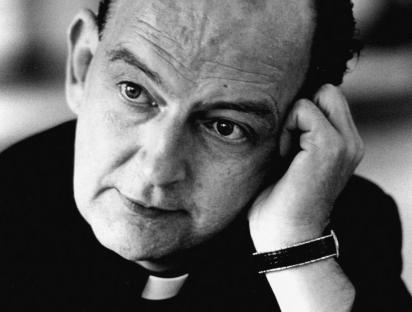
I have known Norah Duncan IV since around 1998, having sung in the Detroit Archdiocesan Chorus and other choirs under his direction. I have always been amazed by his God-given talent. The songs he composes are so easy to sing but rich in faith. His humor is legendary among those who sing in his choirs. We in his choir circle of friends have been greatly impressed with his latest composition, Journey. I was fortunate to be invited to sing in the choir for that impressive choral orchestral cantata this past year.
We are also looking forward to the recording being completed by Andrew Neer to be released under the Naxos label, which will bring this great work into the ears and minds of audiences around the world. I also envision Journey being taken to the stage in some manner—musical, opera? And those of us who have been a part of the Journey experience are hoping the Detroit Symphony Orchestra will ask Norah to conduct Journey at Orchestra Hall.
Aaron Robertson’s article (“The Amateur,” October) was excellent and in-depth, tying so much of Norah’s background and history together. Some of what he wrote about I did not know. I have thought on several occasions that someone should write Norah’s biography as a way of highlighting the musical history of the African American traditions in Detroit. Perhaps Robertson might be that person?
Donna Frentrup
Detroit, Mich.
*
Darkness as a Gift
Thanks for Timothy Schilling’s great article “The Wolf and the Shepherd” (September). I, too, sometimes struggle with various thoughts when I am awakened from sleep. I, too, pray various prayers, thank God for the good things, and ask for continued guidance for us all.
Schilling’s scriptural examples of darkness and light delighted me deeply. I am always in awe of the depth and messages that each word or verse offers us. Even the darkness is a “gift.” So, when I find myself unable to sleep, I will trust that somehow there is a “gift” there for me, and our loving God will help me discover it in time.
For the past twenty-eight years, I had the privilege of working in the catechetical office of the Diocese of Victoria. In my early years, Commonweal was recommended to me by the bishop. Now that I am retired, I look forward to the emails and the articles.
Christella Alvarez
Victoria, Tex.
*
Didymus vs. Thomas
In his otherwise excellent review of Peter Ackroyd’s new biography of W. H. Auden (“Civil Style,” September), Gus Mitchell writes of Auden’s pseudonym for several articles appearing in Commonweal that Didymus is “Aramaic for ‘twin’ and the nickname of the Apostle Thomas.” Actually, Didymus, as transliterated, is a Greek, not Aramaic, word (Δίδυμος) for twin. It is the apostle’s name “Thomas” that is of Aramaic origin, and it, too, of course, means twin. As a native Tom who has thought a lot about the Biblical heritage of doubt in the popular Christian name, I have come to realize over the years that doubt and faith are, in fact, twins. It’s hard to have one without the other. This may have been the attraction for Auden, who was always alert to the existence and influence of opposites in human nature and human experience.
Thomas S. Clemmons
Pawling, N.Y.
*
Heavy Burdens
I very much admire Cathleen Kaveny and appreciated her article “The Importance of Being a Burden” (September 2026). Caring for others is a natural part of life for Catholics. As Kaveny points out, learning to be a burden is also an important part of our Christian journey.
Placing this idea—of being willing to be a burden—within the context of end-of-life issues is complicated in our modern era, though. There are so many ways to extend life that “a natural death” can be eluded for a very long time: Do we even know what a “natural death” is anymore? I agree that assisted suicide is not the solution to this dilemma, yet I believe the idea of saving life at all costs is also flawed.
What of the elderly dementia patient who contracts pneumonia? Given only comfort care, this patient would likely die. Is giving life-sustaining treatment in this situation appropriate from our Catholic perspective, when one could make the argument that such treatments do not really sustain life, but rather postpone death—long past the point where a natural death would have occurred?
The burden of caring can be heavy enough to break families. I suspect that is something those women in Kaveny’s lecture understood: now that our bodies can be kept alive beyond the point of natural endurance, the burden of caring for the soul housed within can become very heavy indeed. A medical system focused on life-sustaining procedures can obscure the dignity of the dying. Opting out of medical treatments can preserve the dignity of the patient. Without this dignity, some may choose to end their lives, rather than have their care become a burden heavy enough to fracture their families.
How can our Catholic faith help us navigate the questions which might arise in our later years, so that we may be burdens without feeling we have become burdensome?
Holly Wiegman
Wakefield, R.I.
*
Grief Is for the Living
Jonathan Heaps’s article (“Conquering Death,” September) brought back memories. My son Brian died in January 1992, a few weeks past his seventeenth birthday. He was in a car accident on a Friday night, and on Monday he was an organ donor.
My mom was still alive, a widow, age seventy-six. My dad had died two years earlier. We lived in Middletown, New Jersey, and mom was in Ozone Park, Queens, New York. I would visit her often over the next few years before dementia forced a move to assisted living.
In those early months of 1992, she and I would sit at her kitchen table and share coffee and cake and talk about my dad and my son. During one of those visits, she told me about the child she had between my older brother and me. It was 1942. She recalled every moment of the stillbirth of “Michael” at a Brooklyn hospital. The most painful part was being in a ward with other women whose babies had lived.
I can’t and won’t blame God for my son Brian’s death. It was an accident. God was there for us in the friends and family who were there for us: my brother- and sister-in-law, friends at work, a woman whom we just met, the father of Brian’s friend who drove six hours to pick up the new varsity football jacket that he wore in the casket.
Brian’s death led me to learn more about grief and provide grief support at my parishes.
Somewhere I learned that “the dead don’t grieve,” that grief is for the folks who are left behind. Let me add, my wife and I had the same feelings Heaps had about our newborns back in ’68 and ’75. One is still with us, and the other is out there with his grandparents and cousins.
Paul Brustowicz
Summerville, S.C.