When I was young, I fell asleep as soon as my head hit the pillow. The next thing I knew, it was morning. A friend once told me, “That’s a blessing.” Now I am older and on most nights I wake at some point. I may lie awake just briefly or for as long as an hour or two. On the whole, I don’t mind it. I figure it’s time God has given me for prayer. I’ve developed a routine. First, I count the day’s blessings. Then I pray, slowly and intentionally, a Glory Be, an Our Father, a Hail Mary, and Psalm 23. Finally, I pray for all the people in my life. I especially like praying Psalm 23, with its green pastures and still waters and high road of righteousness. It’s a lovely nighttime outing. Praying it reminds me of the Hemingway character who, when he couldn’t sleep, mentally fished over the trout streams of his youth. And of St. Thérèse of Lisieux, who, in her dreams, chased butterflies and birds.
But my midnight vigils can also be unnerving, a daunting walk through “the valley of the shadow of death.” In my youth, I had more of a shell, more steel against the world’s arrows. I didn’t worry about life; I just assumed things would work out. Now, the shell is thin. During the day but especially at night, I sense acutely the suffering of people near and far, and I regret my complicity in injustice. I fear that things won’t work out, because evil has the world too much in its grip. At 3:00 a.m., God can seem to be…not exactly absent, but weak and inattentive.
Ingmar Bergman’s film Vargtimmen popularized the expression “hour of the wolf”—the film’s English title. The trailer introduces the concept: “The hour of the wolf is the hour between night and dawn. It is the hour when most people die, when sleep is deepest, when nightmares are most real. It is the hour when the sleepless are haunted by their deepest fear, when ghosts and demons are most powerful. The hour of the wolf is also the hour when most children are born.” Yikes!
The expression “hour of the wolf” gained traction because it resonates with people’s experience. Richard Rohr used the phrase in The Universal Christ, noting, with respect to his own troubled sleep, that insomnia gets worse with age. Sleep Medicine Reviews reported in 2025 that more than 16 percent of the world’s population experiences insomnia, with a higher rate among women than among men. The phrase “hour of the wolf,” however, conveys more than insomnia. It suggests the feeling of vulnerability one may experience deep in the night. My own lupine hours sometimes follow a scary dream, but I may also wake from sleep that was pleasant enough to find myself suddenly overwhelmed by grief or shame. At such times, I second-guess choices I’ve made, or I worry about things that are going wrong in the world and may yet go wrong in my own life. I see clearly the human struggle for survival and the fact that we cannot live without somehow displacing, hurting, or destroying other living beings. I fear we may all be trapped in a bad system from which we cannot escape.
As I have struggled to understand and cope with these experiences, I have turned to the Bible for insight. There, I note that “darkness” and “night” turn up right away (in Genesis 1:1–5). The formless wasteland and darkness covering the abyss suggest my state of mind in the middle of the night. In dreams and in my half-awake state, thoughts and images swirl in free association. The lines from Genesis apply not only to the nighttime but to the daytime as well. Even waking hours may be benighted by confusion or despair. St. Teresa of Calcutta lived with spiritual darkness for fifty years. Often life does not conform to principles of reason, justice, or love. With Job, we see that the wicked and the innocent suffer alike and wonder how a good God can stand by and watch it all happen.
God’s answer to Job, when Job challenges him on this point, is: “Where were you when I founded the earth?” Similarly, the opening chapter of Genesis answers life’s chaos by asserting God’s sovereignty over all that exists. In Genesis, we read that God not only creates but also orders creation, imbues it with purpose, and calls forth life from it. It is reassuring, I find, to be reminded that God, who I have always found in prayer to be good and loving and trustworthy, is in charge of everything—including all the terrible things I struggle to understand.
You might like: Isaac Slater on aging in the monastery
Within the big picture of the Bible, darkness and night play a special role. God creates the darkness before creating the light. It is part of the plan. The arrival of light does not mean the end of darkness. Nor does God’s calling light “good” mean that darkness is the opposite. Night serves us as the time of gestation, rejuvenation, and revelation. In nature, the seed begins in the ground, the child in the womb. Sleep refreshes us. Problems we struggle with during the day magically resolve themselves in the night. Dreams and visitations provide answers. Light brings life to fruition, drawing it into the open air. Night and day together make a full day: “Evening came, and morning followed—the first day.”
In salvation history we see the same pattern. Eve comes from the deep sleep of Adam. God envelops Abraham in a terrifying darkness before showing him the future. Jacob sees the angels ascending and descending. The Passover night ushers in the new day of freedom. The angel of the Lord comes to Joseph in a dream. The darkness of Crucifixion precedes the dawn of Resurrection. The world blighted by sin gives way to the heavenly city, lit by the glory of God.
But make no mistake: without the darkness of night, the Magi would not have seen the star that led them to Christ, the light of the world. We need to embrace darkness as a necessary part of the total process. We have to go through it (urged on by Christ’s words, “Be not afraid!”). Looking back, I see God has made use of my pain and distress. If I hadn’t suffered, how would I know what it is for another to suffer? If I hadn’t stumbled in my arrogant blindness, how would I ever know my need for the light?
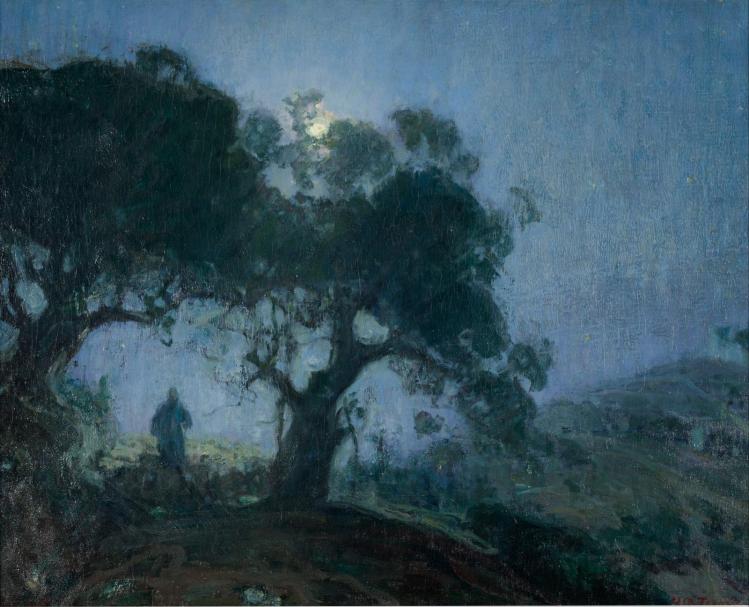
The blessedness of the night is something I now try to embrace in my spirituality. When I probe the darkness, I usually find God more present than I’d realized. Where there is a wolf there is also a shepherd. I cringe when I think of how often I’ve treated Psalm 23 as a pleasant excursion only to find myself once again in the “valley of the shadow.” Not until my desperation mounts do I look to the shepherd—with his rod against the wolf and staff to keep my thoughts from running wild. Only then do I notice he’s been there all along, watching over—even leading—me. It’s the story of my life: thinking I’m in charge, until I find, to my relief, that I’m not.
We welcome your comments about this article. Please send your response to [email protected].