In 1951, a decade after moving to the United States from England, W. H. Auden wrote these lines in the introductory poem to his collection Nones:
All words like Peace and Love,
All sane affirmative speech,
Had been soiled, profaned, debased
To a horrid mechanical screech.
No civil style survived
That pandemonium
But the wry, the sotto-voce,
Ironic and monochrome.
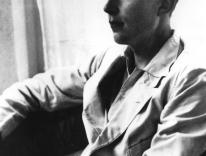
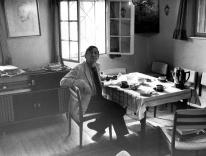
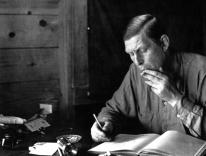
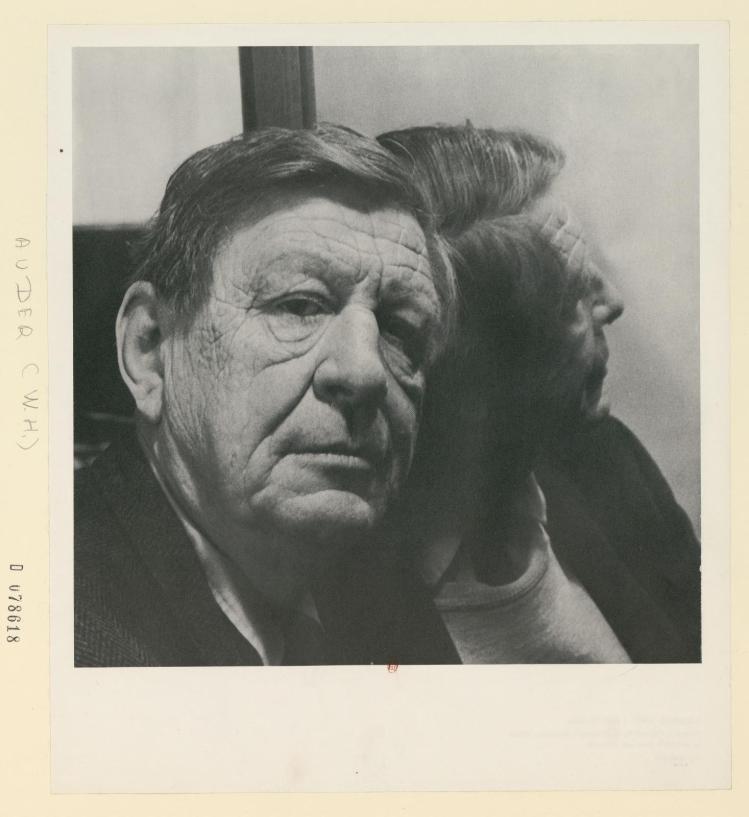
Here, Auden situates his poetry in a world just beginning to emerge from the “pandemonium” of the interwar and wartime years that shaped him and his generation. As the prolific Peter Ackroyd shows in his brisk but thorough new biography of the poet, Auden was, for much of his life, a consummate example of the “civil” poet—the writer as observer-witness. His life spanned the years 1907 to 1973. He had childhood memories from before the transformative catastrophe of the First World War. He had a front-row seat in Berlin as Weimar crumbled and the Nazis rose. There were excursions into the alien landscapes of Iceland in 1937 and China at war with Japan in 1938. As an honorary major in American uniform, he witnessed the total devastation of Germany immediately following the second “Great War” of his lifetime. All this before he was forty.
In one of several articles written for Commonweal under the pseudonym “Didymus” (Greek for “twin” and the nickname of the Apostle Thomas), Auden makes a remark he echoed elsewhere: “A poet only differs from others in having a certain kind of gift for language, and a personal interest in poets apart from their work is unseemly.” Yet it is hard to understand at least some of Auden’s work without a personal interest in the man. For Auden, the public and the private were always, and necessarily, sparring partners.
The last major biography of the poet was Richard Davenport-Hines’s Auden, published in 1995. Auden is a significant enough figure for this to count as a long time ago. No one is better equipped to end this drought than Peter Ackroyd, who has practiced the art of biography as extensively and adventurously as any writer working today. He has written books about Dickens, Shakespeare, Pound, Eliot, Blake, More, the River Thames, and London—to give an incomplete list. Through his historical fiction, he has experimented even further with biographical form.
Yet Ackroyd’s Auden is a comparatively safe venture. At less than four hundred pages (it would be a challenge to make a decent biography of Auden very much briefer—his life and mind are too rich for that), it tells the story of this remarkable, still-confounding, and beguiling genius in a direct and compelling manner. No biography of Auden has been definitive in the way that, say, James Knowlson’s Damned to Fame: The Life of Samuel Beckett is. Ackroyd’s book does not revolutionize our view of Auden, but it does bring several persistent themes to our attention in ways that led me to see Auden afresh.
For one, Ackroyd’s Auden is far more of a mystic and prophetic voice than I had previously grasped. Ackroyd begins by detailing the private mental landscape the poet explored “from the age of six”: the peaks, moors, and lead mines of Cumbria, Lancashire, Derbyshire, and the Isle of Wight formed for the young boy a “private sacred world.” The abandoned machinery of the mines, Ackroyd writes, “moved him as barrows, dolmens and Roman ruins moved observers in earlier ages. He created this bleak terrain step by step, as if he were creating a haven for himself.” From the beginning, Auden’s imagination sought to find a “lane to the land of the dead,” where the poet could travel for communion with the past. “Without some form of communication with the dead,” he once said, “a fully human life is not possible.”
Ackroyd also stresses the young poet’s admiration of Blake (“one of his guardian spirits”) and notes how Auden learned from Blake the “visionary capacity…for illuminating intellectual history in a phrase or image.” The politically conscious Auden of the early years never disappeared entirely. His politics may have changed in complicated ways over the decades, but his imagination always had a social and political side, as one of his most famous poems, “September 1, 1939,” reminds us.
Exiled Thucydides knew
All that a speech can say
About Democracy,
And what dictators do,
The elderly rubbish they talk
To an apathetic grave;
Analysed all in his book,
The enlightenment driven away,
The habit-forming pain,
Mismanagement and grief:
We must suffer them all again.
In his lectures and essays, and even in some of his poetry, Auden could sound like a seventeenth-century French moralist: “One of the troubles of our time is that we are all, I think, precocious as personalities and backward as characters.” A perfect description of the self in the age of social media. And then, of course, there is Auden the love poet, the Auden of “The More Loving One,” “Lullaby,” “If I Could Tell You,” and—inescapably—“Stop All the Clocks.”
What Ackroyd calls “Auden’s endless capacity for love, and his assiduous search for it” was the engine of his work, as was a “massive” loneliness. “There was a certain unknowability about the poet himself,” Ackroyd writes, “an impenetrable hardness at the core.” Despite his desire for a faithful union with a lifelong partner—an ideal that the love of his life, the brilliant and promiscuous Chester Kallman, could never meet—Auden had what one friend described as an “aloof, reclusive personality.” Ackroyd observes that Auden “was always somehow apart. All his friends noticed it. He was no egotist, but he was sharply conscious of his singularity.”
In an early essay, Auden declares “the urge to write, like the urge to speak, came from man’s growing sense of personal loneliness,” and that “writers themselves feel alone from each other, cut off in an indifferent world.” The central struggle of Auden’s life and work, Ackroyd argues, was to harmonize his contradictory selves: the urgent lover with the natural loner, the young “English” Auden—a poet of prophetic address—with the mature “American” Auden, who was constantly seeking, losing, and renegotiating an inner order.
In a preface to the 1927 edition of Oxford Poetry, twenty-year-old Auden wrote that “all genuine poetry is in a sense the formation of private spheres out of a public chaos.” His early poetry revels in its own obscurity, even as it seems to address us readers with startling directness:
Go home, now, stranger, proud of your young stock,
Stranger, turn back again, frustrate and vexed:
This land, cut off, will not communicate,
Be no accessory content to one
Aimless for faces rather there than here.
Auden’s compressed, often cryptic poetry of the late 1920s and early ’30s was centered, as Ackroyd writes, on “an imagined landscape of spies and frontiers or by love aroused and thwarted.” This was the poetry that made him the leader of his literary generation in England. Auden’s “surprising, startlingly modern, accent” employed (as one poem puts it) “an altering speech for altering things.” Ackroyd writes: “His private troubles are in a sense externalized. They are no longer peculiar to himself, but representative of the problems of the age.” This was poetry that somehow succeeded at expressing a public mood—“a climate of feeling,” as editor Julian Symons put it—in a very private language.
As Ackroyd details (and as Nicholas Jenkins explores in far greater depth in The Island), the young Auden was obsessed by the idea of England: what it meant and where it was headed. Poems refer to “our English land” and “English earth.” Auden wanted “to acquire authority as a representative voice, a national seer or prophet,” Ackroyd writes. Yet he eventually abandoned this early ambition and became more and more ambivalent about England itself, describing it in The Orators (1932) as “this country of ours, where nobody is well.” It was when he was awarded the King’s Gold Medal in 1937 that Auden finally realized his crisis. He saw that establishment acceptance was, in Ackroyd’s description,
unsuitable and even improper. To be welcomed, to be understood, to be given a settled place in English society—all this was absurd, even distressing to a young man who had always avoided any such position. He did not want any ties. He did not belong to any one country or any particular society.
He also knew how quickly national loyalty could evolve into something much more sinister. The Orators might be described as, in part, a preemptive rebuttal to Orwell’s famous belief (expounded in his wartime essay “The Lion and the Unicorn”) that the fascism of Italy and Germany could never take root in England, with its inherently ironic sense of authority’s ridiculousness. Auden knew better. Like Orwell, he had “gone to a great public school,” that institutional production line for most British politicians, an institution which, later in life, he compared to “a fascist state.”
Following his move to New York with Christopher Isherwood in January 1939, Auden began what now appears as the long project of the rest of his poetic career: turning from a private-public poet into a public-private one. His language became clearer and more conversational. He moved from the dense “lyric oratory” (Ackroyd’s apt phrase) of his youth to lines such as these from “Doggerel by a Senior Citizen” (1969):
Though I suspect the term is crap,
If there is a Generation Gap,
Who is to blame? Those, old or young,
Who will not learn their Mother-Tongue.
But love, at least, is not a state
Either en vogue or out-of-date,
And I’ve true friends, I will allow,
To talk and eat with here and now.
Me alienated? Bosh! It’s just
As a sworn citizen who must
Skirmish with it that I feel
Most at home with what is real.
“Poetry makes nothing happen,” Auden famously wrote. He later explained: “If not a poem had been written, not a picture painted, not a bar of music composed, the history of man would be materially unchanged.” Perhaps. What’s clear from Ackroyd’s biography is that Auden himself always lived and wrote as if poetry were urgently important, and as if the poet’s task necessarily involved finding new ways to speak the truth to his own age. The only genuine “duty” of the poet, he said in an interview, was to protect the language (“Mother-Tongue”) against degradation. He felt the full weight of that responsibility. “Because” he explained, “what do we think with? We think with words.”
Auden
Peter Ackroyd
The University of Chicago Press
$30 | 400 pp.
We welcome your comments about this article. Please send your response to [email protected].
Correction: Due to an editorial oversight, an earlier version of this review incorrectly stated that the name “Didymus” is Aramaic. It is in fact a Greek name. We regret the error.