As summer twilight flooded the windows of the old convent at my parish in the Bronx, I packed my things, looking forward to heading home for family dinner. Every so often, I like to drop by the parish and help out. Right when I went to leave, a phone buzzed on the table. I recognized the number and picked up, putting my friend on speaker. “Agarraron a mi sobrino,” he said. “El ICE lo llevaron.” The government had kidnapped his nephew.
This disappearance—and the thousands of others like it—is part of a larger ICE strategy. It is now well documented that since the highly publicized murders of American citizens Renee Good and Alex Pretti in early 2026, the agency has ramped up its efforts to disappear more people than ever, albeit quietly. Our friend David and his nephew Juan (not their real names) were at a family gathering. Juan went to move his car and never made it back home.
A couple days later, I called Juan’s brother. On his lunch break, we talked about the writ of habeas corpus and how it applied to Juan’s case. If ICE had detained Juan simply by recognizing him as a brown-skinned laborer rather than connecting him to any particular immigration violation, we could legally challenge his detention. But I warned him: the courts can be slow, and there was no guarantee we would see Juan again. We planned to stay in contact, along with his family and the wider parish community. Proceedings had only just begun.
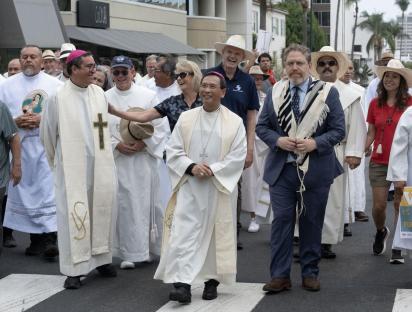
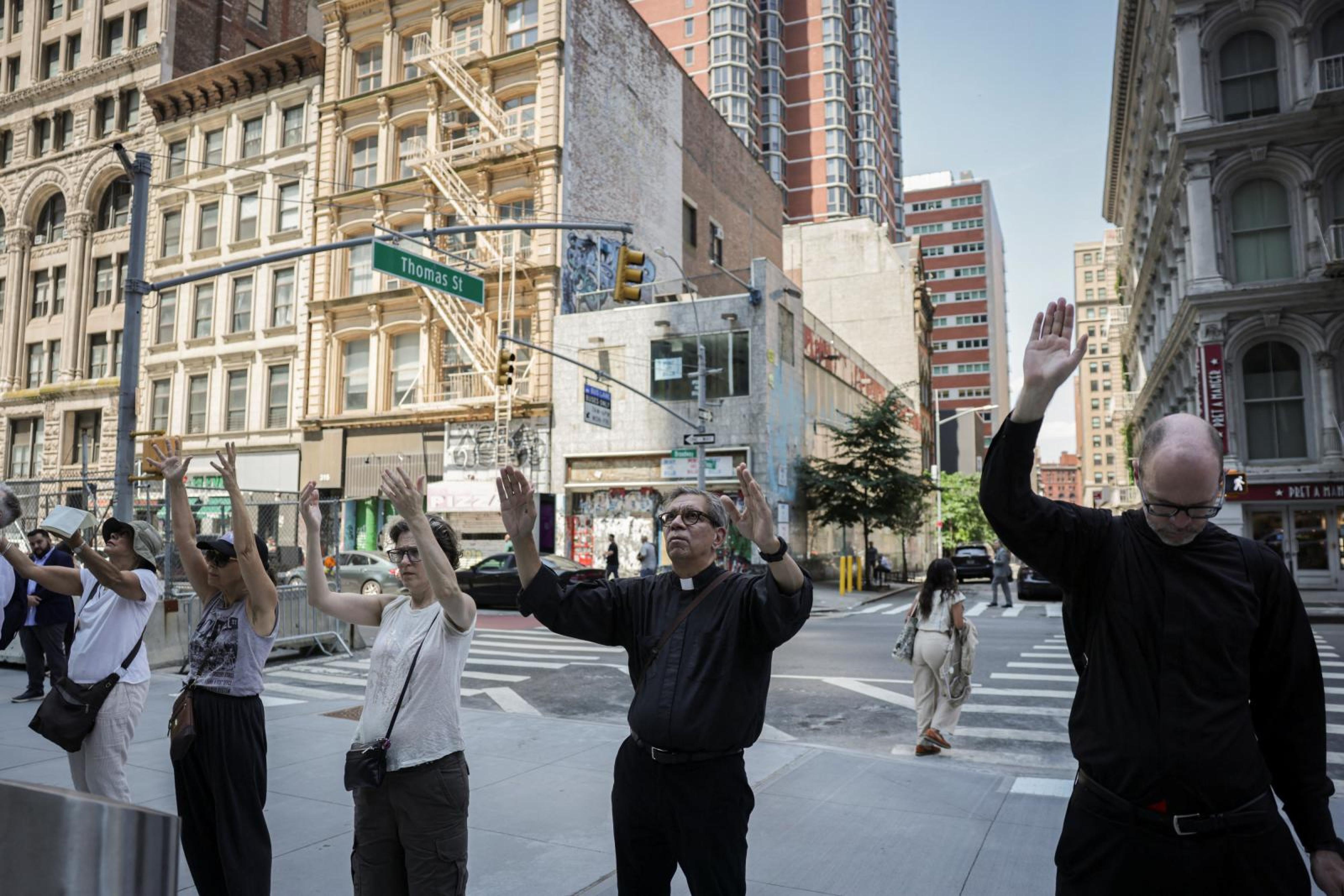
Unlike “removal proceedings,” habeas corpus petitions follow a separate legal path. While waiting in federal prison, Juan would have to digitally attend “master hearings.” David and other members of Juan’s family couldn’t attend the hearings in person without losing a day of work, so several of us went to support our friend. A few days after the call for volunteers went out, our group—comprising students, clergy, staff from the food pantry, ladies from the sewing group, retirees, and other friends—boarded the subway at dawn, bound for lower Manhattan. People make time for their neighbors. They do not want to see more people vanish in front of their eyes.
It was a brisk morning. We walked west along Chambers Street, passing affluent Tribeca residents clad in exercise clothing only to swiftly arrive at the back of the long lines forming for the day’s “mega master” hearings, during which hundreds of cases would be heard. Two skyscrapers, 26 Federal Plaza and 290 Broadway, make up the cold federal campus. The many guards on duty have a tough job, and that morning their demeanors ranged from miserable to confused. Many barked orders in terse English—perhaps the least effective solution to the general confusion, producing more melodrama than clarity.
After passing metal detectors and the leering, gold-framed portraits of Trump and Vance, visitors take the elevator up to a waiting room. The lucky few defendants with lawyers are seen first; the rest must wait with their families or alone on the rows of plastic seats. There has been a dire shortage of legal assistance for immigration cases for a long time. Most defendants do not have ten thousand dollars to spend on a private attorney. Formal training in English—often a second, third, or fourth language—is about as uncommon; occasionally, a guard or two will speak brusque Spanish.
Court accompaniment is frustrating because it requires abiding by the court’s rigid, seemingly illogical rules. It’s much worse for the defendants, whose attendance and compliance are enforced through the implied threat of ICE kidnappings. Each master hearing takes only a few minutes; the real work of immigration court is arriving early, then sitting for hours under the queasy, pale light. Waiting with a group helps pass the time. Looking into another person’s bleary eyes and listening to them eases the indefinite, sickening waiting.
When our big parish group arrived, the whole room eased, and a faint chorus of whispers stirred. It sounded the way a church does in the minutes just before Mass, with people leaning over and shaking hands, the silence broken by toddlers for whom we’ve brought coloring books. There is no prior training needed to walk with people. Judges and clerks alike always seem shocked by the support that our people get in their hearings. Juan had several hearings, all of which were attended by at least five of us. Bemused glances from judges and scowling DHS attorneys seem proof of the parish’s unique capacity to unite people.
In a time when local parishes are declining and the corruption of political institutions has (justifiably) led people to eschew commitment, I see people in the faith show up for each other. It can be difficult to see Christ in large institutions; it is never easier to see the crucified people in front of you.
Men’s prayer groups, summer screenings of World Cup games, the food pantry, a surprise birthday party for the pastor. A seminarian at the parish noted that what we do “isn’t rocket science.” The parish is a group, mostly immigrants, who organize services and resources among themselves. The particular kind of daily help, of presence, that we in the parish offer each other will not come from anywhere else.
After a few weeks, Juan won his habeas case and was reunited with his family. I went on his behalf to Federal Plaza to reclaim the zip-tied white rucksack with the clothing he was wearing when he was grabbed on the street. The government official handed me the bag and wondered aloud: “I don’t know why your client didn’t show up.” Just behind him, his colleague was yelling at a woman to go into the office she was already entering. Moments later, I thought about the irony: Juan isn’t my client—he’s a friend.
I got back to the church just as friends were getting ready to drive Juan home. Proceedings were only back at zero; we do not know his next court date. Asylum cases are rarely successful. By the time this article is published, he could well be deported. The day after an ICE shooting just a mile away, another parishioner told the group that a family member of theirs had been taken. Life will go on, in the country, in the city, in our parish. We hope that everyone can be there on Sunday.