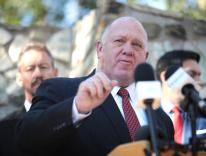
If you go to the website for the School of Theology and Religious Studies at the Catholic University of America and navigate to the page titled “Who We Are,” you will find a large photograph of a professor at the front of a classroom. That professor is Chad C. Pecknold, a postliberal theologian who has defended aggressive immigration enforcement and taken issue with the U.S. bishops’ statements against mass deportation. But if you travel right now to CUA’s theology school and search its classrooms, you will not find him.
Go to Pecknold’s LinkedIn page and you will learn that he is “currently on a leave of absence from teaching at Catholic University in order to serve as Principal Director for Cultural Outreach at the U.S. Department of Homeland Security.” On Thursday, the National Catholic Register published a story about Pecknold’s new government job. At that time, DHS hadn’t responded to the paper’s inquiries about what exactly the position entails, but the article reports that Pecknold is working in Homeland Security’s Office of Public Engagement.
At first glance, this might seem suitable enough. In addition to working as a scholar and teacher, he has been an active pundit at the intersection of Catholicism and political life. It can be laudable for academics to step away from their studies and their students to serve their government when duty calls. But, given the circumstances, Pecknold’s outward-facing role—to the extent its particulars can be discerned—strikes me as deeply inappropriate.
It would be one thing if he was being brought on as an advisor to add a stridently Catholic moral voice to internal deliberations—as an extension of vice president J. D. Vance’s influence, perhaps. In that case, I might be less concerned. Pecknold might function as an “adult in the room,” in the style of many who served in the first Trump administration. It is hard not to welcome any check—however slight—on the gleeful nihilism of the many grifters and groypers drawn to this presidency. Pecknold’s professional advice would, of course, differ profoundly from my own. When it comes to immigration, we have diametrically opposed views. Still, he might be well-positioned to repeat the sound Augustinian advice that no end—whether national security or national “character”—can justify disordered means. He might be able to introduce some intellectual friction into the “move fast and break things” ethos of Trump II’s DHS.
Maybe that will end up being Pecknold’s public-service legacy, but “Principal Director of Cultural Outreach” does not sound like a deliberative role to me. It sounds rhetorical—propagandistic, even. It sounds like he has been hired to continue to publicly promote the administration’s hyper-hawkish immigration aims, to continue to say things like “mass deportations may be a legitimate response to mass migration,” as a Pecknold-endorsed paper released by a Hungarian Christian think tank argued. If that’s the case, then he has been hired to provide theological and philosophical rationalizations for the manifestly inhumane, illegal, and un-American conduct of this Department of Homeland Security.
You might like: Paul Moses on the Gospel according to Tom Homan
Even if a restrictive, nationalistic immigration goal can be forced into the prudential opening left by Church teaching, this administration’s demonstrated means cannot. It is not immoral for a state to police its borders, but it is immoral to keep detained migrants in squalid, crowded conditions, depriving them of everything from medical care to the Eucharist. It is not illegal to remove those without legal status from the country, but it is illegal to defy judicial orders in the process or to deport migrants to places where they face the known risk of torture, disappearance, or death. While Americans can disagree about which policies might rationalize the immigration process, de-legalizing more than a million Black and brown refugees while only admitting white ones is nakedly, shamefully un-American. If Pecknold has accepted a role promoting this administration’s policy ends, knowing it has pursued them by such callous means, I cannot imagine by what casuistry he justifies that choice.
These are my concerns—as a Catholic, a citizen, and a member of the theologians’ guild—but I think Pecknold and, more to the point, his bishop, should be concerned, too. Lay theologians have a lot of ecclesial latitude in their teaching, writing, and conduct, at least as compared with priests and religious. But Pecknold is a theologian at a very particular Catholic institution, one that puts him in a different position than most lay theologians—and that casts a rather different light on his foray into public service.
John Paul II’s Ex corde ecclesiae exhorts that all Catholic theologians “fulfil a mandate received from the Church” and “are to be faithful to the Magisterium of the Church.” Moreover, Canon Law requires “those who teach theological disciplines in any institutes of higher studies whatsoever must have a mandate from the competent ecclesiastical authority” (Canon 812). Of course, in the United States, a certain détente has been reached in which these ecclesial expectations are not always—or even, frankly, very often—respected. Nevertheless, the Church wants its theologians faithfully teaching what it teaches. These expectations, for Catholic theologians, go further than the content of their teaching and research. They are asked for something more fulsome: something like cooperation or participation. The mandatum is a mechanism that tries to establish that collaboration.
Moreover, the CUA School of Theology, as its website notes, is “a pontifical faculty, accredited by the Holy See.” Indeed, Canon Law says that such faculties can only be erected, approved, and directed by the Apostolic See. To teach theology, as Dr. Pecknold does, as part of a pontifical faculty adds, beyond the apostolic mandate, a further layer of canonical mission. As a result, he is particularly answerable to episcopal authority for a lay Catholic theologian. He ought to be more tightly bound by its pastoral purposes.
Pope Leo’s criticisms of draconian immigration restriction and enforcement, in both the United States and elsewhere, have received ample media coverage. Leo has also been specific in affirming immigrant-friendly values as a defining feature of America’s promise. In a brief interview this past summer, he said he loves his home country for “having invited, for generations, people from around the world to be part of America.” In his remarks on the country’s 250th anniversary, he praised its commitment to “the God-given dignity of every human life,” which includes “welcoming, protecting and assisting immigrants, whose hopes, sacrifices and contribution have formed part of the history of this country from its very beginning.”
Those are not the idiosyncratic opinions of a relatively new pontiff. In its November “special message,” the United States Conference of Catholic Bishops expressed that they are collectively “disturbed,” “troubled,” “concerned,” and “grieved” by the treatment of immigrants in the United States. It repudiated the climate created for immigrants by the second Trump administration. Such a special message had not been issued by the USCCB since its 2013 message in response to the Affordable Care Act contraceptive mandate. These “special messages” can only be issued under fairly specific conditions and with no less than two thirds approval by the bishops. The vote for the 2025 message was overwhelming: 216 votes in favor, five against, and three abstentions. This expression of episcopal values and priorities cannot be dismissed the way that Pecknold waved off, for example, the USCCB’s amicus brief in the birthright citizenship case at the Supreme Court earlier this year.
All of which is to say that, were Pecknold merely a lay Catholic theologian at, say, a Jesuit university, I might consider his service to the Department of Homeland Security “lawful but awful.” He would be, so to speak, within his rights. As a Catholic liberal, I might even argue that he is protected by academic freedom. But because his job at CUA includes special responsibilities to the Church, an ecclesial evaluation should be unavoidable and its judgment possibly different. It must be asked whether Pecknold’s service to DHS—this DHS—is compatible with that role. To be sure, the USCCB does not have any kind of collective jurisdiction. Its special message is not canon law. Still, Pope Leo took note, calling it “a very important statement.” He invited all “people of goodwill to listen carefully to its message,” but “especially Catholics.”
Questions about Pecknold’s jobs, old and new, cannot be settled automatically. They require discernment and prudence. But, to be frank, in this case, they must foremost be asked and answered by the archbishop of Washington D.C., Cardinal Robert McElroy, who is also the ex officio chancellor of CUA. According to the School of Theology Faculty Handbook, he “serves as liaison between the University and the Apostolic See and as liaison between the University and the United States Conference of Catholic Bishops.”
I know that American Catholics are not accustomed to decisive episcopal action on an issue like immigration. Indeed, the living memory of what befell dissenting theologians like Charlie Curran at CUA in the 1980s might make some progressives squeamish about the prospect of bishops intervening in a Catholic theologian’s professional affairs. But the teaching office of the bishops requires willingness to discern the point at which power should be wielded. Because Pecknold’s case implicates his responsibilities to the canonical mission of CUA’s School of Theology, the buck unquestionably stops with the archbishop.
Of course, Pope Leo might take notice himself. He has direct and, in fact, universal jurisdiction to consider the situation. Still, the principle of subsidiarity applies, and this is pretty small-fry for his desk.
For what it’s worth, my own judgment is that Pecknold desperately needs pastoral guidance and, indeed, correction. Pecknold seems unwilling to think with the Church about immigration and overzealous to contribute to this administration’s evils. If he proves insusceptible to guidance and correction, then maybe, when his government service is done, he should no longer be found on CUA’s website, nor in its classrooms.
We welcome your comments about this article. Please send your response to [email protected].