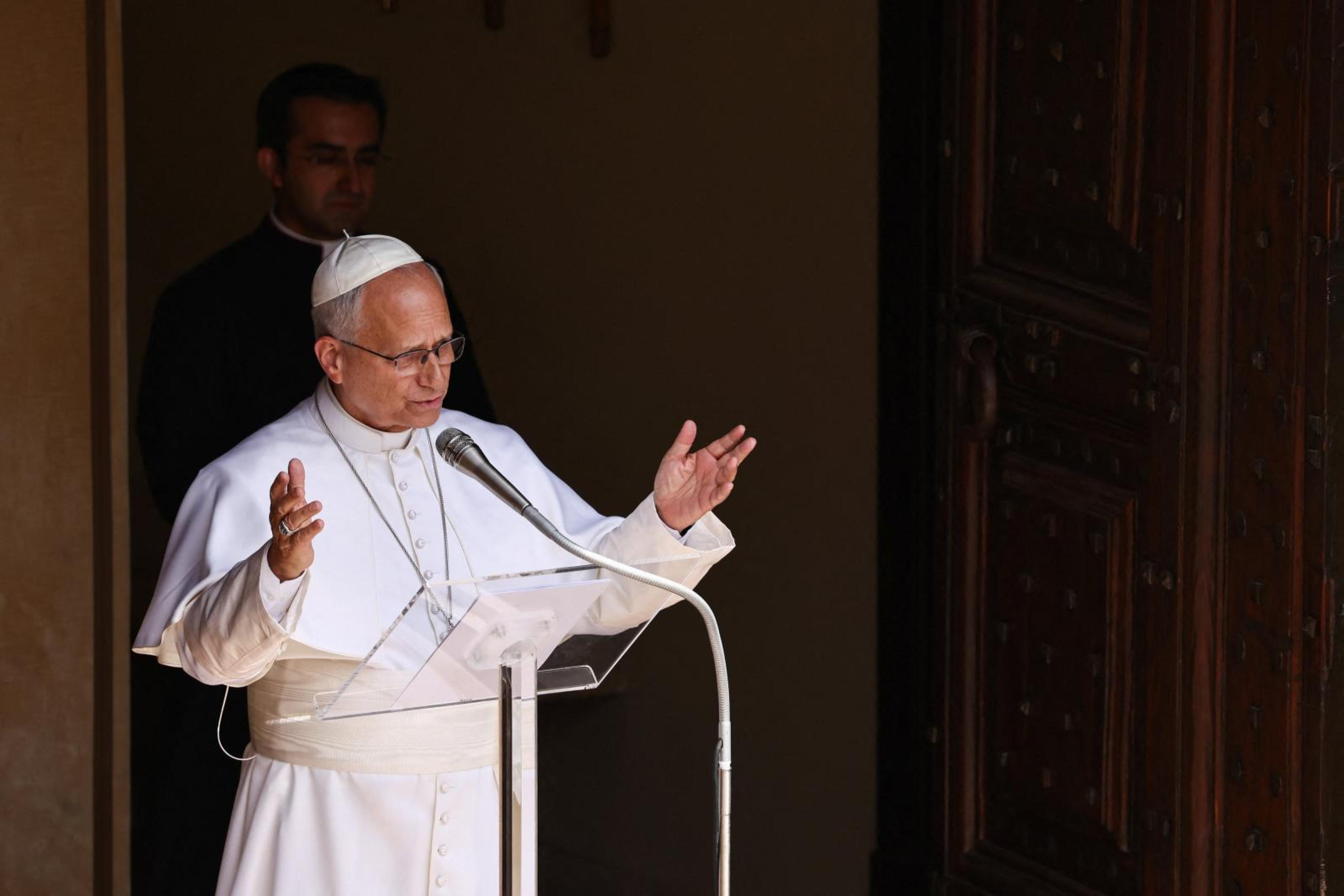
Pope Leo XIV is changing the public voice of American Catholicism. He is building on the legacy of Pope Francis, but has turned out to be better placed than Francis was to shift the direction of the U.S. Church, and not only because of his national origin (or the fact that he’s a baseball fan). Leo has focused his papacy on a series of issues—immigration, economic justice, war and peace, and the moral challenges of artificial intelligence—on which the American polity is hungry for moral guidance. He is lending support to bishops who were named by Pope Francis to shift the priorities of the American Church. His desire to give cardinals a larger role in governance has empowered some of the strongest progressive voices in the U.S. Church’s leadership. The outspokenness of Cardinals Robert McElroy, Blase Cupich, and Joseph Tobin on immigration, the Iran War, and other questions has begun to alter public perceptions of where the Church stands and what its priorities are.
The particulars of the American political situation have also made the pope’s voice indispensable. The extremism of President Trump’s second term, the rise of Christian nationalism, and the challenge of a new illiberal integralism make Leo’s moderation seem radical. In particular, the violent cruelty of the administration’s immigration policies demands the forceful response Leo has offered. Immigration is an issue that largely unites the feuding wings of the U.S. bishops’ conference, even if polling suggests a significant minority of rank-and-file Catholics dissent. Statements from the bishops on immigration are plainly stronger than they might have been absent Leo’s leadership. His shift in priorities has been further enabled by the Supreme Court’s decision overturning Roe v. Wade. While Leo and the Church continue to oppose abortion, it has become much harder for Catholic conservatives to insist that it should remain the defining issue of the Church’s public witness. Francis X. Rocca, who writes regularly on Catholic questions for The Atlantic, was right earlier this year when he flatly asserted: “The most urgent political concern for America’s Catholic leaders is no longer abortion; it’s immigration.”
Judging from the polls, Leo is winning the battle for American Catholic opinion, and despite his many criticisms of the Trump administration, even Republican Catholics are largely sticking with him. A Pew Research Center survey released in June found that 78 percent of Catholics had a favorable view of Leo, down only slightly from the 84 percent favorable rating he enjoyed in summer 2025. Among Catholic Democrats and independents who lean Democratic, his favorable rating in June stood at 84 percent. It’s no wonder that in the same month, a group of fifty-four Catholic House Democrats issued a statement embracing Leo by way of explaining that “the guiding values and principles of Catholic Social Teaching inform our policies” in pursuit of “a just and equal society that works for all Americans.” Leo’s favorable rating among Catholic Republicans and independents who lean toward the GOP did drop twelve points between the two surveys, but still stood at 72 percent, a number that would be the envy of any practicing politician. Given the sharp polarization of American politics, Leo’s ability to maintain his standing across party lines is remarkable. There was also this: only 19 percent of American Catholics told Pew that Leo has been too critical of the Trump administration (and 16 percent said he had not been critical enough). By contrast, 51 percent said Trump has been too critical of Leo.
American political parties often speak of the merits of pitching “big tents” to assemble the largest possible electoral coalition. One of the most expansive political tents in the United States is not a party, but the Roman Catholic Church. It is large and broad, crossing the lines of class, ethnicity, region, race, and, especially, partisanship and ideological inclination. Survey data brings home the reality of this diversity, but so do pairings of prominent Catholics who barely agreed on anything where politics was concerned: Dorothy Day and Joe McCarthy; Justice William Brennan and Justice Samuel Alito; political commentators Mark Shields and William F. Buckley Jr.; Speaker Nancy Pelosi and Speaker Paul Ryan; President Joe Biden and Vice President J. D. Vance.
Such a span of worldviews may seem surprising in a church that is—in the eyes of its critics, but also definitionally—dogmatic. Friends of the Church counter that there is nothing astonishing about this in light of the Church’s dialectical relationship to modernity, its critical attitude toward both capitalism and state socialism, and its impatience with radical individualism, whether practiced in the marketplace or in personal habits.
As a practical matter, the protean nature of Catholic social thought has put the Vatican and individual national churches on different sides of political conflicts at different moments, and the Church itself has changed and reformed over time. Most striking was its embrace of democracy and religious freedom at the Second Vatican Council after long resistance. Even after all these years, the fruits of Vatican II still divide conservatives and liberals, traditionalists and reformers. The schismatics of the Society of Saint Pius X represent a tiny minority but reflect a larger resistance to an expansive reading of what the Council did. Many conservatives insist they reject only the liberals’ emphasis on “the spirit of Vatican II,” which, in a peculiar kind of originalism, they contrast with what they see as the more stringent “letter” of its documents. Recent years have witnessed a resurgence of explicitly antiliberal and antimodern Catholic thinking, particularly in the United States, reflected by figures like Patrick Deneen, Adrian Vermeule, and J. D. Vance. The new integralism, a view that “government must serve both earthly and spiritual ends,” as the writer Laura K. Field put it, is visible in various parts of the intellectual coalition behind Donald Trump, including the Heritage Foundation and in some parts of the tech right.
Whether through the Holy Spirit’s intervention or courtesy of a coalition of cardinals (presumably they can work together), Leo became the first U.S.-born pope in the midst of these struggles. He reflects continuity with Pope Francis in his emphasis on the rights of immigrants and the centrality of economic justice, even if, also like Francis, he has not changed Church teaching on issues such as abortion. One of his most striking asides came in a comment to reporters on a flight to Rome from Equatorial Guinea in April.
“I think it’s very important that the unity or division of the Church should not revolve around sexual matters,” Leo said. “We tend to think that when the Church is talking about morality that the only issue of morality is sexuality. And in reality I believe there are greater and more important issues such as justice, equality, freedom of men and women, freedom of religion that would all take priority.”
If Leo’s allergy to culture wars means he will move slowly around such questions as LGBTQ rights, this has also, perhaps paradoxically, opened the way to his becoming a hero to both secular and religious American liberals because it marks his rejection of cultural conservatism as the centerpiece of the Church’s public mission. It’s true that he treads more carefully than Pope Francis did on certain questions that arouse traditionalists. He did not choose, as Francis did, to use the early months of his papacy as an occasion for ebullient and spontaneous public gestures to mark breaks with the past. When he was first elected, Leo appeared from the papal balcony before the crowds in St. Peter’s Square wearing customary vestments, which proved to be a reassuring moment for some of Francis’s critics.
But many of his early signals were misread as the acts of a cautious man when they were better interpreted as an indicator of the fights he did want to wage. His choice of the name Leo was as revelatory as his predecessor’s decision to honor St. Francis of Assisi. He was direct in lifting up Pope Leo XIII and his 1891 encyclical on economic, social, and labor questions, Rerum novarum, and he immediately defined his task as applying Catholic social teaching to new times and new technologies. “In our own day,” Leo told the College of Cardinals on May 10, 2025, just two days after his election, “the Church offers to everyone the treasury of her social teaching in response to another industrial revolution and to developments in the field of artificial intelligence that pose new challenges for the defense of human dignity, justice, and labor.”
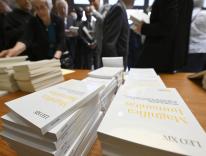
He delivered. Among the many striking aspects of his encyclical on AI, Magnifica humanitas—signed on May 15, 2026, the 135th anniversary of Rerum novarum—was his use of his teaching authority to open rather than close discussion of the social obligations of those building a new technological world. He used Catholic social teaching as a measuring rod for the proper use of AI. But he also used AI to demonstrate the ongoing relevance and urgency of Catholic social teaching.
As Vincent J. Miller, a theologian at the University of Dayton, wrote in Commonweal’s symposium on the encyclical: “Leo’s project is not line-drawing but critical, constructive engagement. Instead of a yes-or-no framing of technology, he asks how, by whom, and to what ends it is designed.” Miller cited one of Leo’s key sentences: “Technology is never neutral, because it takes on the characteristics of those who devise, finance, regulate and use it.”
There was a particular message for the debate among American Catholics over the meaning of “subsidiarity” in Catholic social thought, the complement to its emphasis on “solidarity.” In recent years, conservative Catholics in the United States often used subsidiarity as a battering ram against federal programs to alleviate poverty and provide universal forms of social insurance. But as Antonio Spadaro of the Vatican’s Dicastery for Culture and Education noted in Commonweal’s pages, in Leo’s hands, “subsidiarity is turned upside down.” He wrote,
In classical Catholic social doctrine, subsidiarity protects intermediate bodies from the encroachment of the state. In the digital context, the power that absorbs competencies and decision-making capacity is no longer the state but corporations and platforms, which define conditions of access, rules of visibility, and economic opportunities. Subsidiarity thus becomes a critical instrument against private technological monopoly.
This is an orientation straight out of the American progressive tradition emphasizing countervailing power: if the power of the state should be limited to protect the rights of private and community actors, the concentration of economic and technological power in a small number of private hands must be limited by the state and the community.
Spadaro also pointed to a stark contrast between Leo’s approach and the habits of the current American political debate: that he chose to be “neither apocalyptic nor enthusiastic: he has chosen to think.” This, Spadaro added, “may be the most radical form of resistance.”
Another early indicator of both where Pope Leo stood and how willing he is to arouse controversy were his observations to Crux senior correspondent Elise Ann Allen in September 2025 about what bred political polarization. One “very significant” cause, Leo told Allen,
is the continuously wider gap between the income levels of the working class and the money that the wealthiest receive. For example, CEOs that sixty years ago might have been making four to six times more than the workers are receiving, the last figure that I saw, it’s six hundred times more than what average workers are receiving.
He did not stop there. “Yesterday,” he went on, there was “the news that Elon Musk is going to be the first trillionaire in the world—what does that mean and what’s that about? If that is the only thing that has value anymore, then we’re in big trouble.” The editorial page of TheWall Street Journal was not pleased, nor was Musk. The trillionaire fired back with a tweet citing the Gospel of Matthew. “Why do you see the speck in your neighbor’s eye, but do not notice the log in your own eye?” The pope seemed to take Musk’s invocation of Scripture against him in stride.
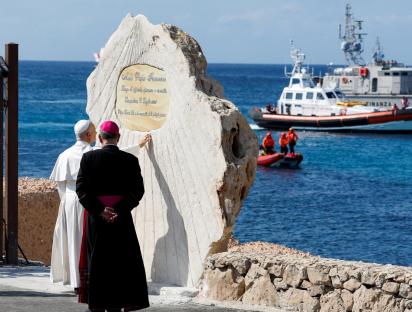
The signals Leo sent early on make clear that no one should have been surprised about how outspoken he would later be about the Trump administration’s immigration policies and war with Iran. His background—as a citizen of both the United States and Peru—gives him a perspective that is global in a very personal way. It also brings together the experience of earlier generations of Catholic immigrants to the United States with the outlook of the American church’s growing Latino constituency. He sees life from both ends of the hemisphere and takes a long view of the migrant experience. Thus did he celebrate his homeland’s 250th anniversary this July 4 from Lampedusa, the dangerous point of passage for so much immigration from Africa to Europe. His powerful speech was a reminder that social sin lies not only in aggressive acts against the marginalized, but also in indifference. “There are also those who choose not to be a neighbor and those who choose not to make a decision,” he declared. “Those who have lost their lives in this sea are victims both of decisions that were made and of decisions that were not made.” Perhaps Leo was remembering the adage coined by the great progressive Protestant theologian Harvey Cox: “Not to decide is to decide.”
It’s far from clear that the American clerical leadership has fully decided to move along the path Leo has set out. There remain many members of the bishops’ conference—along with many priests—who were shaped by the long culture-war period, and there is a new energy among Catholic traditionalists, visible especially among younger converts. In Europe, many supporters of the nationalist right think of themselves as devout Catholics and are challenging traditional Christian Democratic parties as well as more secular progressive parties for support of the faithful.
There can be no doubt that Leo is directly confronting this new far right, which is why he has been on a collision course with the Trump administration. He speaks from the long post–World War II tradition that created what became the European Union and shaped Christian democracy, and that, in tandem with Social Democrats, created the modern welfare state. Leo’s little-noticed April address to a delegation from the EU Parliament’s European People’s Party—in large part an alliance of Christian Democrats—specifically reflected on that tradition in offering a remarkably clear view of his own, anti-ideological politics. He spoke of the need for an alternative to “populism, which seeks only easy approval” and to “elitism, which tends to act without consensus.”
What were the obligations of “a Christian engaged in politics”? His agenda was remarkably clear:
This perspective should seek, above all, to foster dignified working conditions that will encourage people’s ingenuity and creativity in the face of a market that is increasingly dehumanizing and unfulfilling. Such an outlook must enable people to overcome the fear of starting a family, of having children, a fear that seems to be particularly prevalent in Europe. It also needs to address the root causes of migration, caring for those who suffer, while also taking into account the real capacities for welcoming and integrating migrants into society. It likewise requires confronting in a non-ideological way the great challenges of our time, such as care for creation and artificial intelligence. The latter offers great opportunities, but it is also fraught with danger.
This is not a program for Trumpism or European nationalists, but moderate and progressive politicians searching for ways forward might see Leo’s list as an excellent starting point. As importantly, he is calling the American church to its most socially adventurous traditions—to the bishops who called for “social reconstruction” in 1919, embraced a “living wage” in the New Deal Era, and endorsed “Economic Justice for All” in 1983. You might say that Leo is moving back to the future, proving in the process that the long tradition of Catholic social thought provides an opening for new and bracing departures in an era of political and moral exhaustion.
We welcome your comments about this article. Please send your response to [email protected].