In November 2021, Henry Kissinger, Eric Schmidt, and Daniel Huttenlocher, writing in The Wall Street Journal, posed a question that then seemed like a sci-fi thought experiment but now reads almost like a news item: If artificial intelligence wrote the best screenplay of the year, should it win the Oscar? They asked the question with the air of men who knew they could not answer it. Five years later, the most radical reply has come not from a Hollywood jury or a parliament but from an encyclical. Magnifica humanitas is not a treatise on aesthetics; it ranges across the topics of labor, the economy, geopolitics, and education. And yet, if one reads it closely, one will find that art keeps surfacing in it—and never merely as ornament. Art takes us straight to what Leo XIV is most concerned with protecting: the part of our humanity that no calculation can reach. The pope advances a step beyond Hollywood’s question of whether or not the machine can make art. He asks instead: What does art embody and preserve that the machine will never be able to possess?
Leo argues that the ease with which we can now obtain a text, an image, or a solution can “weaken personal creativity and judgment” (100). This is not so much a cry of alarm as a diagnosis. Creativity is not a talent reserved for a chosen few; it is a basic human faculty, and faculties atrophy when no one exercises them. The danger is not the pocket calculator; it is that all the shortcuts now available to us will snuff out our desire to search. Hence the pope’s proposal that “we must learn…how to exercise restraint in the use of AI” (140). The French and Italian versions of the encyclical speak of this restraint in terms of fasting from AI. The point of such a fast would not be to reject the new technology outright, but to protect our capacity for the labors of creation. A line of verse emerges from one person’s struggle with the limits of language; a line of music emerges from an encounter with silence. To remove the resistance of the medium does not set creativity free. It abolishes it.
Artificial intelligences, Leo XIV writes, “simulate empathy and understanding, but they do not understand what they produce, for they lack the affective, relational and spiritual perspective through which human beings grow in wisdom” (99). To inhabit means to be within, to let oneself be involved, to be exposed. AI does not inhabit the language it uses; it passes through that language as a stream of data. It can compose a metrically flawless sonnet without knowing what it is to be in love; it can write a symphony and know nothing of the silence that follows the final chord. Its learning, the pope specifies, “is not the experience of those who allow themselves to be shaped by life and grow over time through choices, mistakes, forgiveness and fidelity. Rather, it is a form of statistical adaptation…[that] does not imply inner growth.” The same intuition runs through Leo’s first Message for the World Day of Social Communications: the machine can simulate voices, faces, wisdom, and even friendship. But to simulate is not to create. A work of art carries within it a biography, a desire, a wound. A machine has no wounds. There is a further passage the art world would do well to read with care, because it touches that world directly: “Just as the creator of an artistic or literary work must consider the values it conveys, so developers are called to embed values in their projects with due seriousness” (111).
A computer code is a creation, and behind every technical choice lies a vision of the human being. The point, then, is not to refuse the machine but to decide which world we let it build—what the philosopher Yuk Hui calls “cosmotechnics.” And yet there remains a threshold that technique cannot cross. The history of art has put the artist to death more than once, but always by a deliberate and risky human act of self-abnegation: even the disappearance of the author was, paradoxically, a signature. The work generated by an algorithm, by contrast, answers to no one, risks nothing, loses nothing. It remains a stranger to the experience of art. This is the danger Leo XIV names without euphemism in his Message: “Much of the human creative industry [is] at risk of being dismantled and replaced with the label ‘Powered by AI,’ turning people into passive consumers of unthought thoughts and anonymous products without ownership or love.”
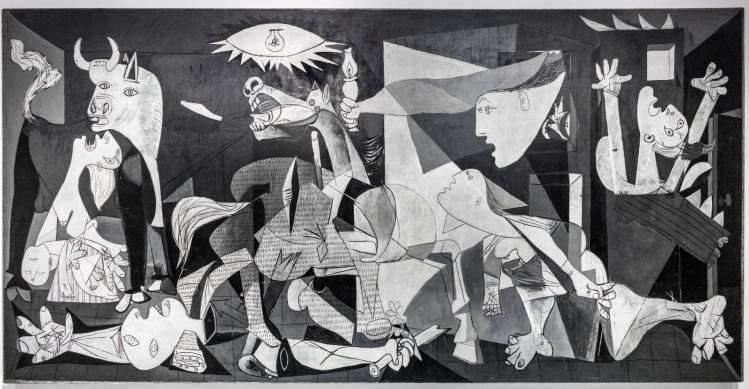
Against the illusory liberation that transhumanism promises, Leo tells us that “finitude, when truly accepted, does not diminish us but opens us to recognizing the face of God and others” (Magnifica humanitas, 122). And it is here that art makes its appearance, as a sentinel: “Authentic culture and art preserve this spark, resisting the normalization of evil.” The pope chooses three works as examples: Beethoven’s ninth symphony, a deaf man’s hymn to universal joy; Guernica, in which Picasso transfigures an aerial bombardment into a cry that can speak to every generation; and Schindler’s List, which forbids us to consign the past to oblivion. Music, painting, and film are all described here as “prophetic.” Not beautiful, not consoling, but prophetic. Art can be prophetic only because the one who creates it has an exposed body and a history.
The encyclical crosses terrain already explored by much contemporary art. One emblematic example: Michelangelo Pistoletto—the Italian artist whose mirror works remain vividly contemporary, from the 2025 New York show at Lévy Gorvy Dayan to the recent installation at the Bass Museum in Miami Beach—now speaks of an “algorithmic spirituality”: the zero and the one of code as the empty and the full, the absence and the manifestation that run through all the great traditions. In this light, artificial intelligence is not an alien force but a mirror—like Pistoletto’s Mirror Painting, which has no image of its own and gives us back our own capacity to generate worlds. For Pistoletto, reality has three layers: the biosphere, our common life; technology, a powerful network capable of “pulling the plug” on entire nations; and art, which bridges nature and artifice and keeps humanity from losing its way. This is what he calls the “Third Paradise”—not the refusal of the machine, but the responsible synthesis of the natural and technological worlds. In this vision, art becomes the tangible manifestation of a creative intelligence that draws humanity toward a point of convergence and meaning—what Pierre Teilhard de Chardin called the “noosphere.” And yet no algorithm captures the shifting essence of a person, and finitude is not a defect to be corrected: it is what gives life its depth. The machine does not die, and for that reason, it does not know what it means to receive time as a gift.
In the twenty-first century, the real danger is not that art will be banned, but that it will evaporate. Intelligence, when made absolute, “overshadows other essential dimensions of life” (113). In any ecosystem, harmony breaks down when a single species proliferates at the expense of all the others. AI is a cognitive species expanding at a dizzying rate. Without counterweights—and art is one of them—it can colonize the entire mental habitat of humankind. A Rothko cannot be reduced to data; a Beethoven quartet is not a performance metric; a line of Leopardi is not a piece of information. These are experiences that exceed every encoding, and it is in that excess that their worth resides. The open question is whether the demand for such experience will survive the relentless expansion of AI. Art does not vanish by decree; it dissolves slowly in those who no longer feel the need for it.
Let us return, then, to the question we began with. Yes, it is conceivable that the Academy might one day award an Oscar to a machine’s screenplay. It is conceivable that such a screenplay could be faultless, even moving. But the prize for which art truly competes is conferred by no jury. “No computational system, however sophisticated, can create a heart that gives itself, or a conscience that discerns good from evil,” Leo writes (233). “Even when machines excel in efficiency, a human face that asks to be gazed upon remains the center of our history.” In his last encyclical, Dilexit nos, Pope Francis warned us that to save the human in the age of artificial intelligence, we need poetry and love. Art is the gesture of one exposed life reaching out toward another. A machine may receive an award, but it cannot return a gaze.
This article was included in a symposium about Magnifica humanitas in Commonweal’s July/August 2026 issue. To read all the articles in the symposium, click here.
We welcome your comments about this article. Please send your response to [email protected].