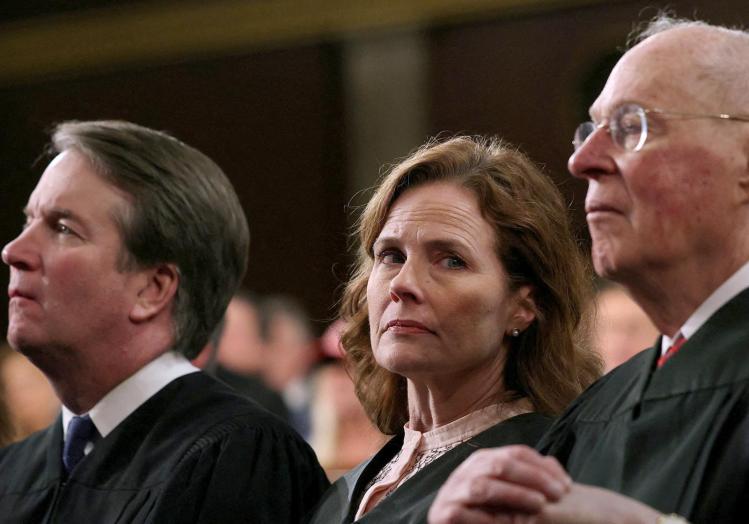
By all accounts, Amy Coney Barrett shines as a parent, friend, and teacher. If the goodness demonstrated in her personal life has been some kind of political stratagem, she has played a long game on par with that of the KGB sleepers of The Americans television series. Person Barrett merits admiration.
But is America blessed to have Associate Justice Barrett on our Supreme Court during the presidency of a man who instigated an insurrection and frays the rule of law daily? Listening to the Law: Reflections on the Court and Constitution does not reassure. Rather, it whistles past our liberal democracy’s graveyard-in-waiting. It ignores dangers of the moment to calm us with schooling on court and Constitution and a recitation of Barrett’s judicial philosophy. Part of that philosophy, oddly, might comfort abortion-rights advocates surveying the post-Roe landscape. Part should alarm anyone relying on the court to check a rogue White House.
Barrett’s lessons on the court presuppose some crisis of public confidence in its internal comity. Barrett tells readers that, while animosities infected past Supreme Courts, the court today hums along, decorous in manner, consistent in procedure, and conscientious in deliberation. Efficient protocols ensure that the cases heard are the worthiest among the tidal wave of petitions that crash down on the court each year. Further on, rigorous exchange between justices and clerks bring select issues and arguments to a high luster. (Barrett, who clerked for Antonin Scalia, endorses an anonymous description of forensic jousting in the chambers of the late, especially impassioned justice: “Every battle is fought out like an Italian street fight.”)
The justices’ shared ethic of collegiality allows thoughtful parsing of differences. During oral-argument weeks, orderly justices-only Friday conferences bring consensus when possible, and prize respect always. Assigned justices proceed to compose draft opinions—majority or dissenting—which then circulate and undergo varying measures of revision. The frequent lack of reasoning in orders flowing from the emergency docket, a.k.a. the shadow docket, prevents premature hardening of conclusions on matters not fully briefed. Reasonableness prevails throughout. All is well.
Barrett traces the history that gave us this dependable, well-oiled judicial machine as well as the history of the Constitution itself. These accounts, enlivened with colorful anecdotes and asides, are clear and engaging. The style brings to mind E. H. Gombrich’s wonderful A Little History of the World. Despite its autobiographical garnishes, Listening to the Law could land on the civics syllabus of a school district that shades red and wishes its students to imbibe the conservative’s tenets of jurisprudence: originalism, textualism, and judicial restraint.
Barrett presents originalism, i.e., taking Constitutional provisions to mean no more or less than what they meant when the Constitution was adopted, as “the right way to think about law.” She does, however, echo her originalist mentor Scalia and declare that she is not a “nut.” Hence, she doesn’t seek the uprooting of all past nonoriginalist decisions. Supreme Court giants such as John (and Thurgood) Marshall, Benjamin N. Cardozo, Felix Frankfurter, and Oliver Wendell Holmes Jr., none of whom discerned a unique legitimacy in originalism, would be pleased to hear it.
Nonoriginalists complain that originalism leaves us captives to the “dead hand of the past,” a past in which only white men of property (often slaveholders) had a voice. Barrett does concede it is likely that “our current Constitution does not fully reflect the values and challenges of today.” She answers, though, with the solution of constitutional amendment.
Scalia, ever daring to lead with his chin, once calculated that less than two percent of the American public could thwart an amendment making its required rounds through Congress and state legislatures. Barrett acknowledges merely an “imposing bar” to amendment. A “slightly lowered bar…might be prudent.” Meanwhile, we ought to make do under the Constitution that Scalia unabashedly pronounced “Dead, dead, dead.”
Advocate again edges out teacher when Barrett discusses textualism, i.e., statutory interpretation tightly bounded by a statute’s plain language with little to no regard for a law’s spirit or purpose. Nontextualists will often look for guidance in a statute’s legislative history as revealed, for instance, in committee hearings, counsel analyses, and floor debates. Barrett warns that “legislative history sometimes qualifies as legislative fiction.” She relates that a brief to the Court by two unnamed U.S. senators cited a colloquy that they (allowably) injected into the Congressional Record after actual debate, despite the exchange never occurring. Barrett leaves out that an opposing party demonstrated due diligence, uncovered the deceit, and brought it to the court’s attention. The episode then reflects more on the two senators—Republican members of the bar Lindsey Graham and Jon Kyl—than on the general utility of legislative history.
In keeping with her contention that textualism has appropriately “swept the field,” Barrett points triumphally to a “dramatic decline in reliance on legislative history,” which, she says, is easily cherry-picked. She primarily cites a 2006 study for this proposition. She omits the authors’ note that “the Court’s use of legislative history may be deliberative and coherent in ways that legislative history skeptics have not imagined.”
Barrett’s judicial restraint maintains both a personal and a broader institutional dimension, the latter consisting of a restrained approach to the court’s power and role. On a personal level, Barrett is adamant about the divide between her private convictions and her job as a judge. Every judge swears “to leave personal preferences and biases at the courtroom door.” Barrett describes a mental exercise of turning facts around to ensure that a preferred result has not hijacked her neutral reasoning. “If a free speech claim involves a message with which I sympathize, I plug in a message I disfavor.”
On account of Barrett’s deeply held Catholic beliefs, two issues have placed in high relief the tension between official duty and individual conscience: the death penalty and abortion. Barrett recounts that, when still a law student, she collaborated with a distinguished Catholic academic to explore the problems presented for Catholic judges dealing with capital cases. Barrett accepts the Church’s prohibition on the death penalty as binding. (This sets her apart from Scalia, who in First Things rejected the “Church’s new [albeit nonbinding] position on the death penalty.”) Barrett nevertheless has seen her way clear to affirm the constitutional soundness of death sentences, just as did former justice Stephen Breyer, also a death-penalty opponent.
One can still hope, of course, that Barrett, not as Catholic but simply as a keenly astute American, will come to recognize how deeply, inevitably, and fatally racism infects our death penalty. Even the decidedly nonwoke Scalia conceded in internal court memoranda that “the unconscious operation of irrational sympathies and antipathies, including racial, upon jury decisions and (hence) prosecutorial [ones], is real…and ineradicable.”
As my fellow death-penalty foes might chafe at Barrett’s holding back her personal beliefs on one front, abortion-rights champions will now, post-Roe, be counting on Barrett’s self-discipline. Barrett’s personal beliefs about abortion go beyond the Church’s stance. Two pro-life newspaper ads bearing her name drew attention during her confirmation hearings. One from 2006 (rightly!) described Roe as “barbaric.” A second from 2013 stated that “since the Supreme Court’s infamous Roe v. Wade decision, over 55 million unborn children have been killed by abortion.”
The latter ad reveals Barrett’s belief that all abortion amounts to homicide, a view suggested by the rhetoric of, for instance, Archbishop Charles J. Chaput and Bishop Robert Barron. Forget gestational distinctions, common law’s “quickening,” Thomist “delayed ensoulment,” or the biological reality of fertilized eggs twinning into two organisms. Forget Pope Francis’s 2022 statement that fetal personhood remains under debate. Children are being killed in massive numbers.
A movement exists for the Supreme Court to extend protection to all life in the womb through the Fourteenth Amendment, protection that would keep with citizen Barrett’s perspective. This proposed route to a nationwide ban is not new. An amicus brief in Dobbs from heavyweight pro-lifers Robert P. George and John Finnis makes it hard to dismiss as fringe. An ascending “common-good constitutionalism” puts some wind at its back.
Justices Thomas and Alito are likely takers. Justices Gorsuch and Kavanaugh may be game as well. So, ironically, some of Barrett’s fiercest detractors, folks who painted her as a tool of theocratic patriarchy and traitor to sisterhood, may be left depending on not only her avowed federalist devotion to legislative process, state autonomy, and regional diversity, but to her individual judicial restraint.
Barrett’s discussion of institutional judicial restraint and power serves poorly in America in 2025. Let’s inventory. Federal prosecutors serve a retributive agenda or find new employment. Inspectors general suffer illegal termination. The military’s Judge Advocate General’s Corps undergoes decapitation with removal of top judge advocates. Generals and admirals are summoned to hear their commander-in-chief propose our “dangerous cities as training grounds for our military.”
An overcharged, overfunded, masked ICE engages in massive racial profiling and recruits with the lie that we have been “invaded by criminals and predators.” An executive order negates the guarantee of birthright citizenship. National Guard troops arrive uninvited in non-MAGA states. Regulatory agencies struggle to retain independence. Major media succumb to shakedowns and self-censor. Powerful law firms grovel. Universities cower and cave.
This is no moment to play down the court’s unique authority, present it as vaguely negotiable, or narrow its effect. “[W]hile the Court gets the last word about who wins an individual case, it does not necessarily get the last word about what the Constitution means.” “While the judiciary’s judgment is final as to the litigants before it, the reasons supporting its decisions are subject to further discussion.” “The opinion sets a precedent that courts will follow in the future, and in general, Congress, the president, and states follow it too. But public officials also take an oath to uphold the Constitution, and when they disagree with the Court’s opinion about what the Constitution requires, they sometimes assert the right to follow their own interpretation of the Constitution rather than the Court’s.” Wouldn’t that be more safely phrased “the right to voice or advocate for their own interpretation”?
Barrett quotes Andrew Jackson saying that the “opinion of the judges [about a federal bank] has no more authority over Congress than the opinion of Congress has over judges, and on that point the president is independent of both.” Barrett then casually remarks: “Perhaps unsurprisingly, the Court has taken the contrary position that Congress and the president must heed its opinions.” One might think that the principle of judicial review, foundational to our constitutional order, just depends on institutional perspective.
Barrett takes for granted the court’s (current) final say in the matter immediately before it. In normal times, this would offset some disappointing language and tone; they could be taken as overzealous expressions of respect for coequal branches of government or defended with qualification. We do not, however, inhabit normal times. Judicial authority itself has never before been challenged so brazenly by a president. Ambiguity or perceived ambivalence endangers the rule of law.
Trump rants against “communist radical-left judges” in the lower federal courts “assum[ing] the duties that belong solely to the President of the United States.” A step ahead, J. D. Vance, when asked about Supreme Court authority over the executive branch, repeated Andrew Jackson’s (likely apocryphal) defiant challenge: “John Marshall has made his decision [regarding the Cherokee Nation], now let him enforce it.” (An acting attorney general in the first Trump administration had been on record disputing the role of the “Supreme Court as the final arbiter of constitutional issues.”)
When Barrett claimed on Bari Weiss’s podcast in September that she would “not know what a constitutional crisis would look like,” could she really have meant it? Barrett observes that the court cannot patrol the land as a “national constitutional police.” True enough. But the court’s appeasing a national constitutional outlaw has not worked. It did not work in July 2024 when Barrett joined in conferring immunity from prosecution on the indicted president. It did not work in June 2025 when Barrett wrote the court’s opinion undercutting the use of nationwide lower-court injunctions to protect birthright citizenship, thereby creating what Justice Ketanji Brown Jackson termed a “zone of lawlessness.”
The American public now requires more than a book that brims with patriotic optimism but ignores our national peril.
Listening to the Law
Reflections on the Court and Constitution
Amy Coney Barrett
Sentinel
$32 | 336 pages