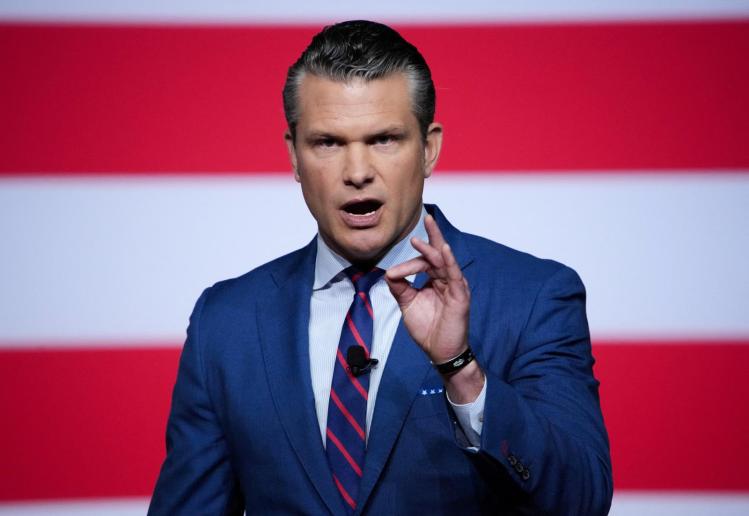
Among the many contentious cabinet nominations of President Donald Trump’s second term, few stirred up as much controversy as Pete Hegseth’s appointment as secretary of defense. Hegseth gained Senate confirmation by the narrowest of margins, with Vice President Vance casting the tiebreaking vote. During the nomination process, the former Fox News personality was accused of sexual assault, alcoholism, financial mismanagement, and woeful inexperience, especially relevant given that the Department of Defense (DOD) is the largest bureaucracy in the federal government.
Hegseth has been widely criticized since taking over leadership of the Pentagon. In March, he participated in a high-level conversation about a strike against Yemen on an unsecured group chat that mistakenly included the editor in chief of The Atlantic. Meanwhile, a number of DOD officials have either resigned or been fired, leading to concerns about personnel staffing and the impact of high turnover.
But there is another troubling part of his tenure that has attracted less attention: his decision to undo the military’s efforts to reduce civilian casualties caused by their operations. Those efforts, underway for some time, had reached a point of real promise. It is a story worth recounting in detail to understand the damage being done under Hegseth’s leadership.
During the so-called “war on terror” following 9/11, military experts came to see that high numbers of civilian deaths in Afghanistan and Iraq were turning local populations against Western invaders and aiding terrorist recruitment efforts. Senior officers like David Petraeus and Stanley McChrystal had learned lessons from Vietnam and, in devising a counterinsurgency strategy, made the protection of civilians a major objective. As a consequence, civilian deaths in 2009 and 2010 dropped by double-digit percentages.
In 2015, after a significant series of internal debates around these issues, the Pentagon issued The Department of Defense Law of War Manual. It organized existing legal directives to convey how the military was to implement and follow the law of war. It also clarified policy. For example, international law acknowledges that legitimate targets may be fired upon even if there is a high risk of civilians nearby being harmed or killed, but only if the anticipated civilian death toll is proportionate to the military objective of the attack. Some interpreters of these laws maintained that there are categories of civilians excluded from the calculus of proportionality: namely, “human shields” and civilians, such as mechanics or cooks, assisting an enemy’s efforts. But the manual established that commanders had to factor in the anticipated harm to such civilians.
The manual was released amid changing priorities during President Obama’s second term: the war on terror was moving away from infantry forces on the ground and toward bombardment from the air. As is widely known, air tactics had been far less discriminate and proportionate in past wars. Hundreds of thousands of German and Japanese civilians died as a result of air raids in World War II. The atomic bombs dropped on Hiroshima and Nagasaki killed an estimated 140,000 and 70,000 civilians respectively. The “secret” bombing of Cambodia during the Nixon presidency may have killed as many as 150,000 civilians.
But by the end of the Obama administration, there was confidence a new generation of “smart” weapons would make an air war far more precise and proportionate. The New York Times stated, “By April of 2016, the Pentagon was reporting that American airstrikes in Iraq and Syria had killed 25,000 ISIS fighters, while resulting in the deaths of just 21 civilians.” Even so, in 2017, Secretary of Defense James Mattis ordered the Joint Chiefs of Staff to provide a review of civilian casualties and called for a renewed DOD policy on mitigation of harm to civilians. That mandate was the distant origin of the “Civilian Harm Mitigation and Response Action Plan” (CHMR-AP), which Hegseth has effectively ended.
Despite Secretary Mattis’s action, during the first Trump administration there was less emphasis on avoiding civilian casualties and greater stress on a total defeat of ISIS. Yet reports of civilian casualties continued to remain quite low even as bombing attacks and reported ISIS casualties increased.
Then, in September 2021, The New York Times published an investigation of a drone strike in Kabul the previous month. The military had reported that the target was a vehicle laden with bombs heading for the city’s airport, but the drone had actually destroyed a vehicle driven by a humanitarian-aid worker. He and nine other civilians, seven of whom were children, were killed. A subsequent article in the Times reported that dozens of civilians had died in Syria as the result of a 2019 bombing, which the military had again kept from public awareness. These articles gave credence to various NGOs that for several years had been reporting civilian death tolls higher than U.S. military figures.
Finally, in December 2021, the Times released a slew of documents obtained through a Freedom of Information Act request showing these incidents were not exceptions in the air war but closer to the norm. In a series of reports that won a Pulitzer Prize, journalists analyzed approximately 5,400 pages of documentation revealing that thousands of civilians had died from U.S. bombing in a campaign “plagued by deeply flawed intelligence” and “rushed and imprecise targeting.”
A former Pentagon official, Sarah Yager, now Washington director at Human Rights Watch, wrote in a retrospective essay for Foreign Affairs that the “U.S. military’s overall record on civilian harm is shameful.” A number of the bombing incidents “appear to be violations of the laws of armed conflict,” while “others represent possible war crimes.” Shortly thereafter, a congressionally mandated independent review of the DOD’s civilian-casualty policies and procedures was published by the RAND Corporation. The conclusion of the ninety-two-page report was that the “DOD is not adequately organized, trained, or equipped to fulfill its current responsibilities for addressing civilian harm.”
It was clear that the new Biden administration had to respond to the growing onslaught of criticism. In late January 2022, Secretary of Defense Lloyd Austin issued a memorandum calling for the creation of the CHMR-AP. The aim was to prioritize the protection and restoration of the civilian environment in future military operations. Austin also emphasized learning from past mistakes and called for improved accountability for violations of DOD policy.
Released in late August 2022, the plan stated at the outset that “[t]he protection of civilians is a strategic priority as well as a moral imperative.” For most people, the moral imperative is clear; killing noncombatants in war is always a moral tragedy, though potentially justifiable within both the just-war and international-law traditions. The issue of strategic priority might not be as obvious, but causing harm and death to civilians may be one reason for decades of U.S. military defeats and stalemates. The prospect of winning civilians’ hearts and minds tends to evaporate amid widespread death and destruction.
The CHMR-AP was organized around eleven objectives addressing a variety of topics: improving knowledge about the civilian environment; reducing errors in identifying targets; integrating guidance into training; policies on transparency and responding when civilians are harmed; and the establishment of a Civilian Protection Center to research and study the problem. The plan was set to end in 2025, but the policies, procedures, and institutions created were meant to last. The goal was to transform the culture to the point that mitigating civilian harm would be seen as a crucial part of the military’s mission.
Many NGOs that had lobbied the Pentagon for years gave the plan positive, if cautious, reviews. On paper it was impressive, but would it be translated into action? It was almost a year and a half before the DOD released an instruction memo with authorization and implementation details, but, despite the slow start, observers reported that the CHMR-AP was being phased in.
An important measure of progress came in November 2024, when the Center for Civilians in Conflict and the Stimson Center jointly issued a sixty-three-page report assessing the state of implementation. Successes in increasing expertise across the DOD were notable. Nearly all the 166 new positions called for in the original plan had been filled and new CHMR institutions in the Pentagon were created to oversee DOD work on civilian-harm mitigation and response. There was also steady progress related to assessing, investigating, and responding to incidents of civilian casualties. Perhaps the weakest area evaluated involved allied partners. The major item of concern here, of course, was the ongoing support for the Israeli government and military amid drastic civilian harm in Gaza.
Prior to his inauguration, Trump’s transition team presented Pentagon officials with a set of early priorities. One was a review, with an eye toward abolition, of the Civilian Protection Center, a key part of the CHMR-AP that Congress had created with a bipartisan majority in 2023. TheWashington Post reported that this was likely part of an effort to distance the Trump administration from Biden-era priorities around civilian safety in conflict areas. The CHMR-AP had created the center to provide combat commanders with information about civilian life in combat areas so they could avoid unintended deaths.
Upon assuming his role as secretary of defense, Pete Hegseth quickly acted to close Pentagon offices and fire personnel implementing the CHMR-AP. He fired the top military lawyers for the Army and Air Force and accepted the resignation of the Navy’s top judge advocate general. Just about every one of the 166 positions created as part of the CHMR-AP were to be eliminated. Given that the implementation of the CHMR-AP was still ongoing, the plan can now be considered “stillborn,” as one critic of Hegseth’s actions put it.
It’s unlikely the secretary of defense is pursuing a path of action with which the president disagrees, but Hegseth’s decisions reflect an agenda he held prior to his role as a member of the Trump cabinet. He spoke repeatedly during his days as a Fox News commentator of the need to restore a “warrior ethos” in the military. During his Senate confirmation hearing, Hegseth was questioned by a number of senators who sought clarification as to what such an ethos entailed. His answers were characterized as “often evasive.”
Hegseth fired top uniformed military lawyers not over any particular dispute but simply as part of an agenda to embrace the warrior ethos. For years, he has criticized military lawyers for imposing overly restrictive rules of engagement upon soldiers in combat. During Trump’s first term, he lobbied the president to pardon American troops convicted of war crimes for their actions in Iraq or Afghanistan. “They’re not war criminals,” he claimed, “they’re warriors.” When he was commanding troops in Iraq, he reportedly told them they were free to ignore the rules of engagement.
One of those pardoned was a first lieutenant, Clint Lorance, a soldier turned in by his own troops. He had ordered those under his command to open fire on unarmed Afghans over a hundred yards away. He then filed a false report stating the dead bodies had been taken away and could not be searched for the presence of weapons. Army lawyers were in strong disagreement with the decision to grant Lorance a presidential pardon, as were the troops who served under him and testified at his trial.
To add one more morally dubious judgment to the record, Hegseth has questioned the Geneva Conventions, a foundation of the international law of war. This was not just an off-the-cuff comment; in his book, The War on Warriors, he proposed that the U.S. military win according to its own rules, not those made by the community of nations.
All of this is to serve “lethality, lethality, lethality,” which Hegseth cited during his confirmation hearing as the focus of his job as the Secretary of Defense. But as Claire Finkelstein, faculty director at the University of Pennsylvania’s Center for Ethics and the Rule of Law, observes: “Lethality as a blanket goal will not help the United States win wars as such. What is needed is precision lethality. When the U.S. military is unsuccessful in its targeting objectives, the costs—not only to the affected civilians—are exponential.” Along with the financial waste of increased spending on military equipment, she writes, the emphasis on lethality may put more U.S. personnel in danger, create resentment from countries we may need as allies, and lead to an uptick in terrorist or enemy activity.
Finally, many senior military commanders support a different and richer notion of a warrior ethos than Hegseth’s morally impoverished version. The virtuous warrior would embrace not only the aim of victory but also ideals of discipline, honor, and respect for the Uniform Code of Military Justice. For centuries the just-war tradition has fostered ethical debate and refinement of the norms of warfare. But its bedrock principles have remained consistent: a commitment to discrimination regarding legitimate targets and to proportionality in weighing the evils caused when pursuing a good.
Among those evils are “moral injuries,” which have afflicted many veterans of our recent military operations. As Lt. General David Barno, who commanded forces in Afghanistan, understands, “Combat can spin out of control and lethality and fighting can turn quickly into murder when passions run wild.” While moral injury can be connected to posttraumatic stress disorder, it is distinct from it. The Moral Injury Project at Syracuse University defines it as “the damage done to one’s conscience or moral compass when that person perpetrates, witnesses, or fails to prevent acts that transgress one’s own moral beliefs, values, or ethical codes of conduct.”
The CHMR-AP—by many accounts a serious project with real promise of lessening noncombatant casualties—was a promising sign that just-war ideals might be translated into policy and practice. Now, that ongoing moral conversation is being sidelined in the name of Hegseth’s warrior ethos. His actions suggest that the U.S. may fight instead in a manner indistinct from that of Russia in Ukraine, with little regard for moral concerns. His warrior ethos may not only cost civilian lives but incur moral injury for American soldiers and shame for the nation’s moral standing.