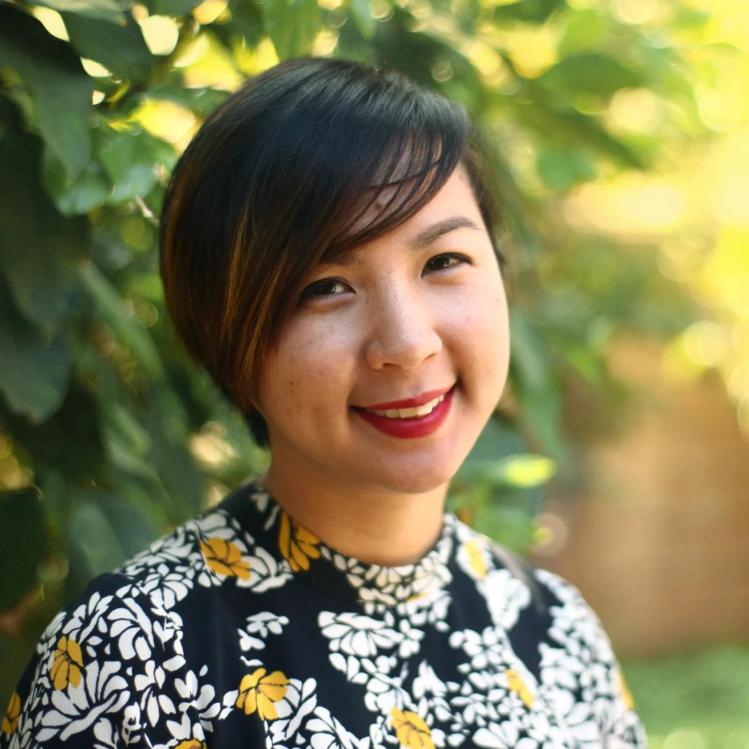
The story of Cathy Linh Che’s parents sounds like the plot of a movie: Vietnamese refugees who, while in a camp in Manila in 1976, were cast as extras in Francis Ford Coppola’s Apocalypse Now. But Che is a poet, and in her second collection, Becoming Ghost, she crafts a lyrical mosaic of her parents’ story and her own. The shards with which she works include the losses of children and homeland, the reverberations of war in their new American lives, intergenerational trauma, and the contradictions of two refugees performing their experiences for a war movie that would be nominated for eight Academy Awards three years later.
In an interview, Che explains that her parents took a small vessel to the Philippines after the war ended in 1975. Near the end of their eleven months there, they were cast in the film along with hundreds of others. “My parents were used to authenticate this art,” she says. “[Coppola] really wanted it to feel like the real thing, and the only Vietnamese people in the Philippines at the time were refugees. That’s the only people you could get access to. So their invisible narrative in this highly visible film is something I’m working with.”
In exploring her family’s history and how it was put on display, Che does not seek to untangle the complex threads of what it means to be a daughter of refugees. Instead, she keeps them tangled. Her poems, rich in imagery and formally surprising, hold the voices of daughter, father, mother, actor, survivor, abuser, director, and even zombie. Often, poems revisit the same details—a surrendered child, a death, a father disowning a daughter. But reading each is like turning a prism to reveal a new reason or consequence.
One of the most pleasurable parts of reading the collection straight through is wondering whose voice we might encounter. In the same interview, Che recalls that her parents were masterful storytellers, and that she absorbed their voices and their histories into her own, as happens to many children of immigrants trying to piece together their identity across languages and hardships. In Che’s collection, we hear the mother on the bizarre artifice of her role: “We’d survived a war / to be cast into the margins // of our own story.” The father, struggling to look forward when the past grips him: “Your life was nothing / I could fathom // from the hell / we kept / escaping.” Or the speaker, haunted by her father’s trauma: “I don’t want to carry the weight / of my father’s war.” Sometimes, as in the opening poem, the first of six titled “Becoming Ghost,” every voice calls out in a fractured and mournful chorus.
Che’s use of form and several poem series that share the same title reinforce the recursiveness of remembering, translating, and living with ghosts. One form called the golden shovel, Che explains in her notes, was “developed by Terrance Hayes, to take sentences from scripts written by Francis Ford Coppola and John Milius, using the words of these sentences as the last word of each line in a new poem.” The most striking of these is “I love the smell of napalm…” comprising nineteen lines that each end with one word from the Apocalypse Now line, “Napalm, son. Nothing else in the world smells like that. I love the smell of napalm in the morning.” In the movie, Robert Duvall, playing Lt. Col. Kilgore, is brazenly shirtless, lean and strutting, shouting orders amid diving jets and napalm explosions, seemingly impervious to the toxic green-orange plumes as he utters that infamous line. He wears a tall, black U.S. Army Air Cavalry hat and gazes reflectively into the distance with an air of ownership over everything around him. The poem and its form enter that scene, exposing an American fantasy against the mother’s bleak reality: “War takes everything we love.” Two lines later, the mother unravels our collective cinema mythology further: “Scene of / myself on a film set. I was the Viet Cong. I was the scenery.”
Watching an Asian American character on the television series The Walking Dead generated a poetic connection for Che in 2015. In her book’s notes, she reflects, “In watching the show, I was struck by the similarities between the experiences of the survivors in the show and my parents’ experiences as refugees escaping the aftermath of the war.” The result was a series of ten poems titled “Zombie Apocalypse Now.” The zombie-apocalypse survivors are stateless like refugees, searching for safety, unsure of how or where to rebuild.
As Che meditates on and merges these two worlds, both literally and figuratively cinematic, she exposes the strangeness of her parents being on a movie set. In the first poem of the series, the father’s raw description of becoming a refugee—“The tectonic universe shifts, // and we are forced to move / like birds fleeing the seasons”—is as plaintive as his lines about the movie: “They ask me to follow / the script. // My death written / before I was born. // When the director yelled Cut! / a whole life evacuated me.” In another, the mother describes multiple shots of the same scene: “I threw myself / onto the dirt // again and again, / pretending // to be shot / in the back. // To the viewer, / I was dead. // I felt dead.” But the zombie-apocalypse poems also cast Coppola and his crew as the devouring undead, gorging themselves on her parents’ pain. The book’s speaker becomes an “unfillable” zombie trying to become human, and then, in the book’s final poem, she is a director, curating her family’s stories, striving to order their voices.
Che’s book turns the camera to the margins of an iconic movie about American male interiority with Vietnam as its backdrop. “History is being viewed / on the television through / the eyes of white America,” declares the speaker of the poem, “FADE IN, EXT.” She continues, “The / fact is, my parents were barely visible through the veil / of that gaze. They were the props of / empire. Characters with short time / and no lines. Or / props to smell like a / real thing. Movie so real, it’s beyond a dream.” And yet, reconciling our imaginations to history is not a matter of countering fiction with facts. In an interview with IMPULSE Magazine, Che says, “Part of this book is me talking to the dead, talking through voices that are no longer alive.” By reviving lost voices, even if mediated through her voice and poetics, Che is filling a silence long needed for a particular American narrative to survive. We see it from Raiders of the Lost Ark to The Mission—white men inexplicably holding absolute control over Native people, completing full and complex character arcs while Natives remain silent props in their own country. In another series of poems, each titled “The Extras’ Commentary,” Che presents tiny vignettes of her parents’ lives off camera, giving flesh and feeling to people made into scenery.
In the end, Che’s book project goes beyond making her parents merely visible and makes them fully human, with wounds that haunt, grace, and harm. There is, among all of the pain that Che unearths, a hope that pulses along all the loss. In the poem “Go,” she presents a stunning crescendo of humanity. Beauty: “Here and now, I make room for joy. / Birds ribbon the air with their singing. // Their voices riot up. The planes / with their hulking engines— / They fly too.” Weariness: “I’ve polished this anger and now it’s a knife. / I’m hardened as a hunter / ornamenting his cave // with the bones of the dead. / I’m so sick of history / dragging behind me.” And tenderness: “To love my father / is to love his wounds.”
Becoming Ghost
Poems
Cathy Linh Che
Washington Square Press
$17.99 | 128 pp.