During Donald Trump’s 2016 presidential campaign, J. D. Vance—then the fresh-faced, thirty-one-year-old author of the just-released memoir Hillbilly Elegy—speculated in a message to an old Yale Law School classmate that the Republican nominee for president was poised to become “America’s Hitler.”
I have no idea if Donald Trump will descend into the same elite hell-circle of history currently occupied by Hitler, as the principled young gentleman who would go on to become Trump’s vice president once predicted. In either case, it would serve the cause of interpreting Trump’s impact on U.S. politics and society well to expand the roster of authoritarian leaders with whom to compare the past, current, and perhaps future U.S. president.
Second-term Trump has put me in mind of former Chilean dictator General Augusto Pinochet. While a great deal separates them, there are parallels between Pinochet’s Chile and the rapid unspooling of democratic institutions and norms in the United States under the Trump administration. Prior to Pinochet’s rise, Chile was Latin America’s oldest and most stable democracy. Then, on September 11, 1973, Pinochet led a CIA-backed military coup against the country’s democratically elected socialist president. He styled himself as a conservative strongman savior of a nation infected by leftist ideology, soaring inflation, and social unrest. Soon after seizing power, he established a secret police force, the DINA (Dirección de Inteligencia Nacional), a Gestapo-style military police force tasked with surveilling, detaining, torturing, and eliminating anyone suspected of political opposition to the regime. Created in response to a national state of emergency, the DINA operated outside both the military’s chain of command and the civilian judicial process, instead reporting directly to Pinochet. The result was a situation of freewheeling, unaccountable, violent repression.
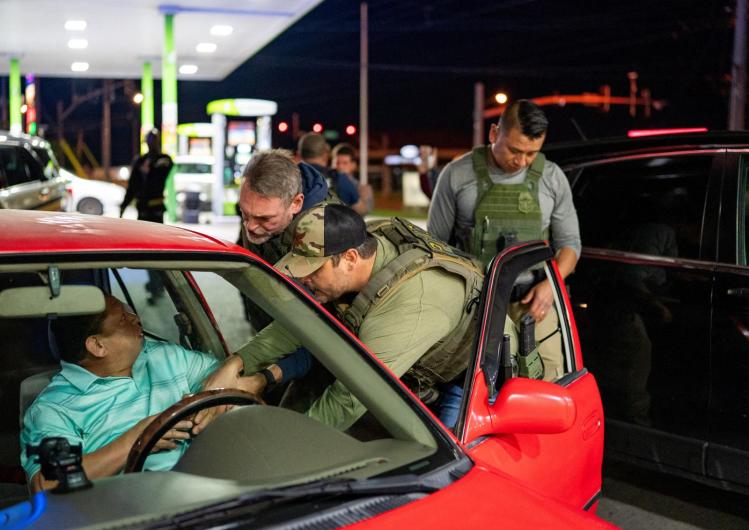
The Trump administration seems determined to fashion ICE into an American-style secret-police force—a group of unidentifiable agents encouraged to operate with impunity in service of a far-right agenda. Trump campaigned on the promise of taking back America from the “woke” left and on restoring American greatness by unleashing a program of mass deportation. ICE has become the primary instrument of that promise. Unlike typical law enforcement, ICE officers cover their faces with balaclavas and obscure their names and affiliations. Videos of violent arrests indicate that agents are unafraid of accusations of excessive force and unencumbered by the expectation of accountability. The terror the agency has unleashed has torn apart communities and driven migrants, asylum seekers, and their families into the shadows.
ICE has rapidly come to function as an ideologically motivated, extrajudicial tool of an increasingly authoritarian executive branch. The massive funding bill approved by Congress and signed into law by Trump in July tripled the agency’s annual budget, making it the highest-funded federal law-enforcement agency in the country. Announcing plans in August to hire an additional ten thousand agents, the Department of Homeland Security issued a press release with a statement from Kristi Noem that ICE “will waive age limits for new applicants so even more patriots will qualify to join ICE in its mission to arrest murderers, pedophiles, gang members, rapists, and other criminal illegal aliens from America’s streets.” This was an actual U.S. government communication from an actual U.S. government agency.
Despite the rhetoric, ICE has primarily targeted asylum seekers and undocumented migrants who live, work, and raise families here, as well as a cadre of others—international students who’ve spoken out against the war in Gaza, men with suspicious tattoos, ordinary American citizens who appear to fit the “illegal alien” profile. Detainees are denied due process, prevented from communicating with their families or lawyers, and shipped off to remote detention centers, where many have testified to enduring physical, psychological, and sexual abuse while in U.S. custody. Some are deported before their loved ones even know what has happened to them. The administration has vastly expanded the use of expedited removal through legally circuitous means. Meanwhile, the practice of “extraordinary rendition”—the extrajudicial deportation of individuals to a third country, as in the Trump administration’s ghastly agreement to send migrants to El Salvador’s Terrorism Confinement Center (CECOT)—prompted U.N. human-rights experts to warn of the United States’ failures to “protect people from torture and other prohibited cruel, inhuman or degrading treatment or punishment, enforced disappearances, and risks to life.”
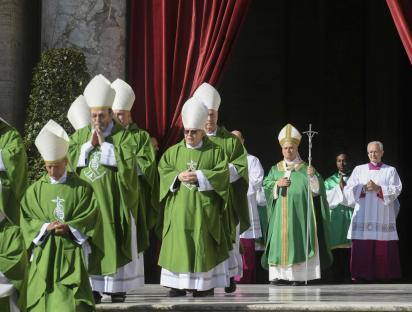
In response to the administration’s immigration crackdown, U.S. bishops and other religious leaders have spoken out with increasing force in defense of migrant rights. On June 20, World Refugee Day, San Diego bishop Michael Pham celebrated Mass and then led a delegation to the downtown courthouse to offer witness and accompaniment to those awaiting immigration hearings. Reportedly, because of Pham’s presence, ICE agents quickly left the area, and none of the day’s anticipated arrests took place. More recently, the diocese launched an interfaith partnership called FAITH (Faithful Accompaniment in Trust & Hope), which coordinates volunteers to accompany migrants through immigration proceedings. In July, Bishop Alberto Rojas of San Bernardino became the first prelate in the country to issue a formal dispensation to Catholics afraid to attend Mass out of a fear of immigration raids. In a letter to the faithful, Rojas cited a recent case of ICE agents entering parish property in San Bernardino “and seizing several people.” He continued:
We have seen a change and an increase in immigration enforcement in our region and specifically in our diocese. Authorities are now seizing brothers and sisters indiscriminately, without respect for their right to due process and their dignity as children of God.
In the face of this crisis, one wonders if there is anything more the Church in the United States can do to defend the vulnerable from threats by the Trump administration. On this question, too, the example of Pinochet-era Chile can offer insight. In 1973, less than a month after the coup, Cardinal Raúl Silva Henríquez, head of the Archdiocese of Santiago, worked with other religious leaders to establish the Committee of Cooperation for Peace (Comité Pro Paz, or COPACHI). COPACHI offered legal, financial, and medical support for those who faced political persecution. Pinochet’s forces targeted COPACHI’s lawyers and associates, and Pinochet demanded that Cardinal Silva dissolve the committee, claiming it was a “hotbed of subversion” infiltrated by Marxists and Leninists. COPACHI ceased operations on December 31, 1975. The next day, Silva founded a new entity: the Vicaría de la Solidaridad, or the Vicariate of Solidarity. Unlike the multifaith organization COPACHI, the vicariate was under the direct jurisdiction of Rome and could not be dissolved by political pressure. For the remainder of the Pinochet regime, the vicariate served as the most significant moral and legal counterweight to the dictatorship. Like the organization that preceded it, the vicariate provided legal and medical services, spiritual support, economic aid, popular education, and public witness for and on behalf of torture victims and their families. But the vicariate’s most enduring legacy was in documentation. By the time its work ended in 1992, it had collected some forty-seven thousand case files documenting human-rights abuses by the regime, making it the most extensive such archive in the country. These records enabled families of the detained and disappeared to seek information about their loved ones and proved instrumental in the process of truth and reconciliation that followed the dictatorship.
Documentation is a form of justice. Undocumented migrants and asylum seekers often lack access to the kind of everyday record-keeping most citizens take for granted—police reports, medical files, workplace complaints, library cards—for fear of “touching the system.” As any archivist will tell you, if there is one thing the Catholic Church is nearly always good at, it’s record-keeping. U.S. bishops who recognize the danger posed by the Trump administration might consider putting their administrative resources to work on behalf of their vulnerable flocks by creating vicariates of solidarity in their dioceses—places for the families of those seized by ICE to record testimonies and to seek information about their loved ones. Call it “documentary accompaniment”: in the short term, a work of solidarity and support; in the long term, a vital archive of truth.