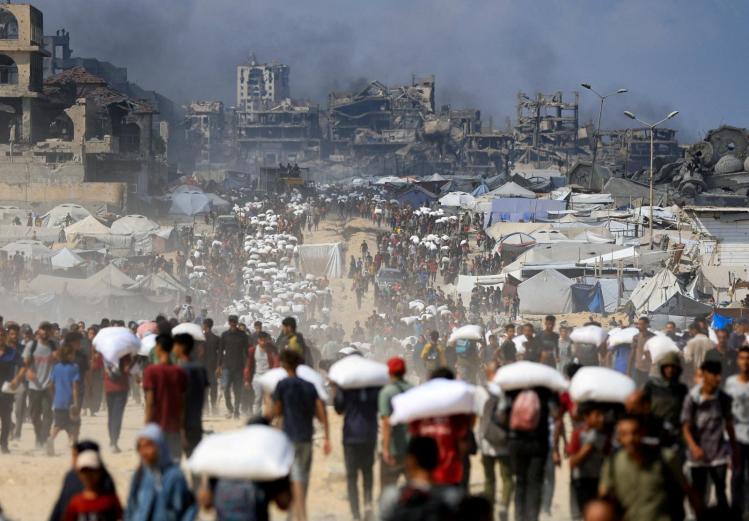
Nearly two years into the Palestinian genocide, the push toward a two-state solution seems to be gaining pace. President Emmanuel Macron announced in July that France would grant Palestine state recognition, eventually doing so in September at the UN General Assembly. The United Kingdom, Canada, Australia, Malta, Portugal, Luxemburg, and Belgium, although with conditions attached, have followed suit. More than 150 of the UN’s 197 member states now formally recognize Palestinian statehood.
The effort began in May last year, when Norway, along with Spain and Ireland, officially recognized Palestine as a sovereign, independent state within the so-called 1967 borders. As the Palestinian genocide accelerated, at the time through the Israeli incursion into Rafah, the stated aim of the recognition was to embolden the Palestinians in a future peace process. Norway was renewing its commitment to the two-state solution, to which it is nominally tied through the Oslo Accords, and resuming its diplomatic role in the region. It has also supported motions to halt arms transfers to Israel, explicitly committed to the decisions of the International Criminal Court, and upheld support for UNRWA amid Israel’s attempts to delegitimize and defund the critical aid agency. “[T]here will be no peace in the Middle East without a two-state solution. And there can be no two-state solution without a Palestinian state,” Norwegian prime minister Jonas Gahr Støre explained in Politico.
Yet Norway’s approach has achieved very little. A “future peace process” remains hypothetical, and the latest “peace deal” proposed by President Trump “promises indefinite occupation,” as The Intercept put it. Its references to Palestinian self-determination and statehood are vague and noncommittal. By exhausting the remedies available to the international community within the liberal international order, Norway has effectively exposed the practical and conceptual limits of liberalism’s primary framework—namely, the two-state solution—for achieving a just peace for Palestinians.
While diplomatic relations between Norway and Israel are cold today, the two countries began the postwar era as close allies, their relationship spurred on by tragedy. In November 1949, a flight from Tunisia carrying Jewish refugees, mainly children, crashed into a hillside outside of Oslo. It made a significant mark on the Norwegian public.
For the next two decades, Norway was one of Israel’s closest allies and greatest admirers. In particular, the Labour Party was in awe of the speed with which Israel built up its social-democratic welfare state. The Palestinians, whose expropriated property was the foundation of the Israeli state-building project, had yet to enter the Norwegians’ public consciousness.
In the 1970s, that began to change. The wars of 1967 and 1973, Norwegian participation in peacekeeping missions in Lebanon, and the emergence of a new generation of more pro-Palestinian political figures spurred a gradual shift in sympathies. But it was the Iranian Revolution of 1979 that positioned Norway to mediate. The revolution abruptly cut off Israel’s oil supply, and American diplomats approached Norway, where oil had been discovered in the North Sea only a few years earlier, about providing Israel with oil guarantees. Fearing a potential diplomatic fallout, Norwegian officials ran this suggestion by chairman of the Palestinian Liberation Organization (PLO) Yasir Arafat. He had few objections, but wanted something in return: a diplomatic backchannel into Israel.
At the time, the Israelis had hardly entertained the idea of talking to the PLO, and it took a decade of tireless lobbying by the Norwegian Labour Party for Israel to eventually come to the table. By 1993, Norway had convinced the PLO to make the concessions Israel required, and the formal framework for the two-state solution, which would shape the international approach to Palestine for decades to come, was born. It remains the lodestar of Norwegian diplomacy. In a September 2024 essay, Norway’s foreign minister Espen Barth Eide asserted that “[o]nly a two-state solution will ensure the Palestinians’ right to determine their own lives and future,” and that it is a “prerequisite for security for Israel and peace and stability in the entire region.”
While this recommitment to the two-state solution is unsurprising, it was not inevitable. Prior to October 7, support for it seemed to be waning. Criticisms of the Oslo Accords appeared to have taken hold among Western policymakers, and the international consensus in support of the two-state solution was as fragile as ever. In his essay, Barth Eide even admitted to his own doubts. He pondered whether time had run out for the two-state solution, and whether the Oslo Accords were now a straitjacket, upholding status quo with false promises of change. From someone who has been involved in Norway’s diplomatic efforts in the Middle East for more than two decades, this hesitancy was refreshing, even if it was ultimately overcome.
Norwegian scholars have corroborated Barth Eide’s doubts. Jørgen Jensehaugen of the Peace Research Institute Oslo (PRIO) has stated that “nothing in today’s situation suggests that a two-state solution is possible.” Hilde Henriksen Waage, history professor at the University of Oslo and close observer of the Oslo Accords, agrees. Twenty years ago, she published a paper showing how the peace process took place on Israel’s terms from the outset, in part because Norway did not have the geopolitical muscle for the role it wanted to play: “Norway invariably acted on Israel’s premises, bowed to Israel’s ‘red lines,’ bent over backwards to accommodate Israel’s security concerns.”
The observation is not novel. As early as 1993, the year Oslo was signed, Edward Said famously declared the accords “a Palestinian Versailles,” forcing Palestinians to abandon legitimate claims to Gaza and the West Bank in return for Israeli recognition of the PLO. Of the overall effect of the two-state framework, Adam Hanieh wrote in 2013:
By reducing the Palestinian struggle to the process of bartering over slivers of land in the West Bank and Gaza Strip, Oslo ideologically disarmed the not-insignificant parts of the Palestinian political movement that advocated continued resistance to Israeli colonialism and sought the genuine fulfillment of Palestinian aspirations.
The two-state framework, in other words, channeled Palestinian organizing into one of two camps: the impotent-by-design Palestinian Authority (PA) or groups such as Hamas and Palestinian Islamic Jihad. Space for alternative modes of resistance was suffocated. In an interview with New Left Review, Rashid Khalidi describes the Oslo Accords as the formalization of shifting aims within the PLO “from a position of liberation of all of Palestine, with a secular-democratic state for Muslims, Christians and Jews in which everybody is equal, to a one-state plus multiple-Bantustans solution.”
The doubts of Palestinian scholars are further supported by the map of the proposed Palestinian state. It shows a fragmented West Bank, scattered with settlements now home to over seven hundred thousand Israelis and tenuously linked to Gaza by a narrow corridor cutting through Israel proper. Those concerned with Palestinians’ well-being should see that prosperity is not possible under this geography. And those concerned with Israeli security should ask themselves how this solution will persuade anyone to lay down arms and abandon rightful claims to land their family lived on less than two generations ago.
Criticism of the two-state framework is often met with the retort that one state is even more of a fantasy. But this sense is shaped by the prior commitment of policymakers to the two-state paradigm. This circular logic renders the framework self-validating, reinforcing the two-state solution’s dominance and crowding out space to envision alternative futures for Palestine. Similarly, as Norwegian diplomacy keeps the two-state solution on life support, it may well work to obstruct the growth of a global movement for one state with equal rights in historical Palestine.
We should instead take seriously what both Palestinian scholars and the Israeli government have been telling us for years, that the two-state solution is dead. It’s time to examine its legacy, including the dilution of power and responsibility in occupied Palestine. The PA, one of the principal inventions of the Oslo Accords, mainly serves as a mirage state, ready to absorb blame for and to justify continuous cycles of political violence by the occupying power. Because its existence is preconditioned on Israel’s apartheid regime, the PA has neither the will nor the power to represent any meaningful challenge to Israeli settler-colonialism. This two-state framework without a genuine second state has allowed Israel to maintain material power while escaping responsibility.
The two-state solution is thus less a political compromise than a moral one. Its attraction lies in the fact that it allows Western states to advocate for peace without confronting the uncomfortable reality of Israeli ethnonationalism and apartheid. The Oslo-based Palestinian writer and human-rights activist Iyad el-Baghdadi explained it in 2021 as “an in-between position that salvages Liberal Zionism from its tragic incoherence…a lie used to lull Palestinians into passivity and help Liberal Zionists and their mostly white allies to pretend that their worldview continues to be coherent.”
For Norway, meanwhile, the two-state solution allows it to play peace broker without having to take difficult positions toward Israel or its allies. And it gives the country entrée into top international-policy circles, where it can promote its own national interests. “Our Middle East engagement has made us interesting,” former foreign minister Knut Vollebæk discovered: “When I talk to [European leaders], they are very interested in what happened in the Middle East. What did I make out of my visit there? What is my view on that? And then I can slip in some words about salmon and the gas market directive and such things, because I have already given them something.”
The two-state solution may also reflect the enduring trope of a primordial hatred between Muslim Arabs and Jews that renders their coexistence impossible. Norway, for example, is a liberal democracy and not shy of mentioning the fact (though its enduring colonization of the Sámi people is an important counterexample), but along with many other Western states, it does not promote liberal democracy in the context of Israel and Palestine. It’s hard to avoid the conclusion that the political imagination of Western policymakers is still tainted by what Said called “orientalism”—especially when you consider the fact that Arabs and Jews live side by side in practically all liberal democracies, including Norway’s.
Societies previously involved in armed conflict can and do reconcile to live peacefully together. Research on effective transitional justice mechanisms is abundant. Norway’s diplomatic establishment is aware of this: the country has acted as a facilitator and guarantor for peace talks between Colombia’s government and the Revolutionary Armed Forces of Colombia (FARC). Of course, reconciliation processes are usually complicated. The road is often painful, marked by setbacks, recurring violence, and persistent political divisions. No doubt, this would be the case also in Israel-Palestine. Nevertheless, for committed liberals, post-conflict reconciliation is a worthwhile pursuit as long as freedom and equal rights are on the table.
The commitment of Western liberal democracies to a two-state solution has always rung hollow, and after more than thirty years, it has failed to realize Palestinian human rights. Indeed, it was never intended to. From the outset, its implementation was predicated on the relinquishment of righteous Palestinian claims to land, justice, and return for the realization of a state whose contours remained undefined and conditional.
The trajectory is toward a one-state reality, if it hasn’t already arrived. The only remaining question is the nature of this state. Continued commitment to the Oslo framework is steering us toward a further solidified Israeli apartheid state and away from a liberal democracy that guarantees equal rights for all its citizens.
The end of Oslo, if we accept it, compels us to look for a new framework to help us make sense of the enduring violence and guide us toward its just conclusion. Framing Israeli control over Gaza and the West Bank as apartheid provides such a lens. It rejects the false notion of parity between two states, introduced by the Oslo Accords, in favor of the asymmetric exercise of power by one over the other. It forces us to interpret Palestinian violence, such as the October 7 Hamas attack—however shocking and deplorable—not as the military operation of a hostile state, as the two-state framework asks us to, but as a rogue action taking place within a context of settler colonialism. In rejecting Oslo’s logic of compromise, the apartheid paradigm rewinds the political clock to a time before Arafat’s unreciprocated concessions, restoring the centrality of Palestinian claims to return, justice, and land. Though it may not say so outright, this paradigm gestures toward a single democratic state grounded in equal rights for all.
The Hebrew term hafrada—meaning “separation”—has long been used by Israeli officials to describe the system imposed on Gaza and the West Bank. By the time B’Tselem, Amnesty International, and Human Rights Watch began describing this system as apartheid in 2021 and 2022, both Israeli and Palestinian scholars had already spent half a century analyzing Israel’s legal and material policies of separation with apartheid South Africa as a prism.
This historical analogy not only offers a viable framework; it also points toward potential responses. In the South African case, the international community—or at least parts of it—lent support to domestic anti-apartheid efforts through political, economic, and cultural boycotts. South African teams were largely barred from international sports; the country faced boycotts, divestment, and an oil embargo. While these pressures did not on their own dismantle apartheid, they supported and amplified the work of the South African civil-rights movement, which ultimately brought white supremacy to an end. As Palestinians continue their struggle for freedom, justice, and self-determination—today, against the backdrop of a genocide—the South African experience is a reminder that meaningful solidarity requires difficult political choices.
Ultimately, it is for Palestinians to define what justice looks like to them. But members of the international community that take seriously their commitment to liberal values must reckon with the current two-state framework and ask whether it can truly offer a path to justice. If the argument for that framework can no longer be made persuasively, it is time to stop tilting the tables in its favor.