Among the several traditional liturgical celebrations restored over the past year by Pope Leo XIV, there’s one obscure rite you’ve probably never heard of. The “Blessing of the Lambs” dates back to at least the sixth century, when St. Gregory the Great began vesting metropolitan archbishops with pallia—white woolen bands embellished with six black crosses, worn around the neck and draped over the chasuble—as a symbol of fidelity and communion with Rome. According to legend, the two lambs whose fleeces provided the wool for those pallia were owed to the pope as annual “rent” for a fief originally granted by St. Constance, daughter of the emperor Constantine.
Lambs, of course, are everywhere in the Gospels. In Luke, Jesus sends out his followers as “lambs among wolves,” while John presents Christ as both the Good Shepherd and Lamb of God. As if to incorporate such rich and varied symbolism, the modern form of the Blessing of the Lambs extends for months and includes multiple rituals. The lambs, crowned with halos of red and white roses and decked out in twin capes at the Basilica of St. Agnes Outside the Walls, are transported to the pope for a blessing at the Vatican on January 21, the feast of St. Agnes. They are then driven a short distance to the Benedictine convent of Santa Cecilia in Trastevere, where the lambs are entrusted to the nuns. During Holy Week, the lambs are shorn, and the sisters begin weaving pallia from their wool, preparing the garments for their conferral in St. Peter’s Basilica on June 29, the Feast of Saints Peter and Paul.
Like all things Roman, the ritual is a palimpsest, layered with endless revisions and rewritings. The process doesn’t exactly lend itself to cinema, either, since so much of it—especially the long winter, when the lambs are busy bleating, eating, and growing their wool—happens in obscurity, behind the walls of Santa Cecilia. So it’s something of a minor miracle that Agnus Dei, a new documentary directed by Massimiliano Camaiti, even got made.
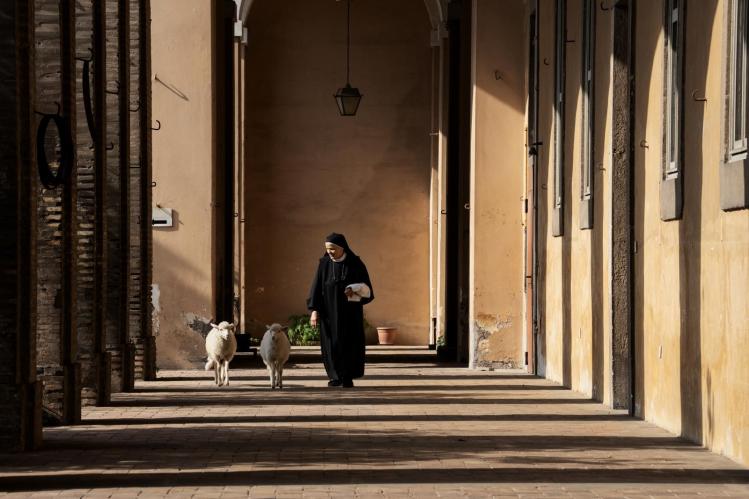
Working with a limited budget, Camaiti spent years persuading the community—some twenty nuns, mostly from Italy and various African nations—to let him bring his camera inside the convent. After several refusals, he eventually gained their trust and followed them for five months. With its lack of interviews, scant dialogue, and long, still shots of the convent’s arcaded cloister and sprawling garden, Agnus Dei is subtly Christlike: humble, meek, and pure.
Part of what makes the documentary so interesting is that Camaiti isn’t a believer. Without reverence, sentimentality, or exoticism, he shoots the nuns as a curious observer, presenting the raising of the lambs without any explanation. Filming in the squarish “academy ratio” to mimic the feel of the enclosure, Camaiti is just as interested in Santa Cecilia’s architecture and ninth-century mosaics as in the lives of the sisters. He often frames the nuns vertically, against soaring ceilings, which both dedramatizes the action—usually not much more than nuns chanting the Hours, shuffling along corridors, or performing household chores as they listen to Vatican Radio—and suggests the presence of the other, higher world they simultaneously inhabit.
If the nuns are mostly silent, the lambs themselves are anything but. Their bleating can be cute, but it’s also exasperating: separated from their mother in a chilling early scene, the lambs need round-the-clock care as they adapt to life in the convent, a task that falls almost entirely to Suor Vincenza, an elderly Italian with a knack for knowing what her charges—piccoli, small ones, she calls them—need in any given moment. Sometimes it’s milk, which she heats and dispenses from an oversized baby bottle. Sometimes it’s play, as when, in early spring, the lambs begin a game of hide-and-seek as they wander from the flowering garden to the laundry room, where sheets billow in the breeze. Occasionally they require medical care, which is administered by a local vet, and affection, which Camaiti captures in Vincenza’s subtle vocal intonations, facial expressions, and occasional caresses.
In a sense, Agnus Dei is less about monasticism than maternity—its moments of joy and delight, but also fear and heartache. It asks what it means to mother and allows one particular person to offer a very specific, idiosyncratic response. Vincenza, we slowly learn, has done this before: not just with other lambs—she has framed photos of her feeding an earlier generation of piccoli—but caring for her own children (she is a widow) and grandchildren, who come to visit her in Rome. The gathering, in a small room in the monastery, is bittersweet. Vincenza’s young-adult grandchildren are upbeat and chat about the food, which she has spent a long time cooking, even as her son Marco, who calls and visits less often than she would like, appears awkward and a little uncomfortable. He seems to be pondering the absence of his deceased father, whom we see in one of Vincenza’s photo albums. Her husband’s arm is wrapped around her. He is grinning; she is beaming.
But nowhere is Vincenza’s maternal grief more palpable than in the harrowing scene in which the lambs—“They’re sheep already,” she quips—are finally sheared. It’s a bright sunny day, and Camaiti shoots it appropriately. His camera lingers on the flowers, tall grasses, and citrus trees dotting the garden. But there’s tension: “Che ti fanno?” (“What will they do to you?”) she anxiously repeats, sitting with a strained face, clutching a second lamb as the first is shorn by a local shepherd.
Camaiti’s filmmaking, usually restrained and matter-of-fact, intervenes a little more forcefully here. Vincenza’s grimaces are crosscut with the lamb’s bound body held down on the shearing table. His panicked bleating gives way to synth music by Husk Husk as Camaiti cuts to a still shot of the shorn fleece sitting atop the metal table, tinged with a few drops of blood and wrapped in a white shroud. The shot’s composition mimics the Spanish painter Zurbarán’s famous Agnus Dei, from 1635. Camaiti then cuts to a close-up of Stefano Maderno’s 1600 statue of St. Cecilia, which lies beneath the altar where the nuns chant their offices. Hands bound, neck sliced with a sword, St. Cecilia appears like an innocent lamb led to slaughter. The moment is extraordinary. In reality, the lamb hasn’t been harmed, but Camaiti makes us feel the shearing as Vincenza does: as a violent sacrifice.
“I loved this film,” one Catholic priest told Camaiti during a Q&A after a screening in Italy earlier this year; the audience had loved it too. “But instead of sacrifice, I would prefer you talk about vita donata, that is, self-gift,” the priest continued. “It is more Christian, highlighting the positive aspects of Christ’s loving decision to surrender his life for the salvation of all.” When Camaiti told me this anecdote in an interview last month, I nodded in agreement. It aligned well with my own liberal Catholicism and my progressive theological sensibility. But as I thought more about it, I think Camaiti’s insistence on sacrifice—something beautiful, yes, but also something awful, gruesome, inseparable from the violence that necessarily accompanies it—is exactly right. Suor Vincenza had made a sacrifice: not just the decision to enter the monastery after her husband’s death, but over and over, day after day, year after year. Admitting that her act of self-gift also hurts doesn’t detract from the beauty of the life she’s given; if anything, it enhances it.
As it happened, Holy Week in 2025 was marked by one more death. Pope Francis passed on Easter Monday just as Agnus Dei was being shot. Camaiti hardly dramatizes it, preferring instead to show one sister watching the papal funeral from a cellphone as she peels vegetables in the kitchen, the telecast’s helicopters whirring in the skies nearby. We don’t really hear much about Francis in the film, and the sisters’ grief over his passing is muted. Pope Leo’s May election, and his decision to reinstate the personal imposition of the pallia by the pope at St. Peter’s meant that Vincenza and her sisters got to watch the new pope handle the fruits of their labor.
The pallia are small symbols. But, like sacraments, they express far more than their modest appearance might suggest. In the film’s closing sequence, Vincenza switches off the television showing Leo bestowing the pallia and files back into the choir for prayer. As the liturgy begins and the sisters’ chant fills the soundtrack, Camaiti cuts one final time. We’re back in the sheepfold, where we witnessed the birth of the lambs in the very first scene. Dozens of sheep now look straight ahead into the camera as the song continues and the shot fades to black. We haven’t quite seen God, but we’ve come close.
We welcome your comments about this article. Please send your response to [email protected].