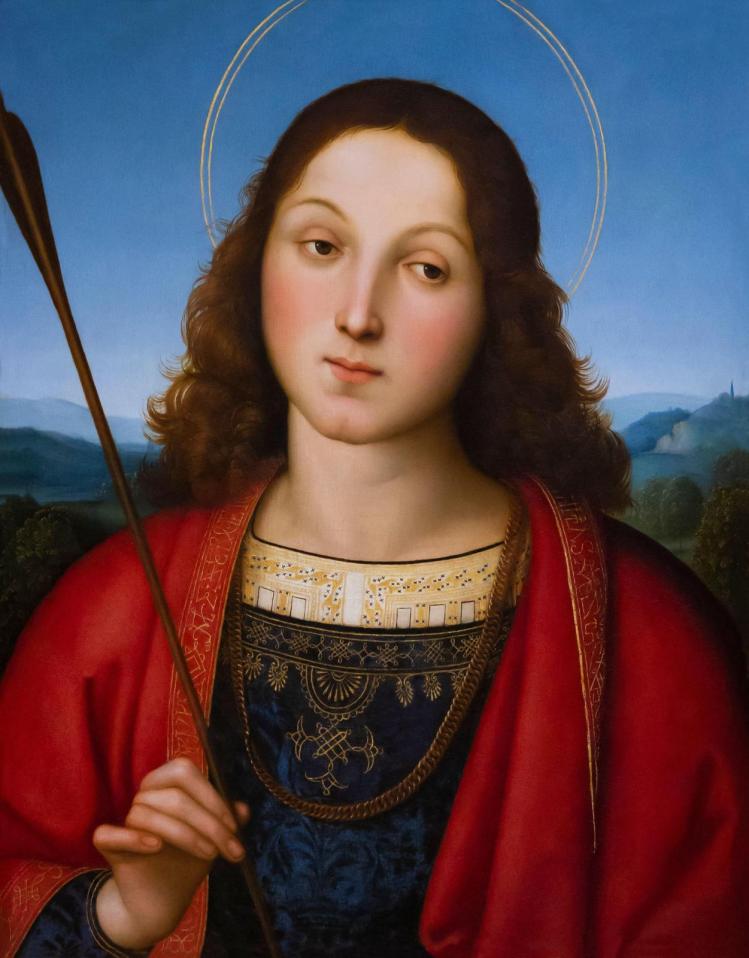
At first glance, there is something cold and formal about the portrait. Raphael’s Saint Sebastian in Half-Length, painted around 1503, when the artist was nineteen, departs radically from traditional iconography of the saint. Gone is the dramatic tension, gone are the visual pleasures that made paintings of Sebastian so popular during the Renaissance: no muscly torso pierced with arrows, no wide-eyed gaze directed skyward, no mouth agape in pain or ecstasy.
Instead we find a tight-lipped, androgynous youth, a gold chain draped over his embroidered blue velvet frock and red cloak. Behind him, forested green hills roll into misty blue mountains. Sebastian, head slightly tilted, eyes half-lidded, is peaceful but aloof. The arrow shaft resting in his right hand seems less a weapon than a pen or paintbrush, further abstracting him from his martyrdom and all its gory, human details.
But look again, and you’ll find warmth. Notice the care that Raphael lavishes on Sebastian’s brown curls. The sunlit ringlets that flow over his right shoulder take on a reddish-blonde glow. Now see how the same gleam permeates the whole painting: the gold stitching in Sebastian’s clothes, the rounded contours of his forehead and cheeks, the dappled trees and sun-flecked clouds beyond. Suddenly, the painting pulsates with vitality and grace. We aren’t just glimpsing the mind of a saint as he serenely contemplates martyrdom. Raphael has placed us at the precise point where humanity and divinity converge.
Raphael is often an afterthought to Leonardo da Vinci and Michelangelo Buonarroti, his more artistically anguished predecessors. That his work deserves a second—as well as a third, fourth, and fifth—viewing is the thesis of Raphael: Sublime Poetry, the landmark show at New York’s Metropolitan Museum of Art through June 28, curated by Carmen Bambach. It includes thirty-three paintings surrounded by more than 140 drawings, along with rare books and manuscripts, prints, a detached fresco, and three monumental tapestries. Many have never been seen in the United States. Like the Vatican Museums, whose narrow paths and large crowds seem to have inspired, for better or worse, the show’s layout at the Met, you can’t take it all in at once. Raphael: Sublime Poetry is the result of loans from some sixty European and American museums and collections. The catalogue itself weighs more than five pounds.
But rather than overwhelming the show, the scholarship supports it. Bambach’s evocation of the broader civic, intellectual, and artistic worlds into which Raphael was born in 1480 gives you just enough to grasp the extraordinary confluence of classical ideals, courtly sprezzatura, and lay religiosity that defined the High Renaissance, especially in the idyllic hilltop city of Urbino, where Raphael’s father, Giovanni Santi, trained his son in painting, poetry, and architecture. (He died when Raphael was only eleven.)
Raphael’s earliest commissions were produced for confraternities, lay religious groups whose idiosyncratic rituals often included public processions with painted images of patron saints. There’s a poignancy to his Processional Banner of the Confraternity of the Santissima Trinità, painted when he was sixteen: in addition to calm, naturalistic images of Saints Sebastian and Roch kneeling beneath the cross and of God removing a rib from a sleeping Adam, the work’s twin panels show heavy damage from being frequently paraded through the streets of Città di Castello, near Perugia, where the confraternity ran both a hospital and a church. Sebastian and Roch, along with the Trinity, were thought to offer protection from the plague; Bambach speculates that Eve’s creation from Adam’s rib mirrors the creation of the Church from Christ’s side.
From the perspective of our disenchanted, secular age, we tend to view the Renaissance as a time of rupture, the moment when European civilization moved decisively from the crude Dark Ages to a more enlightened and rationalist perspective. Such a view would never have occurred to Raphael or his contemporaries, who didn’t perceive any conflict between the classical achievements they were birthing anew and their deeply held Catholic faith, which was also being revitalized.
Humanism did indeed concentrate on this world, but usually in tandem with the unseen other. The task of painters was to visualize both. Such congruity appears in how Raphael appropriates the rational lines, stately columns, and graceful palazzi of the late fifteenth century Città ideale—possibly painted by Fra Carnevale, himself a Dominican priest—for his own predella painting of the Annunciation, for the Oddi Altarpiece (1503–5), displayed beside Raphael’s accompanying cartoon drawing. The painting itself is perhaps less remarkable than Raphael’s preparatory sketch, which allows us to grasp how Renaissance paintings were produced. Two rows of stout Corinthian columns follow perspectival lines into the distance, where they culminate in a double arcade framing a landscape both urban and rural. Precisely drawn gridlines reveal how Raphael carefully measured the foreshortened figures of Gabriel and Mary, placing their heads and feet in direct relation to the columns and each other.
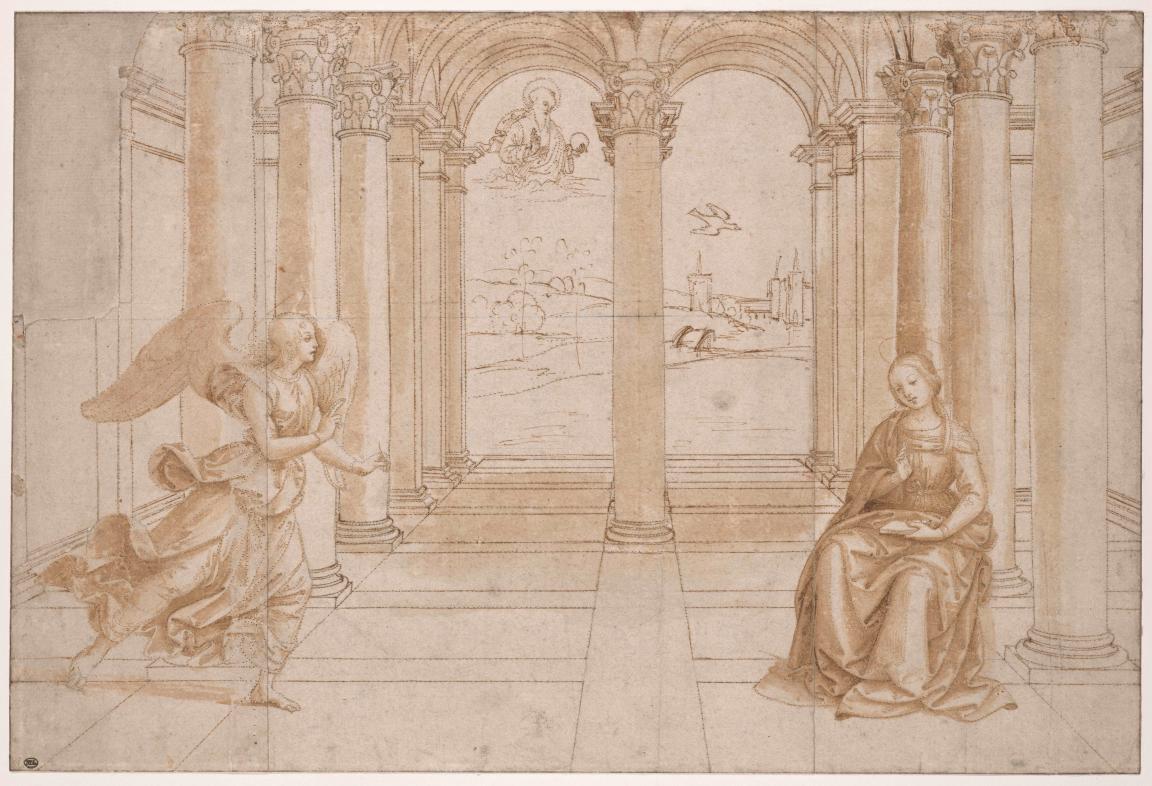
There’s circular movement choreographed in this straight grid—squaring the circle is itself a Dantean image of divinity—as our eye traces a clockwise, three-dimensional ellipse from Gabriel’s left foot to the image of God floating above the fields and sending the Spirit, who descends towards Mary’s seat by the lower right column. Such geometric precision is difficult to achieve in freehand painting. Thus we see tiny holes in the outlines; they’re the result of pricking, a process that allowed painters to transfer full-scale drawings to wood or canvas by using pounce bags, which left powder tracings on the new surface to be painted over.
Another standard idea about the Renaissance is that it valued “originality” above all and often celebrated the achievements of the individual. The show gently pushes back against that idea, showing us how Raphael absorbed and assimilated Leonardo’s bozzare pronto (quick, spontaneous drawing) and Michelangelo’s retrieval of classical postures from ancient Roman sculptures. Thus does Leonardo’s study of a galloping horse find its way into Raphael’s sketches of babies in motion, while Michelangelo’s weighty, writhing drawings of naked bodies are reflected in Raphael’s studies for a muscular trio of nude men carrying a heavy corpse. Borrowing from a Roman sarcophagus depicting the death of the Greek hero Meleager, it would later be incorporated into Raphael’s Entombment of the dead Christ.
Not that Raphael needed to study classical depictions of grief: he had enough in his own life, including not just the death of his father but his mother as well, who died from complications in childbirth when Raphael was eight, and the deaths of two siblings in their infancy. Displayed in an exhibition case is a handwritten book of expenditures from the Convento di San Francesco d’Assisi in Urbino recording the prices Raphael’s father paid for their funeral candles.
Highlighting how painful such an experience could be, on the opposite wall we find a harrowing 1480 relief, Death of Francesca Pitti Tornabuoni, by Andrea del Verrocchio and Francesco di Simone Ferrucci. In the left panel, relatives weep as they behold the swaddled corpse of the stillborn child, while in the right, a group of nursemaids wail in lamentation at the loss of Francesca, her arms and head limp on her deathbed.
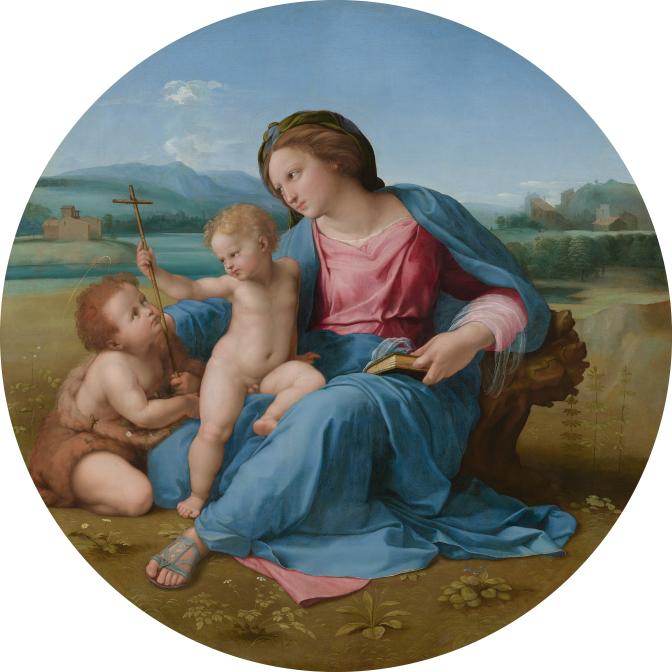
Perhaps it’s smart, or maybe a bit manipulative. Either way, the show uses death as a prelude to a group of Raphael’s Madonnas, all of the “Madonna of Tenderness” type. The best of these is the Alba Madonna (1509–11). First, there’s the circular tondo format. Popular among wealthy private patrons in Florence, tondi evolved from deschi da parto, plates gifted to celebrate births, into objects that usually hung in bedrooms. Positioned high on the wall opposite the bed, tondi were meant to be viewed from below, a little like a portal window in a church nave; the circle itself evoked divine perfection, on extraordinary display in Michelangelo’s famous Doni Tondo, which has never left Florence. (It’s now in the Uffizi.) In it, the Holy Family appears as a sculptural swirl of springloaded spiritual energy, more electric even than the spark of creation leaping from God’s hand to Adam’s finger in the Sistine Chapel.
Raphael had ample opportunity to see Michelangelo’s tondo (he did work for the Doni family, too) and the Alba Madonna—depicting Mary dressed as a peasant and seated in an open field as she plays with the infant Jesus and John the Baptist—is his calm, confident response. Unlike Michelangelo’s rippling, static figures, Raphael sets his tondo in motion in a more understated way, beginning with Mary’s pinwheel pose, her limbs coiled around the two babies as they trade stares. At first glance there’s little activity, until we follow their gazes. Jesus gazes at John and John gazes at Mary, who then gazes back. The tension is mirrored in the way Jesus grasps a small wooden cross from John, which allows us to read Mary’s expression as a combination of love and admiration, but also deep sorrow at the future deaths of both. Mary’s emotional maturity is echoed by her physical fortitude—her sheer presence in a field that recedes into a ridge of mountains and a clear blue sky. An apparently mundane moment becomes eternal, as heaven descends to Earth.
It’s something of a shame, and an accident of history, that Raphael’s style became the standard for academic painting for the next three centuries. If there’s a fixedness to his style—evident especially in the way he depicts the faces of Mary, Jesus, and the saints—there’s also a firm idea among Raphael’s critics that the beauty he endeavored to depict was more ideal than real, more divine than human. It partly explains the contemporary preference for Michelangelo and Leonardo, whose work seems more endowed with individual personality and is thus more accessible for contemporary viewers who lack the philosophical and theological context in which Raphael operated. It’s why, for instance, Raphael’s Vatican fresco of The School of Athens is far better known than the theological Disputa that appears on the opposite wall.
One of the Met show’s highlights—and for me, the real revelation about Raphael—are the dozen or so drawings he made for the latter fresco, in which theologians, poets, and painters (Dante and Fra Angelico among them) discuss the nature of the Eucharist around an altar as Jesus and the rest of the heavenly court circle above. The care and intensity that Raphael gave to these studies is surprising: Why take the time to depict the precise postures of the monks and bishops, to the point of drawing them in the nude, only in order to drape them with robes and miters in the final product?
Evidently because the physical mattered to Raphael. Perhaps the material world, as detailed in the Neoplatonic philosophy he’d imbibed from his friend Baldassare Castiglione—whose flattering portrait hangs with a series of others, including La Fornarina, a half-nude portrait of Raphael’s Roman lover—was the gateway to heaven. It’s not by chance that Raphael’s sketch for the allegorical Figure of Theology herself is one of his most alive and arresting. She appears breathless with excitement, practically about to drop the book in her lap as she rushes from heaven to inform humanity of the reality of God’s love.
One of the final works is a mid-sixteenth-century print by Antonio Lafreri, Papal Benediction in Saint Peter’s Square. If the Vatican seems like a patchwork of unrecognizable buildings, that’s because that’s what it looked like in the 1500s, when construction of the monumental new basilica had only just begun. It’s a stark reminder that history is never fixed. If you can make it to the Met before the end of June, go see for yourself, and let Raphael show you the perfectibility latent within every person. And if not, there’s always Rome—but then even those frescoed vaults and stanze won’t last forever.
We welcome your comments about this article. Please send your response to [email protected].