On June 12, the U.S. government released a batch of documents recording encounters with UAPs: Unidentified Anomalous Phenomena, or what we used to call UFOs. Among these documents were a redacted report from the FBI, an artist’s rendering of a 2022 incident near Colorado Springs, and a secret 1949 report commissioned by the U.S. Army. All of these purport to describe sightings of alien spacecraft. If accurate, they would give us proof of the existence of intelligent life beyond Earth. Serious stuff. But tell me: Did you notice? Do you care?
I’m sure that Steven Spielberg did, and does, and will continue to, so long as the U.S. government continues to release such information. Hollywood’s greatest living entertainer has spent the better part of his career imagining the first interaction between humans and aliens, with the latter always presented as superior the former. The neon-sign spaceships that buzz middle America in Close Encounters of the Third Kind trigger all manner of familial collapse, but they are piloted by big-eyed, gray-skinned creatures who seem to know us better than we know ourselves. E.T., too, has come to study Earth; yet E.T. turns into a story of interstellar transference, of alien wisdom that comforts and enriches a wounded child. Even the tripedal marauders of his War of the Worlds prove to be fatally curious about the planet they have come to consume.
These are all stories of encounter, of the revelation of intergalactic life arriving all at once on humanity’s doorstep. But what if the aliens came, and no one noticed? Perhaps we don’t care because we don’t know—because we weren’t allowed to know. Wardex, the fictional aerospace contractor in Spielberg’s new film, Disclosure Day, has committed itself to harnessing and hiding all evidence of alien visitation. The evidence includes the actual flesh-and-blood beings who have crash-landed on our planet over the past seventy or so years. The aliens have all been press-ganged by men like Noah Scanlon (Colin Firth), a villainous tech magnate who views all things extraterrestrial with a mix of fear and proprietary pride. The public can’t be allowed to know about the aliens, he believes; it wouldn’t be able to live with the knowledge. So he employs his knowledge about the aliens to enrich himself and hold on to power.
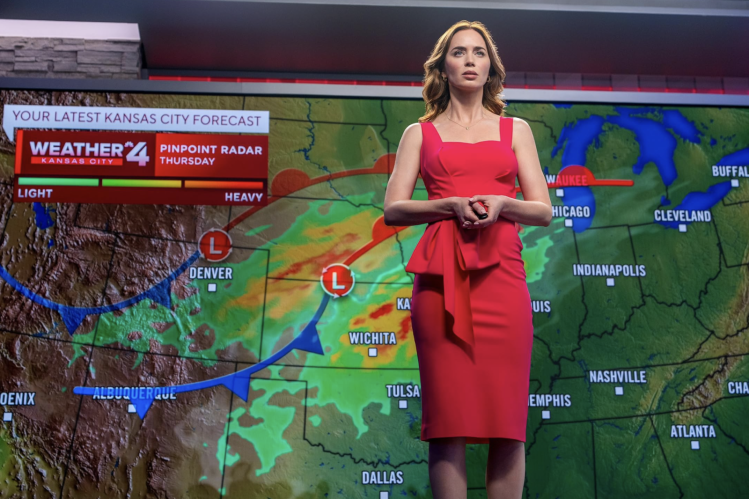
Unfortunately for him, Disclosure Day begins with a serious breach of that public-private firewall. Cybersecurity specialist Daniel Kellner (Josh O’Connor) has stolen an incredible quantity of sensitive information as well as a strange crystalline device that no one dares to handle with their bare hands. Kellner is a former Wardex employee, and he’s being directed by a high-level scientist named Hugo (Coleman Domingo), who now believes that the public has a right to know everything the company has kept secret over the past decades. The theft connects Kellner with Margaret Fairchild (Emily Blunt), a Kansas City meteorologist whose live breakdown on air seems to portend greater transmissions from beyond the stars.
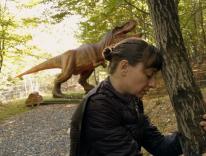
Those, anyway, are the puzzle pieces, and Spielberg—working from a script by David Koepp—spends most of the movie shuffling them around the board with the promise that the picture will have assembled itself by the finale. That this promise is only partly kept testifies to the flaws in Koepp’s script, but the director’s blockbuster ambitions must also bear some of the blame. From Jaws onward, Spielberg has been consumed by the spectacular—how to stage it, and what it means. The dinosaurs of Jurassic Park served both as a high-water mark for special effects and a prescient dig at the replacement of flesh-and-blood craftsmanship with its uncanny simulacrum. He has since kept abreast of changes in filmmaking technology while framing story after story around the deceptive nature of the moving image. In films as different as Minority Report and The Fabelmans, the camera manipulates whatever it is lucky or unlucky enough to have captured in the first place, a process of simultaneous documentation and fabrication.
In keeping with that formula, Disclosure Day pins everything on a seeing-is-believing climax of surprisingly sunny proportions. Yet despite moments of real terror and magnificence, the result feels strangely inconsequential, if not outright implausible. Spielberg’s past adventures with the extraterrestrial tapped into real currents of cultural unease—from the spiritual yearning that arose from the disintegration of the American family to the country’s newfound sense of vulnerability in the wake of September 11. And the first hour of War of the Worlds, with its images of a civilian population annihilated by advanced airborne weaponry, has lately taken on new and discomfiting resonances.
Yet, deliberately or not, Disclosure Day includes very little that could disturb us in 2026. Just as he would come to regret the indiscriminate violence of Jaws, Spielberg seems to lament ever having suggested that meeting a UFO might be anything less than the greatest experience of one’s life. His somewhat forced optimism comes to a head in the sequences involving Jane (Eve Hewson), an ex-nun who has become Daniel’s girlfriend. Jane fears the revelation of another supreme intellect, because she does not believe that people could accept a higher power other than the Christian God. Koepp’s script raises and resolves these worries in so perfunctory a manner that I cannot understand why he included them at all. Needless to say, Jane, like the viewer, will eventually come around, welcoming the strange new lights in the sky; otherwise, there would be no movie.
The result of all this is a film of surprising slightness, without enough depth or wonder to weight it down in the public consciousness. Spielberg has not had a real hit since 2018’s Ready Player One, and Disclosure Day does not seem likely to break the losing streak. This spring’s major theatrical releases have been defined by Millennial nostalgia-bait, merchandizing traps for children, evasive celebrity biopics, and cynical brand resurrections. The past month has been dominated by Obsession and Backrooms, two horror movies from filmmakers barely in their twenties. Both films are preoccupied with appearances, with simulated surfaces that gesture toward their own apparently intentional lack of substance. Their popularity does not bode well for the medium.
Spielberg is, of course, a master of appearances, but his films have often reached hidden and surprising depths. His unprocessed neuroses have a way of insinuating themselves into the final product, often unconsciously. There is an incredible clip from Inside the Actors Studio where James Lipton says to Spielberg about Close Encounters of the Third Kind: “Your father was a computer scientist, your mother was a musician. When the spaceships land, how do they communicate? They make music on their computers.” Spielberg can’t believe what he’s hearing, because until that moment he never paused to wonder why he felt compelled to put that pairing into his film. Such unconscious fixations have formed the bedrock of a half-century of American popular cinema, and I will take them any day over the self-protective self-consciousness of a generation raised to do battle in the cage of social media.
The question, it turns out, is not what the aliens in this new film have to teach us, but rather what we can learn from Steven Spielberg. He remains a master of blocking, and even his most chaotic sequences masterfully track the special relations of moving bodies, maintaining clarity and amid the film’s relentless forward movement. In a virtuoso final stretch, all characters converge upon Kansas City, and the full disclosure of alien life occurs on, of all things, cable television. It is proof of the director’s virtuosity that he manages to construct a dazzling climax out of such plainly preposterous material, a symphony of whip pans and snapping fingers that nearly makes up for all the computer-generated imagery on display. Spielberg wants to imagine a world united by the knowledge that we are not alone in the universe, and he still wants to imagine a culture that comes to watch a movie about that. Both fantasies seem more improbable now than when Spielberg’s career began, but better these harmless and dated delusions than most of what moviegoers are being offered these days.
We welcome your comments about this article. Please send your response to [email protected].