The best works by the Finnish painter Helene Schjerfbeck leave you convinced they might vanish from one moment to the next, just as a dream seems to grow sharper right before it ends. For all their winking tints and sinuous linework, the dominant mood is one of bittersweet calm, reminding us that fugacity, when it recurs often enough, eventually achieves a sort of permanence. Seeing Silence: The Paintings of Helene Schjerfbeck, on view at the Metropolitan Museum of Art through April 5, is a fittingly relaxed introduction to the artist, revealing Schjerfbeck’s discreet mastery, one cleverly understated canvas at a time.
Born in the summer of 1862 to Olga Johanna Printz and Svante Schjerfbeck, an office manager for the local railway, Schjerfbeck would spend much of her life at a remove from the Finnish metropole of Helsinki. Standard biographical treatments suggest that this isolation exacerbated Schjerfbeck’s depressive tendencies, and that together these help explain the painful sense of solitude that often imbues her canvases. In fact, though it would be wrong to downplay the role of physical and mental debility in Schjerfbeck’s life and career, the major note might just as well be struck by her sustained industry and series of deep and artistically nourishing friendships. While studying and working abroad throughout the 1880s and 1890s, Schjerfbeck spent a great deal of time in Paris, imbibing the city’s atmosphere of artistic tumult. By 1902, largely as a consequence of mental exhaustion, Schjerfbeck had resigned her position at the Finnish Art Society’s Drawing School, moving with her mother to the town of Hyvinkää, roughly thirty-five miles northwest of Helsinki. Two years after her mother’s death, in 1925, Schjerfbeck relocated to Tammisaari, where she lived until the onset of the Second World War. In 1946, at the age of eighty-three, she died of stomach cancer in the spa hotel of Saltsjöbaden in Sweden, an easel by her bedside.
The transition between Schjerfbeck’s early, sentimental naturalism and her somewhat formless middle period—characterized by a brightening of the palette, an increase in fluidity of line, and unconventional poses—marks the greatest stylistic leap in her career. From there, the subdued modernism of her late period emerged with comparative ease. On the whole, Schjerfbeck’s modernism is a piecemeal thing. Having spent the bulk of her career in Hyvinkää, she seems to have experimented quietly, riffing on themes and techniques she’d picked up during her peripatetic years and whatever fresh influences made their way to Hyvinkää. Her encounters with El Greco’s work—likely through colorless reproductions—were vital to the maturation of her style and help explain the evasive quality of many of her later canvases, their air of turning away from the viewer or of hiding in plain sight. Other marked influences included Puvis de Chavannes, whose stark, archaic-seeming murals fed Schjerfbeck’s naturally retrograde tendencies.
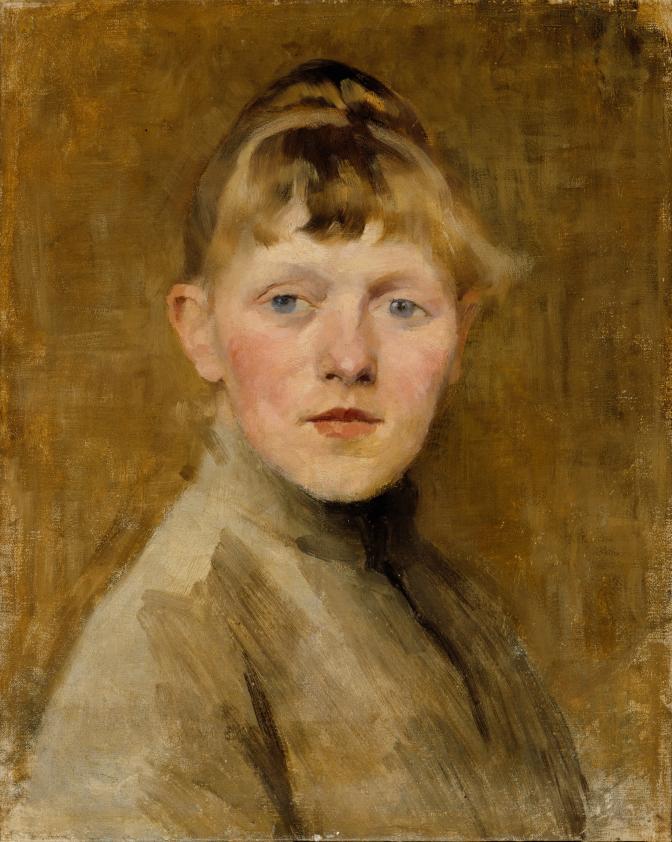
Much of Schjerfbeck’s later work gains its primary appeal through a particular softness—you might almost call it a cloudiness—and an evenhanded brightness that bring to mind Tiepolo. These canvases exhibit a muted will to diffusion, the roots of which can be found, oddly enough, in the early work’s intensity of focus and habitual gesture of isolation. The stark and shadow-bound outline of the arm in Youth, painted in 1882, is just as distinctive as the blurred limb in The Sailor (Einar Reuter) from 1918, though the latter seizes the eye almost paradoxically through its dramatic haziness. In works like Self-Portrait (1884–1885) and Portrait of a Man, from 1880, the brushwork of the background traces the silhouette of the figures, as if sympathetically drawn to them, so that the works have the feel of light reliefs.
The Door, from 1884, anticipates many of the perspective-fracturing motifs Schjerfbeck would employ later in her career. What we see is a corner in an empty chapel in Pont-Aven, Brittany. The opacity of the door, subtly disturbed by the slivers of light creeping in around its edges, is on the point of being lost; this is a door on its way to becoming a window. And in fact, the rounded arch of the door frame recalls the monumental window, with its flung-open casements, in Caspar David Friedrich’s View from the Painter’s Studio (1805–6). This waiting room has many of the qualities of a dream space, suturing together varying representational modes. The door itself is like something out of Vermeer, while the archway on the right seems to anticipate one of de Chirico’s looming, lonely arcades. Fading into the wall as it does, the archway destabilizes the painting’s sense of distance; the wall itself seems oddly insubstantial, like a shoal of clouds over the sea at dusk.
A softening of transitions and a generalized morbidezza, along with uncertain backgrounds, would become hallmarks of Schjerfbeck’s style. Painted in 1907, Silence depicts Schjerfbeck’s neighbor, Anna Lintumäki, though the sitter’s personality has been dissolved in the canvas’s lambent, otherworldly tones. Schjerfbeck would often start her paintings with a model, and after the basics of the image had been established she would finish the work from memory. The mistiness of many of her mature paintings can partly be ascribed to the softening effects of recollection. A powdery light, as of moonlight reflecting off water, gives a Symbolist sheen to Silence.
While the emblematical mystifications of Symbolism weren’t generally to Schjerfbeck’s taste—her mode, mostly, was milder allegory—she did produce at least one work worthy of the movement. The Tapestry, painted between 1914 and 1916, is an utterly cryptic canvas dominated by a wonderfully lucent blue, similar to the hue of Lintumäki’s dress in Silence. We see a man and a woman standing in what is presumably a room, though a wide vista opens up illusionistically before them, presenting depthless water and what might be an island with a stand of trees so thin they seem like poppies. Distance is again distorted. The figures’ heads appear to be much farther away from each other than the positioning of their feet would suggest. In the man’s pose, the Mannerist línea serpentinata has been softened, though the impression his figure gives of extreme thinness, reinforced by Schjerfbeck’s having scraped the canvas raw along his legs, still signals a debt to El Greco.
Schjerfbeck was fascinated by the passage of time and enjoyed playing with temporal effects. Inspired in part by encounters with Renaissance frescoes—especially the Tornabuoni frescoes of Botticelli, which the Louvre acquired in 1882 shortly after their rediscovery—Schjerfbeck began to experiment with materials in the 1880s and 1890s, incorporating charcoal, gouache, and other media into her oils. The goal was in part to achieve a matte surface that appeared artificially aged. Critically, she also began to scrape away at her canvases, resulting in a pentimento effect. From the turn of the century on, her canvases are ripe with manufactured time. Fragment (1904) is the most extreme embodiment of this tendency. A simple study of a redheaded girl set against the gold of sacred space, the painting is an abraded icon. If it weren’t for the subject’s appearing in three-quarter profile, it would seem to have come down to us from Byzantine times.
In Schjerfbeck’s late portraiture, the modern feeling is a result of line, angle, and a certain theatricality rather than any bold reimagining of color. The subject of Girl from Eydtkuhne II (1927) appears mantis-like, projecting like a tulip from a cut-glass vase. The eyes, steady and level, are self-evidently Picassoesque, and the background billows like a curtain, serving as a foil to the flat, Klimtian mosaic of the girl’s bolero jacket. Elsewhere, highlights become an important tool. The subject of Girl in Beret (1935) is set against a dark background. Slivers of light delineate her nose and neck, while a bright coin or scallop marks her forehead, hinting at an impossible roundness. These highlights are even more stylized in Schjerfbeck’s portraits of her nephew Måns. The Motorist (1929) dresses its sitter up in Pulcinella-like contrasts; his cheeks appear violently rouged, lending an evasive, almost sheepish quality to the sleepy compression of the eyes.
If Schjerfbeck’s portraits are often studies in stylized diffidence, her other figurative paintings seem to probe the reticence of objects. On display are a few lovely still lifes that reminded me of Morandi’s work. With its marred trefoil and foreground dedicated to a reflected band of color, the tastefully portentous Still Life with Blackening Apples (1944) is on the cusp of abstraction; the titular fruit comes on like a mistake, a blot of ink among the heteroclite massing of shapes. Green Apples and Champagne Glass (1934) is a funny little canvas, the apples having been plucked right out of Cézanne. Behind them, a clot of shadows gathers, while the canvas to the left of the champagne flute has been scraped into a contrastive glow. If the bowl that holds the apples is overly translucent, its borders almost impossible to discern, the glass of the drinking vessel is startlingly opaque.
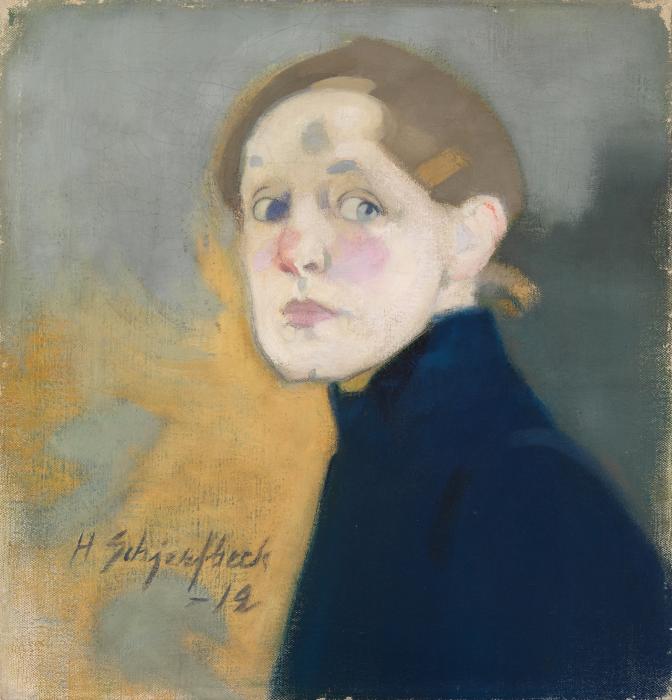
This frustration of the viewer’s gaze—preventing us from seeing through what we should, by all rights, be able to—feels especially relevant to the exhibition’s obvious showstopper. Seeing Silence ends with a series of self-portraits, painted between 1895 and 1945, that capture the aging process subtly and then, by the end, expressionistically. The last few paintings are jagged, Munchian masks, hollowed-out and ghoulish. Over the years, Schjerfbeck’s face served as a battleground of sorts, a site of stylistic experimentation. In its pitched presentation of her features—the chin so dramatically extended it seems to exist on a separate plane—the Self-Portrait of 1935 borrows from cubism. By and large the portraits on view at the Met show us Schjerfbeck in a state of mild recoil. Seeming to have been startled by her encounter with the viewer, she shrinks back from us, withdrawing into the canvas.
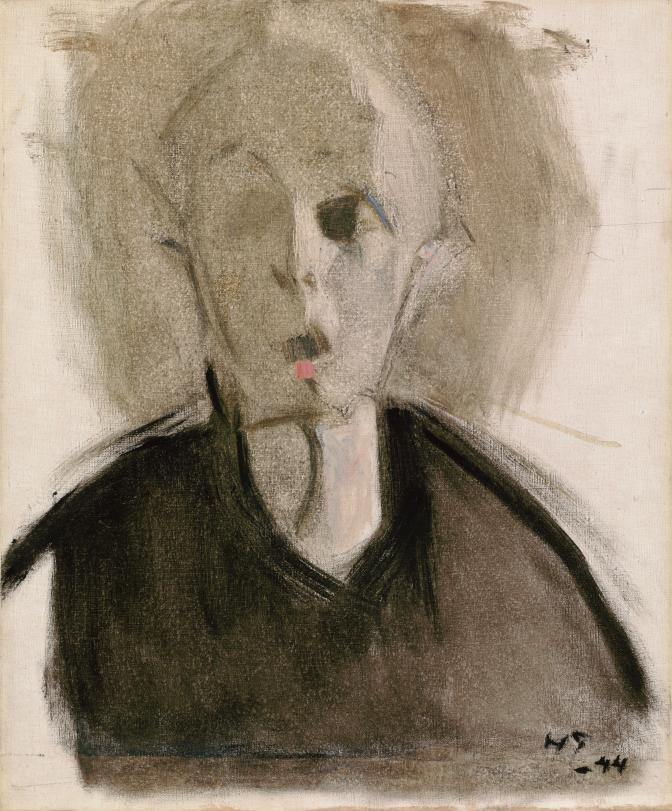
Schjerfbeck generally favored oblique stagings in her portraits. Her seated figures exist on subtle slopes; invariably, they look down, away, or off to the side. Often, as in My Mother (Mother Reading) (1902), Maria (1909), and Woman with a Child (1887), the subject is approached from behind. It isn’t so much that Schjerfbeck’s sitters are unaware of their status as subjects in a painting. Instead, they seem to have actively chosen, out of some dreamy sense of propriety, to ignore us. It’s notable, then, that in the final four self-portraits on display, Schjerfbeck looks at us head-on—though here the notion of looking is troubled. In Self-Portrait with Red Dot (1944) one eye is left unarticulated, while the other, closed and rendered with an almost classical realism, makes for a disturbing punctum. Its shading makes it seem to protrude, and there is something immensely horrifying in the failure of that eye to be present, trapped as if behind a suffocating veil of plastic. In Self-Portrait (An Old Painter) (1945) the eyes are black gashes, nothing more, while Self-Portrait, Light and Shadow (1945) offers one eye as a shadowed slit, the other as a gray smear.
Self-Portrait in Black and Pink (1945) gives us the eyes at last, both unequivocally there, though what they might be looking at is difficult to say. It is not an interaction, whatever we’re being made privy to; we don’t see into Schjerfbeck in the way she seems to see into us. But really, she doesn’t see us. Something impersonal is doing the seeing. This look is looking itself, a stare stripped bare of any object, dislocated in time. In this image painted not long before the artist’s death, her gaze occupies center stage. It arrests us, if it cannot arrest time.