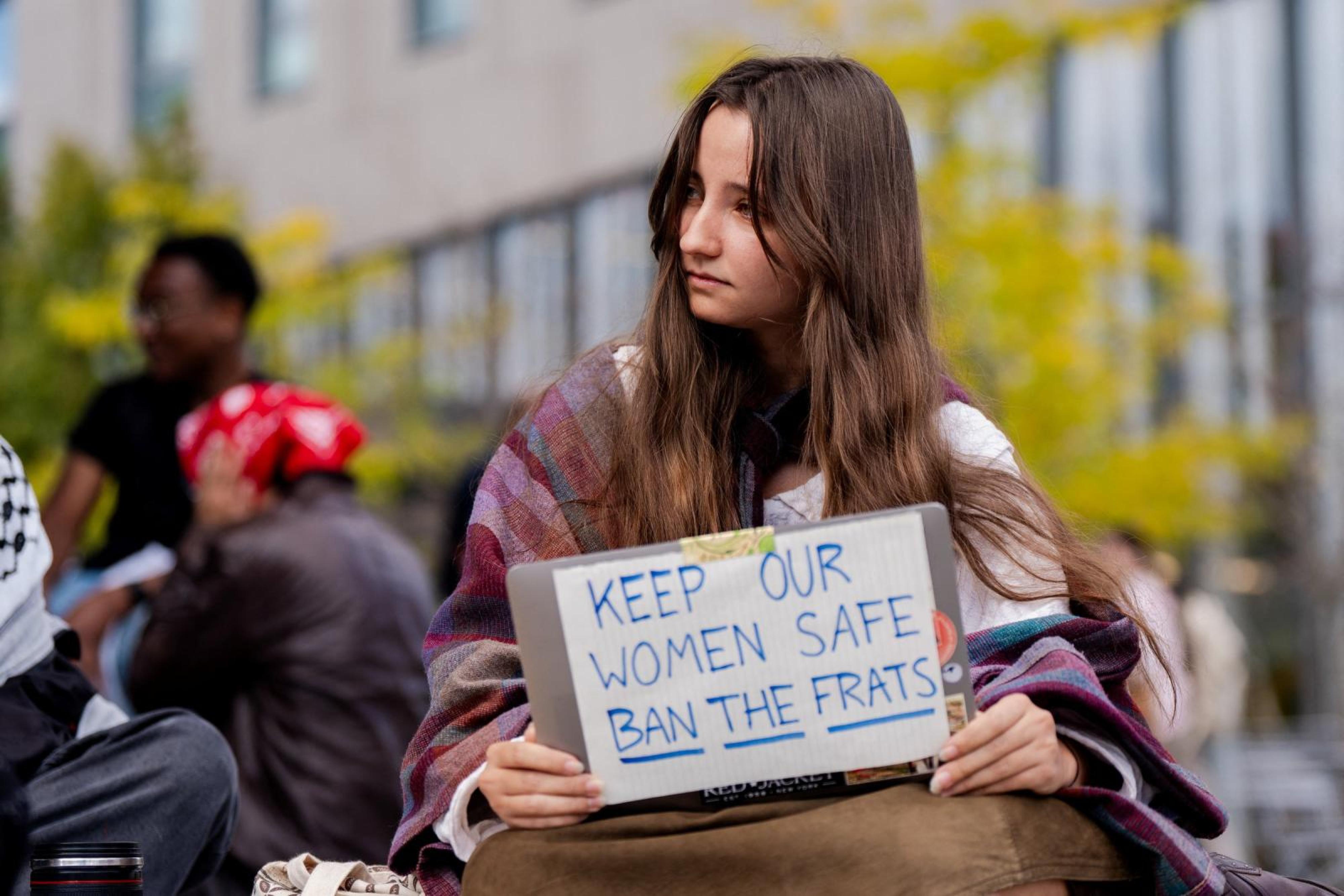
Cornell President Michael Kotlikoff’s recent interview with The New York Times—his first since allegations of gang rape at the Chi Phi fraternity in 2024 became public a few weeks ago—was clearly intended to convey the university’s resolve to learn from its mistakes, but his careful, lawyerly remarks were hardly reassuring. Despite his protestation that he was “personally sorry” for “the fact that Jane Doe experienced what she experienced,” and that he had “listened to and understood” the anger, he gave no indication that he or Cornell administrators were ready to accept any responsibility for the assault. Nor did he outline any substantive changes that might curtail the kind of abuses that have arisen at the campus’s fraternities and sororities over the past two decades. His remarks implied that there was little he could do beyond banning fraternity and sorority parties for the rest of the year, hiring a few extra staff, and pledging to keep listening. He seemed miffed that Cornell was being singled out for special scrutiny: “I think this is a problem if you talk to any university president.”
Cornell has one of the largest systems of Greek life in the country, with more than a third of its sixteen thousand undergraduates involved as active members in a fraternity or sorority. That’s the second highest rate of participation in the Ivy League (behind Dartmouth, a much smaller school), and higher even than the rates at many state universities like Penn State, the University of Michigan, and UCLA. Cornell’s fraternities and sororities—whose alumni associations and national chapters own not just the multimillion-dollar mansions that make up much of the university’s physical space but the extensive land on which they’re built—also have an unusual degree of influence over the decisions made by the administration and its board of trustees. (Both Kotlikoff and Anne Smalling, the board chair, who appeared with him at the Times interview, have children in Greek life at Cornell.)
Perhaps that’s why, despite intense pressure from students, alumni, prospective students, residents of Ithaca and Tompkins County, and Cornell’s faculty senate, Kotlikoff and Cornell’s board are unlikely to reform Greek life at the university, much less consider abolishing it. It’s true that bans can be challenging even at colleges and universities with less robust Greek life systems than Cornell’s: nationally, more than 50 percent of fraternity and sorority alumni donate to their alma maters, compared to just 10 percent of the general alumni population. Despite Cornell’s unique hybrid public-private status—five of its eight schools are funded in part by New York State—and its professed egalitarianism (“Any Person, Any Study”), Greek life is a major source of revenue for the university, not to mention a major provider of housing and dining services. If it does ever go away, it probably won’t happen overnight.
But if Cornell really does want to lead the country in ending the culture of rape, abuse, and class stratification that Greek life facilitates, banning fraternities and sororities, immediately or gradually, is the only viable path. Whatever the motivations of their founders, these institutions long ago ceased to be true fraternal or mutual-aid societies, and they no longer provide a real service to the rest of the university or to the community at large. At best, they create opportunities for students to make friends and network. But at what cost?
For me, the issue is personal. From 2005 to 2006, for a period totaling about eighteen months, I was a member of the Cornell chapter of Delta Kappa Epsilon (DKE, or “Deke” for short). Though it was housed at Cornell in a Victorian “gray stone castle” with a tower and underground temple, and though it boasted an alumni list that included then-president George W. Bush, DKE was ranked among the lowest fraternities on the social totem pole. (Chi Phi, then as now, is supposedly somewhere in the middle.) Deke was understood to be a “nerd frat,” mostly engineers and science majors, but constant drinking and drug use kept the house’s collective GPA low.
Though it didn’t host expensive parties as some of the wealthier, “rapier” fraternities did, DKE possessed a distinct culture of casual drug use and misogyny. Weed, opioid pills, and mushrooms were readily available. One man, a year older than me, had the words “Eat Pussy” tattooed inside his upper lip. I never got involved in drugs, and drank only occasionally, but I was an outlier; the craziest thing I ever did was build a big snow jump on the roof of the second-floor balcony, then ride a snowboard off it down into the courtyard below.
I joined DKE as a freshman, and I did so because I wanted what other young men and women who join fraternities and sororities say they want: fellowship, community, friends. Cornell is a big school in a small and often cold city. I hadn’t made friends through my first classes, mostly large lectures with hundreds of students, and I wanted to fit in somewhere. My grandfather, who had been socially isolated as a Jewish student, first as an undergraduate at the University of Pennsylvania and then as a medical student at the University of Chicago, had found a home in his fraternity. He’d urged me to give Greek life a chance, and he was paying my tuition. The DKE guys, a few of whom I met as they were sitting around a hookah in front of a roaring fireplace and talking about Star Wars, were interested in books and movies and music. They seemed normal. I decided, along with my roommate and a few others from my dorm, to pledge.
The brothers had told me that DKE didn’t haze, but that was a lie. The hazing was light at first, and mostly optional. Late one night I got a phone call from a DKE brother who demanded that I “come down to the house” to finish a keg. I told him I had an exam the next day and hung up. I was able to keep putting off those “invitations” all semester. Besides having to interview the other members of the fraternity and a few alums, the burden was comparatively light—like a fun extracurricular.
But then, just before the last classes of the semester, came “Hell Week,” which culminated in a long weekend experience that felt like torture. Perhaps my participation, like that of many hazing victims, was “voluntary,” but only in the narrowest sense of the word. My nineteen-year-old mind registered everything that happened: first being screamed at by forty- and fifty-year-old alumni with liquory breath, gruff voices, and weird aliases like “The Saint”; then being forcibly stripped out of my suit and tie, blindfolded, and forced to stand for hours with my hands tied behind my back, as music blared on repeat. I was forced to swallow a live goldfish from a cup filled with what I was told was vodka. I was led to what I was told was a real bed of nails and was ordered to jump on it with bare feet. I tried to run away, twice, until some of the brothers physically restrained me.
I felt lucky to emerge without any serious physical injuries. But of course not all injuries are physical. When it was all over—and after a confusing “trial” staged in the vast, quasi-Masonic temple rising from basement level up to the second floor—I was officially made a brother. I wasn’t proud. The next year I lived off campus. The year after that, I left Ithaca to study abroad in Italy, but not before submitting a detailed report on the hazing I’d experienced to the university. Apart from a brief, hostile confrontation with a few of my former fraternity brothers just before graduation and nearly two decades’ worth of mailed solicitations from the alumni organization, I’ve had no contact with anyone from DKE since.
My own experience, and the many reports I’ve read over the years, have led me to conclude that abuse—whether in the form of hazing, excess consumption of drugs and alcohol, or sexual assault—is endemic to Greek life. When fraternities and sororities exist as closed societies, operating as laws unto themselves, we should expect such abuses to continue. When only extreme cases like Jane Doe’s attract the attention of administrators, who respond even then with only tepid and temporary disciplinary measures, these groups reasonably assume that they may continue with the behaviors that have traumatized so many young people.
There are other avenues of reform short of outright bans. In 2014, in response to numerous instances of assault, hospitalizations from drug and alcohol abuse, and survey results indicating that more than half the student body felt unsafe at frat parties, Wesleyan’s president Michael Roth gave fraternities an ultimatum: admit women, or disband. Writing in The New York Times, he explained that his decision was informed by evidence from social psychology: “In spaces controlled by a tightly knit group, people are less likely to speak out when bad things happen. The hypermasculine culture in all-male fraternities often feeds on denigrating women, and people feel pressure not to intervene.” The experiment was a success: two formerly all-male fraternities went coed and flourished. Only DKE refused, suing the university and ultimately relinquishing their house. They continue to exist as a nonresidential student club.
Whatever the outcome of the Jane Doe case—New York state law may make it difficult for prosecutors to secure convictions for any of the “Cornell Seven” even if they do manage to obtain indictments—the episode makes clear that drastic reform is needed. In his interview with the Times, President Kotlikoff boasted that admissions staff have been reaching out to high-school guidance counselors, reassuring them that Cornell is still a safe place with abundant resources for counseling and mental-health care. He invoked the traditional American notion of higher-education administrators standing in loco parentis, offering moral guidance and emotional support for students who are still on the way to becoming fully formed adults.
But Cornell’s administration should be less content with merely helping students deal with trauma after the fact and more concerned with preventing it. That would require curbing, if not banning, fraternities and sororities, but it appears that Kotlikoff would rather talk about anything else. He laments that students are arriving at college with dangerous vices: “They’re not prepared. And of course they’ve been exposed to social media, pornography, and misogyny. This is a challenge for us.” His proposed solution to such challenges: “We have to respond by building character, judgment, responsibility and care for each other.” Unfortunately, Greek life on campus is destroying those very things faster than any university can hope to build them. It is time for the fraternities to go.
We welcome your comments about this article. Please send your response to [email protected].