Historian Marcia Chatelain is the Presidential Penn Compact Professor of Africana Studies at the University of Pennsylvania. She won the 2021 Pulitzer Prize for History for her book Franchise: The Golden Arches in Black America. Her new book, How Bright the Path Grows: The Untold Story of the Women Who Made the March on Washington, is a group biography of several women—some famous, some not—who worked in support of civil rights. Chatelain spoke about it recently with Associate Editor Griffin Oleynick for The Commonweal Podcast. Their conversation has been edited for clarity and length.
Griffin Oleynick: The March on Washington for Jobs and Freedom, which took place along the National Mall on August 28, 1963, is one of the most recorded and remembered events in recent American history. It’s when Martin Luther King Jr. gave his “I Have a Dream” speech before the Lincoln Memorial, and it represented a watershed moment in the history of the civil-rights movement. Why was it necessary to write a new book about it?
Marcia Chatelain: For this project, I asked myself what it would mean to write about civil rights from a different perspective—in the shadow of Martin Luther King, with King as a bit player at the margins. That helped me uncover both the many layers that made the movement so effective, but also how riddled it was with fissures and disagreements.
When it comes to the women who were involved, we tend to use all kinds of shorthands about the March on Washington. Every year, someone will write an article about the women who were not fully acknowledged or ignored. But a lot of those are factually inaccurate, because no one has really spent time to find out about the women of the march.
I tell the stories of a group of women, some famous, some relatively unknown. This gives us an opening and makes us understand that we never have the final story or the final analysis. There are always more stories to tell, and that can be helpful to remember. The whole movement wasn’t the March on Washington. That was one day of many days of struggle that preceded and followed it. What did it mean to have the moral courage and the vision to fight for justice in this particular way, day after day, year after year?
Writing the book reminded me that everyone has something to offer. Everyone has a gift they can use to uplift humanity. I’ll give a very Catholic example from my own life: When I was in high school, my school put on the musical Working by Studs Terkel. It’s a showcase of labor, with a justice orientation.
One of the songs in the musical was called “Something to Point To.” Everyone needs something to point to. And that has been so affecting for me. Each of the women in the book has a set of experiences that reveals a talent, a capacity, or an ability, and that’s what they’re bringing to the civil-rights movement. The men around them may not recognize the depth of that. But the women know what they have—even when their gifts are ignored, exploited, or taken for granted.
GO: How Bright the Path Grows is a deeply researched history, but the writing also feels incredibly personal. We enter vividly into the mental, spiritual, and social worlds of your subjects. It’s subtle, but it feels like you yourself are part of their story.
MC: Writing this book was special. It was the first time I really felt like a writer, like writing was also part of my vocation in addition to teaching. It was also something I chose to do, and enjoyed doing, rather than writing for homework or to fulfill professional requirements.
Everything changed for me after I became a parent at forty-one. Writing took on this incredible sense of urgency. I wondered: How was I going to be both a mother and a professor, after I had poured so much of myself into both? I felt like I needed to write books so my son could get to know me better, so that he could know me at different stages in his life. I’m currently the person who takes him to school, packs his lunch, tells him to turn off the TV, and plays Legos with him—what will he have of me beyond that? I want him to know that his mom cared enough about history and cared enough about writing to spend time in it.
The emotions I was feeling—the pure joy and grace of parenthood as well as the exhaustion and the confusion about what to do next and how to do it well—all came into my writing about these women. I could feel their experiences of sexism and racism, but also their sense of urgency, of wanting to transform the world, of needing to transform it. Even when they weren’t certain it was possible, they kept trying.
As I was finishing the book last summer, the federal occupation of Washington D.C., where I was living, began. There were ICE raids. The National Guard was deployed on city streets. It was the first time I felt like I could relate, even minimally, to the women in the book. I would stay up late to work on the book and could hear the helicopters, the noise outside. I felt a new, more intense sense of anxiety and fear. And to think about how those women navigated not just their political lives but their personal and emotional and spiritual lives made me pause and identify more with them. Writing about civil rights in the mid 2020s feels really different than it might have if I was working on this book fifteen years ago.
GO: You mentioned the women’s spiritual lives. Tell us more about that—and the broader range of cultural and emotional experiences that often get left out of the history of the civil-rights movement.
MC: I wanted to push back against a particular iteration of the culture war that is too focused on punishing historians for not making heroes. That’s not our job! The work of a historian is the total opposite: it’s about uplifting humanity and helping us see the real struggles that have informed the way people fight for justice. My goal was to talk about the imperfections, the morally questionable or transgressive behaviors.
Those women are not perfect. But they are so fully human that they are able to do heroic things. I want people to find them both outstanding and relatable because that is what we are. If you feel good about everyone and there’s no tension, no queasy feelings about some of the choices they made, that is not helpful. It’s perpetuating myths for the sake of mythmaking.
But there is a kind of spirituality these women have. They’re so faithful to the vision of freedom and to each other. Movements and community involve conflict; sometimes trust is broken.
But they don’t turn their back on the ideas. They get upset. They may leave an organization. But they never become cynical, jaded, or willing to give up their political commitments. What these women all have in common, other than the civil-rights movement and different proximities to it, is that they always believe in it. They always believe in the possibility that we can achieve a real democracy, a real fellowship of people.
GO: As an example of that, you tell the story of Rosa Parks, whom we think we know a lot about. I did not know anything about what happened to her during and after the Montgomery bus boycott—how she was quickly forgotten by civil-rights leaders, and forced to endure years of grinding poverty.
MC: Rosa Parks had an interesting trajectory, always opening herself to new kinds of growth in the movement. She was not committed to the idea of nonviolence until she was much older, maybe in her forties. After the Montgomery bus boycott, she lost her job as a seamstress at a department store, just as Martin Luther King was being elevated to new heights of fame. Rosa Parks suffered the financial retribution that was very common in the South towards civil-rights activists.
And throughout her life, she never really recovered or got the honor she deserved. She was unsafe in Montgomery, so she moved to Detroit, where she couldn’t find a job. She spent a year working at the Hampton Institute as a kind of innkeeper, and guests would see her and ask, “Aren’t you Rosa Parks? What are you doing here?”
And all through these years, between 1955 and 1963, people keep talking about how wonderful Rosa Parks is, how someone should get her a job, help her, send her a little bit of money. But there was no sustainable effort on her behalf, and it wasn’t until John Conyers Jr. was elected to Congress in the late 1960s that she had any kind of stable employment, and then only as a legislative aide.
I tell her story because I want to make sure readers understand what it actually means to sacrifice. We think about the civic martyrdom of people who lose their lives, as King did, and that’s very real. But we also have to think about the kind of slow retribution that a lot of people in the movement had to deal with. Rosa Parks was emblematic of that kind of punitive response to justice work.
GO: What might this mean for younger generations interested in justice work? Can the world really be changed?
MC: I often cite the example of W.E.B. Du Bois, who died the night before the March on Washington, at the age of ninety-five. He was born in 1868, just three years after the end of the Civil War. So he saw Reconstruction, which failed, and then missed the March on Washington, and lived nearly a century without seeing any substantial improvement in the treatment of African Americans. Nor did the women in this book, either, for most of their lifetimes. But they were present for, and participated in, a rapid transformation in ideas about social equality.
I say all of this to point out that we do not know how the story ends. But we do know that there are different ways we can order our society. We have people who still remember the days of segregation, and we remember the days where segregation was considered a foregone idea. We have to hold the reality that we can go either way, that there’s nothing inevitable about what happens.
We see all of the work it took to change the world. And we also know that there’s always a possibility that things can change back. Knowing better doesn’t necessarily mean that we do better.
This can be a little bleak. But it needn’t be debilitating; over the course of our lifetime, we do not know what will happen. The trick is to remember the capacity we have within us. We have the power to continue uplifting humanity.
I try not to be too judgmental of people in the past and the choices they made, and I think we should apply the same logic to ourselves. We’re using the best kind of information, the best frameworks possible in order to imagine what’s happening now and to reimagine the future. Studying history helps us feel more comfortable living with the tension of knowing and not knowing all at once.
GO: Along with that, there’s a characteristic that strikes me about the women in the book: they’re all incredibly nimble, personally, professionally, and socially. A lot of their success seems due to their flexibility.
MC: I’m glad that you said that, because the thing that I admire the most about all these women is their intellectual curiosity and depth. I appreciate it more and more as I get older, as I see some generational tensions today in terms of moving politics forward or moving the country backwards.
Those women want to learn things. They love spending time with younger people. They like supporting younger activists. They don’t agree with everything, but that is not the point. Some are able to get formal education, but most are not. They have to learn on the job, and for that they need curiosity.
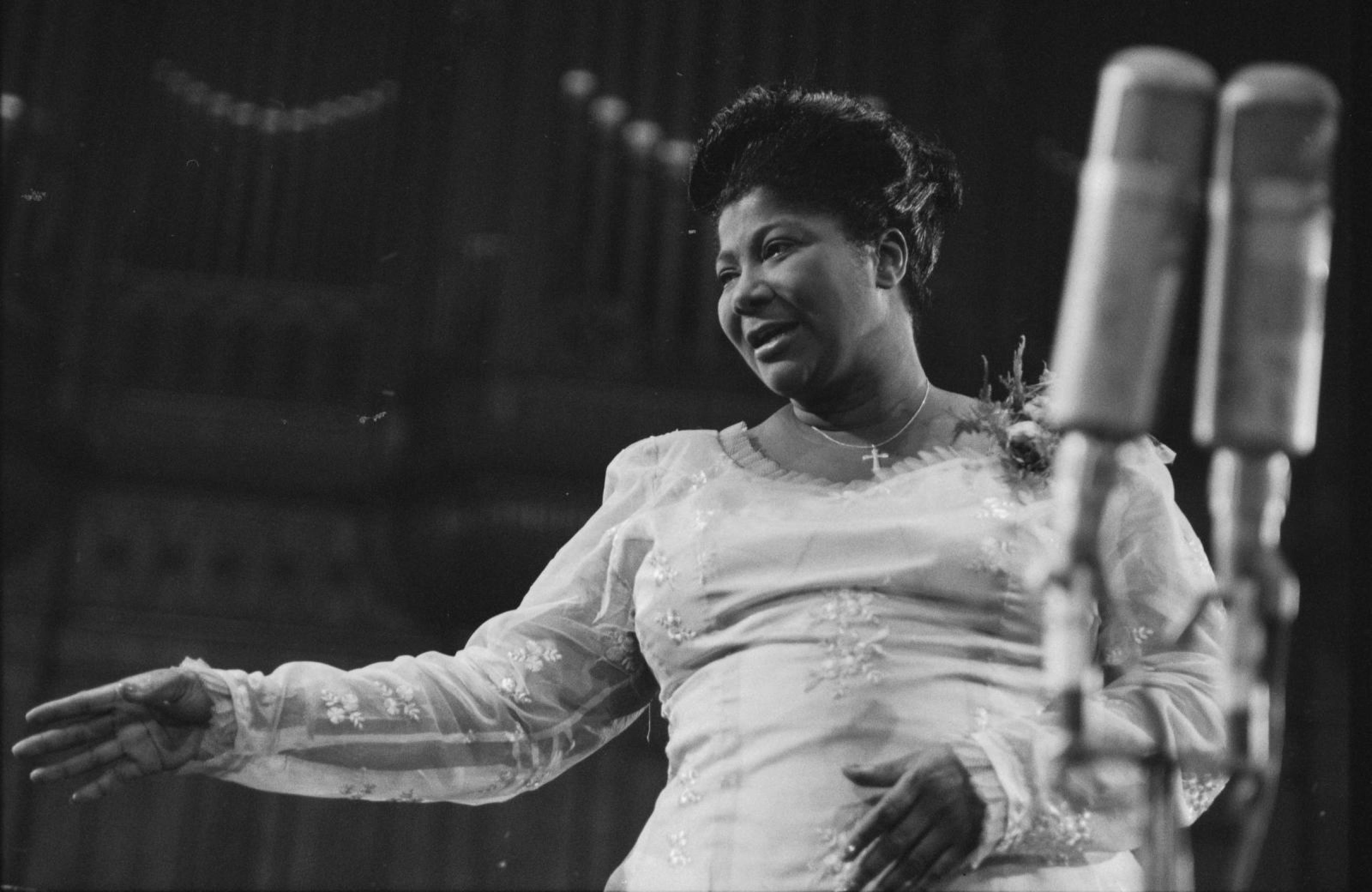
I think about the singer and performer Josephine Baker, who was barely schooled—not only did she not attend high school, but she barely finished elementary school. There she was, living in Paris in her midtwenties, speaking perfect French. I think about Mahalia Jackson, who never had a music lesson, but could both understand the richness of music and the business side of it.
Or Diane Nash, who was educated in a very strong segregated high school in Chicago. She attended Howard and Fisk. She was among the Black elite in terms of her education, and she immersed herself in the study of nonviolence and Gandhian philosophy.
Those women are so brilliant, and they grow as they age in this appreciation for learning that offers a rebuke to our own era of artificial intelligence and supposed efficiency. I try to get my college students to resist the machine, to resist the robot. But what I really want for them is not mastery, but curiosity, the ability to sit with the tension of not knowing what happens. Even if you don’t know the answer, the process and the struggle and the deliberation and the discernment is its own reward.
When I look at all of those women’s lives—some who lived to ninety-nine years old—that’s the thing I see worth emulating. In the case of Gloria Richardson, I interviewed her granddaughter and her daughter. They told me repeatedly that she was always learning something.
Richardson always wanted to know what was happening. She wanted to learn about Black Lives Matter. She wanted to know what young activists were thinking about. Rosa Parks, too, loved members of the NAACP Youth Council and hearing about the Black Power struggle. And Eva Jessye, a musician at the March on Washington, then in her sixties doing weird experimental opera after working in Hollywood, always wanted to know what the latest songs were on the radio.
These women had such an appreciation for what humanity brings. That comes from not just their marginalization, but understanding that the way to fight marginalization is to immerse yourself in your own humanity and in the humanity of others.
We welcome your comments about this article. Please send your response to [email protected]. And listen to the full interview with Marcia Chatelain here: