Norah Duncan IV is a tall man with a deep, unhurried voice. He exhibits the genial reserve of someone who has spent fifty years marshaling choirs and mingling with American bishops. When he tells me about something delicate—a late cardinal’s opinion about an abandoned Detroit church or a racist slight directed at him by a fellow Catholic—he drops to a hush, as though trying not to revive some dead controversy. Over four conversations across several months, I found that one reliable way to break through Duncan’s formality was to ask a technical question about his own music. Then he lights up like a boy.
In the music room of his house in Farmington Hills, a suburb of Detroit, Duncan keeps a Johannus organ, a digital instrument that can imitate various pipe organs from around the world. He gleefully put it through its paces for me, summoning the distinct sounds of the Manchester Hall organ and a Dresden Silbermann. Minutes later, his enthusiasm shifted to a YouTube clip of an organist playing his arrangement of “Go Tell It on the Mountain.” Duncan narrated the performance.
“A little jazzy. Then I do this gospel type. You hear that?” The audio turned again, brightened, climbed. “And then like a French toccata,” he said, an homage to Louis Vierne and Charles-Marie Widor, two nineteenth-century Paris organ masters. In a single Christmas carol, Duncan had passed through the Black church, the jazz club, and a French cathedral. He does not consider them to be incongruous places.
For half a century, Duncan has held together what the U.S. Catholic Church and American music generally keep apart: gospel and plainchant, the neighborhood parish and the downtown cathedral, the folk singer and the classically trained one. He is a self-taught organist who served for nearly thirty years as music director at the Cathedral of the Most Blessed Sacrament, the seat of the Archdiocese of Detroit, through the years when the city around it was losing people. In collaboration with others, he drafted a landmark 1980s text showing American bishops how to make room for Black expression throughout the Roman Mass. And when the question of what to call him comes up—organist? church musician? composer?—Duncan reaches for a much smaller word than his peers use to describe him. He calls himself an amateur.
Duncan was born in 1952, the eldest boy in a crowded house of seven children. Amid the noise of his family, he was the child who most wanted to be left alone. “Maybe that’s why I’m a musician,” he said. “I can work well by myself.” His mother was a cradle Catholic with New Orleans roots; his father was from Alabama. The first church he remembers attending is Visitation, on Detroit’s west side, which was predominantly white when they arrived. By the mid-1960s, the church would be mostly Black.
What Duncan heard at Visitation was not typical of a Black church. The choir director was Edmund Jennings, a Black teenager trained in chant and polyphony at Detroit’s Palestrina Institute. Under Jennings, the choir sang Latin motets that Duncan did not understand but could not stop listening to. “The polyphony, the chant. It’s just so otherworldly,” he said.
He came to his own instrument by trespass. At thirteen, he used his status as head altar boy to sneak into the church, climb a ladder past the stained-glass windows, and swing over the choir-loft rail. A priest caught him and handed him a key. What drew him to the organ was Jennings. “Maybe what I found most impressive was the fact that it was a young African American man playing it, a teenager,” Duncan said. When the pastor later fired the parish organist, a man who was prone to falling asleep mid-Mass, the loft came open. “I went up there and taught myself four hymns without any lessons,” Duncan said. “I just learned how to play the organ on my own.”
The organ was not Duncan’s first instrument. Because of his long arms, Duncan was initially handed a trombone at an archdiocesan program that offered free music lessons to inner-city kids. When Detroit erupted with racial unrest during the summer of 1967, accelerating a massive flight from the city, many children departed with their families. They left a number of accordions behind. Duncan taught himself to play the instrument. At St. Martin de Porres High School, he decided to perform the Young Rascals’ hit “Groovin.’” The curtain opened early to show him holding an accordion, drawing laughter from the crowd until he plugged the instrument in and played. “And then there was rocking and clapping and cheers,” he said.
Popular music was everywhere. St. Martin de Porres was near Hitsville U.S.A., the house that served as Motown’s first studio. Johnny Allen, a legendary Motown arranger who wrote for the Supremes and the Temptations, was the father of one classmate. Through his teens, Duncan played keyboards in the Afro Armada, a twelve-piece band. They worked local venues and crossed the river to play in Windsor, Canada, as “wannabe Commodores, wannabe Dramatics,” he recalls. Duncan never believed he had the chops for Motown, but Allen saw something the boy did not. He gave Duncan a book on arranging when he graduated from the University of Detroit.
Duncan also nearly became a priest, applying to Sacred Heart, the major seminary in the middle of Detroit. But during a dark Sunday evening Mass, he realized how detached the seminary was from the surrounding Black neighborhood. “This doesn’t feel right,” he thought. Years later, the activist priest Lawrence Lucas asked why he had never been ordained, telling him, “You know more about what’s going on than most priests.”
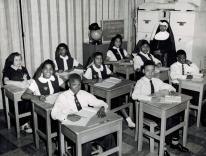
The Church was changing under Duncan’s feet, and so was its music. In 1969, Edwin Hawkins’s “Oh Happy Day” became an international hit, bringing the sound of the Black church into the Catholic sanctuary. Duncan remembers tambourines appearing at Visitation and St. Martin de Porres, along with afros, the music of Nina Simone, and the gospel of Mattie Moss Clark and the Clark Sisters. When Visitation, St. Agnes, and St. Teresa schools merged and became the predominantly Black St. Martin de Porres High School, the school admitted Protestants, introducing “a very different kind of charism and identity associated with the Black church” alongside courses in Black history and religion.
This was part of a larger post–Vatican II shift. Duncan can recite some of the milestones, including the canonization of the Ugandan Martyrs in 1964—that marked the first time a Black chorus sang in St. Peter’s Basilica—and the founding of the National Office for Black Catholics (NOBC) in 1970. Detroit had its own machinery, too. Deacon Allen McNeeley ran an institute to train ministers for the city’s Black community, and James Tatum’s contemporary jazz Mass could be heard at St. Cecilia’s on the city’s west side.
Much of Duncan’s musical education came from Clarence Hightower, whom he calls his musical grandfather. A classically trained tenor, Hightower spoke French, which connected him to Duncan’s maternal, New Orleans–born great-grandmother. That friendship led Duncan’s mother to sing in Hightower’s choir at Sacred Heart—Detroit’s Black Catholic “mother church”—and around 1972, Hightower took on the young Duncan as a mentee, a relationship that lasted until Hightower’s death in 1988.
Hightower introduced Duncan to a repertoire of concert spirituals by R. Nathaniel Dett, William L. Dawson, and John W. Work III. Working in the formal tradition tracing back to the Fisk Jubilee Singers in the 1870s and running through historically Black colleges, those composers arranged songs of the enslaved for trained choirs. It was a claim on the seriousness of Black music decades before “inculturation” became a buzzword in post–Vatican II Catholic circles. Hightower also introduced Duncan to Detroit’s working musicians, people like Dorgan Needom Jr. and Donald Vails and his Choraleers. At St. Cecilia’s, Duncan heard its music director Robert Slaughter’s old-style gospel, and he listened to works by Detroit composers like Charles Coleman, who had studied under the renowned French organist Marcel Dupré.
“I realized that before the NOBC and these other efforts, African Americans were already actively involved in Catholic churches,” Duncan said. At a 1974 workshop on Black Catholic worship at St. Joseph’s College in Indiana, Duncan met some of the figures who would define his field. The most important was Clarence Rivers, the “dean of Black liturgists,” who had written the music for the first official English Mass in the United States in 1964. Though not formally trained in music, Rivers proved that Catholic worship could invoke Black traditions without ceasing to be Catholic. His piece “God Is Love” set plainchant against what Duncan calls the “fingerprints of the Black voice”—“the flat thirds, the occasional flat fifths and flat sevenths.”
While teaching at St. Martin de Porres High, Duncan caught the attention of the man who made his career. He brought a choir to the annual chancery Christmas Mass celebrated by Cardinal John Dearden, where they sang Black music. Dearden was a principal architect of the postconciliar Church in the United States. He sat through all four sessions of Vatican II and helped shape its documents, and he later served as the first president of the National Conference of Catholic Bishops. He used his immense authority to make room in Detroit for the kind of music Duncan’s high-school choir brought into the chancery.
From 1976 to 1980, Duncan served as the music director at St. Clement in Center Line, a predominantly white parish of 3,300 families north of the city. The choir welcomed him, but some others did not. “I do remember some people telling me they couldn’t invite me to their homes because I was Black,” he said. “People would talk.”
Out of pure annoyance, Duncan wrote what remains his most famous piece of music at St. Clement. “I couldn’t stand what the folk group was singing after the 5:00 Saturday Mass,” he said, calling it an uninspiring “little folky Alleluia.” Asked by the pastor to find an alternative, Duncan wrote his own lilting Alleluia. He told me he composed the piece in about five minutes. “I try to write from the perspective of the singer,” he said, “the amateur singer. Can this person remember this tune? It’s so simple. No one needs to buy any music. You can pick it up by ear.”
At a 1980 Mass of Thanksgiving for Cardinal Dearden, 2,400 singers performed the unnamed piece, and someone in the crowd dubbed it the “Duncan Alleluia.” The name stuck, though Duncan thought it should be the St. Clement Alleluia. It spread globally: Detroit priests carried it to Rome, where the priest and composer Michael Joncas later heard it, and word of its use returned from Nigeria, Germany, and Australia. Duncan credits much of his Alleluia’s reach to John Bell, the Scottish hymn-writer, who came to Detroit for a weekend workshop, heard the Alleluia at Blessed Sacrament, and sang it straight back to him. Bell put it in a collection of short liturgical pieces used across the English-speaking world. Though the two men came from different backgrounds, they shared a fundamental belief: worship belongs to the people in the pews.
In 1979, Duncan wrote a Mass for the ordination of Fr. Tyrone Robinson, a young Black priest mentored by Deacon McNeeley and Fr. Donald Clark, a central Detroit figure in the Black Catholic movement. Duncan describes writing it with a shrug: “Why am I writing Masses? I never took a course in composition.” Robinson vouched for him to Patrick Cooney, rector of the Cathedral of the Most Blessed Sacrament, who gave him an audition. But Duncan believes the decisive factor was Cardinal Dearden, who had heard him at St. Clement and at Robinson’s ordination. Dearden concluded, in Duncan’s words: “Norah will be able to bring unity to our church, uniting the ensembles from the inner city, from the suburbs, from the rural areas.”
“I think [Cooney] felt this was the moment…to have a Black music director who could serve not only the mainstream liturgical needs, but also what was required for effective ministry in the Black Catholic community,” Duncan said.
In 1983, Duncan also became coordinator of archdiocesan music ministries, running workshops, choosing hymns, and eventually earning his master’s degree. At Sacred Heart Seminary, he lectured in liturgical music to future priests—almost all of them white—and conducted televised liturgies at the cathedral. “People heard about it,” he said. “‘Did you see what they did in Detroit? That’s a Black man conducting that.’”
Word reached the U.S. bishops. In the eighties, the American hierarchy formed a Black Liturgy Subcommittee under a young Wilton Gregory, the future cardinal and archbishop of Washington.
For that subcommittee, Duncan wrote the first draft of In Spirit and Truth: Black Catholic Reflections on the Order of Mass (1987), which walked through the liturgy part-by-part to explain how Black traditions were not deviations from but expressions of Catholic worship. He wrote the draft because, as he put it, “when you get a bunch of bishops together and a bunch of people with their degrees, they’ve got to have something to work with.”
When the bishops’ conference created its own office for Black Catholic affairs, the subcommittee was wound down. “But see, these things just stop,” Duncan said, looking back without bitterness. “The general spirit, the spirit and truth, there’s a lot in there that could still be used. It’s just a different Church now. It really is.”
Decades later, as the landmark Black Catholic hymnal Lead Me, Guide Me was being revised for a second edition, Duncan volunteered to write a Mass setting. The result was his Unity Mass, which he designed to hold multiple musical traditions at once. Its Kyrie was inspired by a trip to Nigerian churches in Enugu, Port Harcourt, and Abuja. “The experience of going up into the choir loft and seeing not an organ…but a drum right in the middle,” Duncan said, “that is the principal instrument right there.”
Drums sat at the center of his Mass, and Duncan wrote the Gloria in a loose calypso style for Caribbean families in American parishes. The Mass was not widely adopted, and the Gloria in particular drew objections. One critic, assuming the composer was female, wrote: “It’s quite obvious that Miss Duncan can write very well for piano. However, it’s questionable whether or not this music should be in our churches.” Duncan answered this critique with a quiet vengeance: he wrote another Gloria, “Holy Name of Jesus,” in a completely traditional style. Premiering in 2011 and published widely by GIA, it proved he could write what the establishment demanded. He simply chose not to do only that.
That fluid movement between traditions was entirely consistent with Duncan’s roots. In the early 2000s, Duncan partnered with Fr. Daniel Saulnier of France’s Abbey of Solesmes, the world’s center of Gregorian chant scholarship, to host a Detroit summer program. The two had met at an international congress where Duncan stood up to insist that Black musical expression belonged in the universal Church. To Duncan, who grew up singing “Ubi Caritas” and “Tantum Ergo” alongside the gospel tambourines of the 1960s, classical plainsong was a natural fit. Yet his multifaceted approach puzzled archdiocesan officials who, viewing him strictly as a liturgical liberal, misread the collaboration. “They were concerned that I was suddenly going conservative on them,” he recalled. In reality, like Clarence Rivers before him, Duncan saw no contradiction between a calypso Gloria and a Gregorian melody. Both men performed the exact same pastoral task: putting sacred sounds where the living people are.
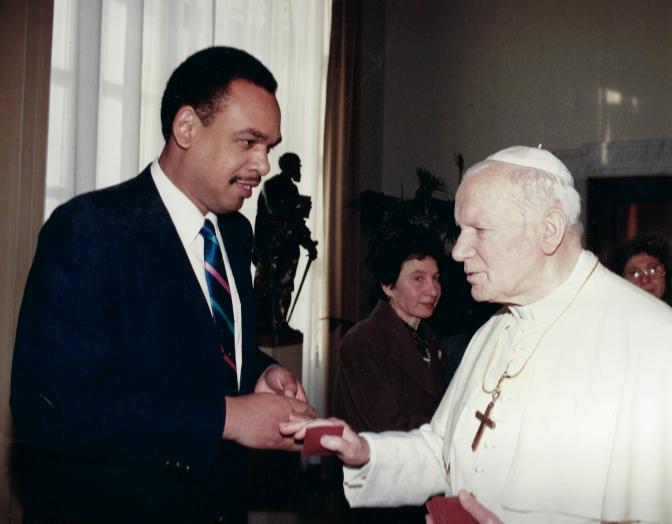
Duncan’s largest assignment came in 1987, when Archbishop Edmund Szoka invited Pope John Paul II to Detroit. Other host cities had years to prepare; Detroit had seven months.
Initially told he would need a choir of up to ten thousand, Duncan negotiated the size down to 1,200 singers representing every corner of the archdiocese. He built a program to match that diversity: a Gloria by Alexander Peloquin, Spanish music at the Offertory, a Polish piece at Communion, and an African American woman as cantor.
Then came a logistical crisis: every charter bus in the region was booked. The rescue came from outside the Church entirely. “A whole caravan of Hebrew school buses,” Duncan recalled, transported the choir and orchestra to the Pontiac Silverdome. Duncan remains proudest of the invisible labor: “I had a plan, and I had to execute the plan…. Imagine just assembling music and folders for 1,200 people.” For those twenty-four hours, it seemed, Detroit was “the seat of the universal Church.” Duncan is unsentimental about the actual Mass, which suffered from a storm and some erroneous musical notes, but when he walked into the cathedral the next morning, the congregation stood and applauded.
At some point, the cathedral became too small for Duncan’s ambitions, a shift he describes mostly as a budget question. It was one thing for a pastor to permit a small Advent concert, but another to fund Handel’s Messiah, Bach’s Magnificat, or the Verdi Requiem, which Duncan mounted in 2000. For his summer recital series, he brought in world-class talent, including Simon Preston, the English organist who had played Lady Diana’s wedding at Westminster Abbey, and Olivier Latry, the organist of Notre-Dame de Paris. These were his happiest creative years—shaping diocesan liturgies with a sixty-five-voice chorus—peaking around 2003 or 2004 before administrative duties at Wayne State pulled him away. He retired from his role as Blessed Sacrament’s music director three years later.
Instead of leaving the Church entirely, Duncan walked into the concert hall, serving repeatedly as the chorus master for the Detroit Symphony Orchestra. Like the legendary Detroit jazz trumpeter Marcus Belgrave (another influence on Duncan) or educator Charles Coleman, Duncan’s ultimate goal was community-driven: he wanted people from Black Catholic parishes and Wayne State, an urban research university, seen doing exceptional work downtown, and he wanted Black Detroiters in those seats. “This is your orchestra,” he said. “These are your people.”
Duncan’s own writing gradually drifted toward the concert stage. After arranging spirituals for Oregon Catholic Press and the Lead Me, Guide Me revision, which was published in 2012, he wrote an arrangement of “Hold On” intended specifically for the concert hall. During the pandemic, he compiled the solo-voice collection Give Me Jesus (2021). When his dean suggested he apply for the Murray E. Jackson Award—a prestigious prize designed to fund major new creative work—Duncan hesitated, repeating his familiar refrain: “I keep telling people writing isn’t my thing…. I’ve never formally studied composition.” Then he offered his defining self-theory: “Maybe it’s because as an inner-city kid, certain things, you just can’t wait for formal training.”
Duncan won the award in 2024. The piece he wrote with it is called Journey, and it is nearly forty minutes of spirituals arranged for soloists, chorus, and chamber orchestra. It moves in a single arc from slavery to freedom. Duncan considers Journey, which he wrote in his seventies, to be the most ambitious music of his life.
To create it, he started reading. He turned to Hampton University’s collection of spirituals, to John W. Work III’s book American Negro Songs and Spirituals (1940), and to the anthology of spirituals assembled by James Weldon Johnson and his brother J. Rosamond Johnson. He cut the roughly three hundred and fifty songs in all down to fifty, at which point he knew he needed a spine. Duncan found his throughline in the songs themselves. “That’s what I thought was the best way of focusing it,” he said of the movement from bondage to liberation. “And then it became easy to classify certain spirituals and see that progression from the darkest times upward.”
Taking me through Journey’s score, Duncan becomes the boy at the console again. “Deep River” he sets for baritone against harp, strings, and a solo bassoon, and it is immediately captivating. Under “Changed My Name,” he puts a double bass, “which is just the foundation of so much Black popular music, especially bluesy music,” and lays the chorus over the soloist in what he calls a “quasi call-and-response.” He hears that song as an act of self-assertion, and he describes it in the first person, as though he were the one singing. “I know the world’s going to be against me, but I’m stepping out. I’m saying I’m important, I’m somebody, I’m going to change my name. I’m not going to carry the master’s name.”
“I Am Seeking for a City” is apocalyptic. It was meant to be the finale, sopranos climbing to a high B-flat over full chorus and orchestra, but Duncan changed his mind. He wanted to end in celebration. “I need some dance, something,” he said. So the piece closes with “Great Day / O Freedom!,” a New Orleans tuba line running under African drums.
There is a line in the finale about God building up Zion’s walls, and Duncan built it a chord with a high B-flat falling two and a half octaves to E-flat. “That’s the wall,” he said. Then he hesitated, and his voice dropped. “And the image of the wall, this is awful for me to say, but I remember our president talking about the wall that was going to separate the United States from Mexico.” This is what he means when he says these songs are not artifacts. An enslaved person’s hope for a rebuilt Zion becomes, in twenty-first century Detroit, an argument about a border. Asked why he insists on ending Journey with a celebration rather than something more foreboding, he does not equivocate. “I always believe there’s going to be a brighter day. That this too will pass. I really believe that.”
Though Duncan’s award did not require a performance, Journey was brought to the stage by conductor Andrew Neer of the Oakland Choral Society, who secured the necessary funding and musicians. But those resources highlighted metropolitan Detroit’s economic divides. At a Wayne State rehearsal, Duncan realized that two-thirds of the chorus had never lived the struggles described in the music. When a Black student emailed Duncan to ask why many of the performers and the conductor were not Black, he did not reply, knowing the systemic explanation: music on this scale costs money, and in metro Detroit, that capital is largely white-owned and located outside the city limits. Duncan’s dream is to eventually conduct Journey himself with an all-Black chorus and orchestra at Orchestra Hall in Detroit or Carnegie Hall in New York City, a move he sees as carrying Detroit outward to other people.
I had already watched the premiere of Journey, first performed by the Macomb Symphony Orchestra in fall 2025, on a video Duncan sent me before I heard the cantata performed in a church. The most recent performance this past May was at St. Clare of Montefalco in Grosse Pointe Park, a beautiful space and, as Duncan noted from its podium, the church where Pope Leo XIV was ordained a deacon. There was a Detroit logic to the performance of Journey that I saw. Among the soloists was Joan Belgrave, the jazz vocalist and widow of Marcus, which put the concert-spiritual tradition and the Detroit jazz scene on the same stage. Duncan has been trying to get these genres into the same room, to breathe the same air, for much of his life.
While introducing Journey, Duncan mentioned something else: the pope had recently apologized, in Magnifica humanitas, for the role the Holy See played in legitimizing slavery and failing to condemn it. Then the music started, and knowing what was coming did not protect me from it. When it ended the applause went on and on, and Duncan yet again took a well-earned bow.
Is Duncan a true composer? He allows, cautiously, that he might be “a skilled amateur composer.” Though some of Duncan’s peers call Journey a major work of literature, he is more comfortable reporting their praise than claiming it. He considers it sacred music but is firm that it is not church music.
A late friend once defined Duncan’s legacy: “When you lift up all these people around you…they raise you up in return.”
At his final address as Wayne State’s music chair, Duncan spoke of the inner-city kid on a bicycle who could never have envisioned this life. Afterward, a couple of colleagues admitted that they assumed from his refined bearing and sharp suits that he had grown up “bougie.” He was amused by that but remains genuinely amazed. “My life has been a series of imaginings,” he said, recalling playing in St. Peter’s Basilica and meeting a pope. He refuses to let his story rest on mere wonder. The addition he offered is the truest thing about him: “And more than just imagining, the need to plan and prepare.”
We welcome your comments about this article. Please send your response to [email protected].