Lately I have been trying to rediscover traces of something sacred in my life, objects or practices that are inviolable simply because I have decided they should be. In my living room, Robert Alter’s three-volume translation of the Hebrew Bible sits as a beautiful, gilded prop on a side table; I wrote marginalia in the books six or seven years ago and have not consulted them since. The closest thing I have to a shrine is in my kitchen: one corner of a buffet cabinet with my dead dog’s old sweater and a repurposed jewelry box that contains a thatch of his black-and-white fur. I attend online therapy every week—my most consistent ritual—and I am a year and a half sober in a way that feels vaguely penitent.
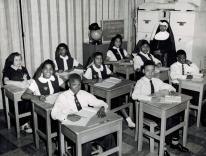
My old idea of the sacred withered when I was in high school. It was soon after my grandfather died. The afterlife I had believed in growing up seemed like a pacifying ruse. Early on Sundays, my mother would knock at my door, hear silence, then push it open slightly to ask if I was going to church. I had been doing so for most of my life. But in those moments, I turned to stone whenever she tried to stir me. Eventually, I found enough courage to say no. I went from a childhood of eating Communion wafers, failing to speak in tongues, reading the Psalms, and flipping through hymnals to sleeping through Sunday mornings with only mild guilt.
By the time I left Michigan for college in 2013, I believed I understood why I was no longer religious. For one, I had been too skeptical for my own good since I was a child. Sermons that threatened hellfire, condemned queer people, and criticized other faith traditions were discordant with whatever notion of unconditional love I was hearing about in the same breath. Other environmental factors likely influenced my growing doubt. Through a scholarship, I attended a private, independent high school in a wealthy Detroit suburb that attracted kids from around the region. It was diverse-ish, encouraging rigorous inquiry and self-exploration to an extent that was foreign to me at the time. The school sent me to a national student conference in San Diego promoting inclusivity, mutual understanding, and social justice. My mother and I didn’t have much money, but the world and its people were opening up to me, exposing fault lines in everything I had believed to be settled, including my tottering faith.
As a thirty-one-year-old Black American—a younger Millennial—who was raised Baptist and is now religiously unaffiliated, I am part of the generational cohort driving one of the most drastic religious reconfigurations among Black Americans today. As sociologist Jason E. Shelton notes in his 2024 book The Contemporary Black Church, Black Millennials—born between 1981 and 1996—make up the first generation of Black Americans that is not majority Baptist. Millennials in general have caused a sharp uptick in the number of Americans who identify as religious nonaffiliates, or “Nones” (31 percent, according to one Gallup poll, compared to 19 percent for members of Generation X). But, according to the Pew Research Center, most Black Nones are not strictly secular: more than a third believe in the God of the Bible, and more than half believe in some other higher power. As an agnostic myself—two percent of Black adults identify as such—I am an outlier among those who don’t claim a formal religion.
While younger Black Americans have been leaving their churches for decades, they have not abandoned spirituality. I wanted to understand how people like me—those who grew up in the Black church and later found themselves outside of it—were channeling the impulse to believe. Were they finding something better, or just something different? Were the communities and practices they were building capable of replacing what the church had provided: the regularity of gathering, intergenerational bonds, and a shared moral framework? I began reporting this piece partly to answer those questions and partly because I recognized myself in that group. Many of us are arranging objects on our shelves and calling this process holy, trying to figure out what to do with the spiritual longing we felt when churches stopped working for our benefit.
A January 2026 article in The Michigan Chronicle titled “The New Black Spiritual Renaissance” noted that “for many Black millennials and Gen Z, traditional religion didn’t always leave room for full expression.” Recourse to practices such as ancestor veneration, Hoodoo and other African-derived religions, herbal medicine, and astrology were signs, the author wrote, that “we are no longer satisfied with borrowed paths. We are creating our own.”
The question of how and where Black people cultivate sacred communities outside of Christianity has come up increasingly in recent years. The prominent religious historian Anthony Pinn, a Black African Methodist Episcopal minister turned atheist, published a book in 2024 called The Black Practice of Disbelief. In it, he writes about “meaning-making…without god(s)” and the “new religious movement” he calls “Black humanism.” Is it possible, Pinn wonders, for Black Americans who don’t believe in a deity to still be religious? Can a humanistic interest “based on social justice, ethics, black liberation, black feminism and serving black communities within the context of heightened anti-Black state violence, segregation and misogynoir” constitute its own unique form of spirituality? What are the alternate spaces, communities, and traditions that affirm the sacrosanct nature of Black lives here and now?
Pinn’s concern for the welfare of Black people without a church is part of a broader cultural anxiety about what happens to people when the institutions that once organized their social lives—religious congregations chief among them—disappear without obvious replacements. There has been research about the link between the current loneliness epidemic in the United States and the decline of civic engagement and belonging across the country. The growing number of American Nones has led some researchers to ask whether those people are as happy and healthy as their religious counterparts. As recently as 2025, a study in Sociology of Health & Illness suggested that although leaving one’s religion (more specifically, the community that comes with it) is correlated with declines in wellbeing, the more important predictors of long-term wellbeing are how a person feels about their decision to leave, how recently they left, and whether they participate in other “values-based communities.”
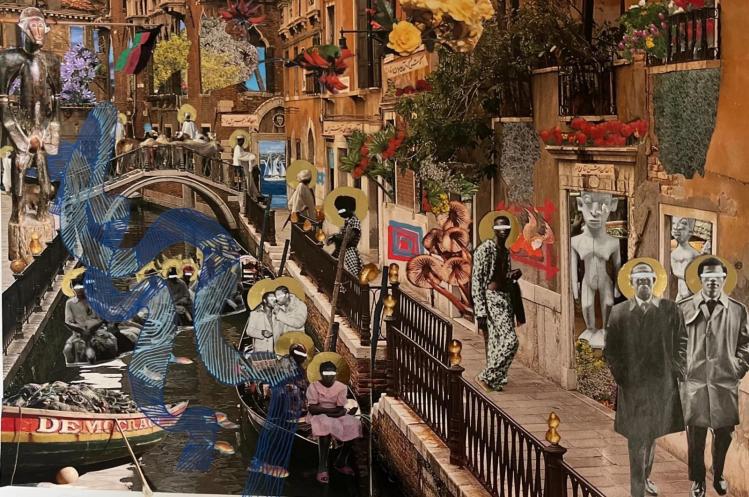
What then do alternate communities look like for Black Millennials who have left the church? One answer arrived, for me, through an organization called Intelligent Mischief. Intelligent Mischief is a New York City–based creative design lab cofounded by artist-organizers Aisha Shillingford and Terry Marshall in 2013. In addition to providing consultancy work for social-justice organizations, the lab creates interactive exhibits and speculative art inspired by Black radical traditions from Afrofuturism to Afrosurrealism.
Like many other people, I found its online community—the “Secret Society of Black Utopians”—by going down an internet rabbit hole in the postpandemic period. The group was described as “a global community of…speculative world builders, freedom dreamers, fugitive designers, futurist maroons and prefigurative makers” invested in a world in which all Black people are “thriving, euphoric, sovereign and free.” For years, in the absence of church, I had been telling some friends about my desire to find community among Black artists and other creatives. The Secret Society felt like something I’d been looking for, a space (albeit virtual) that took seriously the boundlessness of Black imagination.
In fall 2025, soon after I put out a call in the WhatsApp group for people to speak with me for this article, a subchat focused on spirituality was created. More than fifty members from around the world joined, from as far away as Nigeria, though most were based in the United States. The Black Millennials who agreed to speak with me were a geographically and spiritually diverse group. They ranged from ages thirty-two to forty-five. They lived in Los Angeles and Oklahoma City, Brooklyn and New Orleans. I wanted to look beyond statistics and surveys to understand something about the texture of this generation’s shift away from institutional Christianity. What were some of the generational turning points and personal circumstances that would cause people to leave the churches where they grew up?
The people I spoke with were all shaped by Christianity to some degree. Many grew up in interfaith households or social environments. Most are queer and came of age during the first iteration of the Black Lives Matter (BLM) movement in the early 2010s, when the contemporary Black church’s political weaknesses became hard to ignore. They were absorbed into an internet-saturated world that dissolved the informational and social monopoly Christianity had long held over its members. Well-educated, geographically mobile, and connected to networks of Black radical thought, their political ethics became inseparable from their spiritual lives. Rather than simply leaving Christianity behind, these spiritual maroons often accumulated wisdom from other traditions, channeling their desire for sacred connection into Buddhist sanghas, abolitionist-adjacent work, and social justice–oriented public programming. What unites them is simpler to describe than what distinguishes them: a desire for consistent gathering, shared rituals, and the gift of being known.
Intelligent Mischief cofounder Aisha Shillingford, an “Xennial” (a Gen X/Millennial cusp) born in 1979, was raised in Trinidad, in a family split between French Caribbean Catholicism and Anglicanism. In Trinidad, the religious calendar belonged to everyone. “Growing up in a country that is simultaneously diverse and highly representative,” she said, “there’s a kind of shared consciousness of respect and a lot of involvement in each other’s religious practices as part of being a citizen. Everyone kind of acknowledges, if not celebrates, Eid. Everyone. Same thing for Diwali.”
Aisha converted to Islam at seventeen, drawn to the faith by its physicality (“How much prayer there was and how embodied it was”), its lucid answers to existential questions about death, and the fact that “it was a family I was choosing.” She spent a decade organizing in Boston’s Muslim community, but the strict “self-monitoring” dimension of her Islamic practice ultimately induced anxiety. Gradually, she became more of a nomadic spiritual seeker, at one point beginning interfaith study with a rabbi.
“I learned over time that truth cannot exist inside of one tradition,” she said. She recognized that by experimenting with multiple faiths, she was always building on her understanding of the world, not renouncing any part of herself. “I’m usually not feeling like ‘this [spiritual tradition] doesn’t have the truth.’ It’s more like something comes along and, hey, here’s some more over here. And I’m like, oh wow, let me add it on. Almost like adding it on is what creates greater access to greater wisdom.”
Amber Jones, thirty-five, grew up in Baltimore with a layered religious history in her family. Her paternal great-grandfather was a Baptist reverend in South Carolina; his son became a deacon and eventually abandoned the family. On her mother’s side, her grandmother became a Jehovah’s Witness and died, Amber’s mother believes, because the community’s beliefs prevented a necessary blood transfusion. “My mother had a lot of resentment,” Amber told me, “because she felt like [her mother’s] life could have been saved if she could have had certain procedures.”
Her mother joined a Baptist church when Amber was five but refused to make attendance mandatory. The restrictiveness that had killed her own mother was not something she would pass on. Amber believes she inherited a specific kind of wariness because of this. “I’m always a little bit skeptical of anything that demands extreme and total devotion,” she said. “I don’t want to feel like anything is controlling too much of my life.”
Shelley Bruce, thirty-seven, grew up in Los Angeles between an Evangelical Lutheran church and Immaculate Heart, an all-girls Catholic school that had broken with the archdiocese because its rebel nuns refused to stay quiet about the war in Vietnam. At fifteen, Shelley was sitting in a spirituality class that taught dream interpretation, yoga, and meditation, “which I thought to be very L.A.,” she said. Between the Lutheran church and progressive Catholic school, her formation gave her a foundation without a cage. “I had a good rootedness and sense of morality and direction. But it wasn’t so hard and fast that I felt really too indoctrinated in a harmful way.”
For many of these spiritual maroons, what made leaving the church possible was that they had never felt fully integrated in the first place. Amber Walker, thirty-eight, grew up as a pastor’s kid in the Ferguson-Florissant area of Missouri, which meant she was expected to participate in her church community. She was involved with the praise team and youth choir. From a young age, she was also aware of something she couldn’t discuss publicly: her aunt in Detroit, who she would visit during the summers, was partnered with a woman. “That was my first interaction with that context,” she told me. “So when I was five or six, I was like, oh, I like girls. I like boys. And I didn’t know it was wrong until I got to youth group and they told me it was wrong.” This sparked a period of pragmatic self-censorship. “It wasn’t even that I was afraid of shunning,” Amber said. “It’s more like, I don’t want people not to invite me to stuff or not to want me around.” Amber waited until she found a justice-oriented, affirming church years later before she came out as pansexual.
For Shelley, the discovery of her own queerness arrived more slowly. She had grown up assuming she was straight, and it wasn’t until a friend pointed out, early in college, that she was “a little homophobic” that she began to examine the idea. Her gender-studies program taught her that sexuality and gender existed on a spectrum, not as binaries. “Is it really wrong to be gay? [Believing so] felt wrong in my spirit. It felt wrong in my body. It felt so punitive and limiting. And it didn’t feel like God and life itself could be that limiting.”
During my reporting, I found that individual ruptures from Christianity, when they occurred, were rarely about doctrine alone. Often a specific person or a family tragedy played a significant role in a person’s decision to disaffiliate. Najah Amatullah Hylton, thirty-seven, grew up moving through several churches—an Air Force base chapel, an Assemblies of God congregation—before joining a Black, nondenominational megachurch she genuinely loved. “It was revolutionary,” Najah said. But the cracks appeared incrementally: a pastor once told the women in the congregation to stop praying for God to send them a husband and to pray instead to become a wife. Najah left for six months after that and then returned. “I don’t know why I came back. I got over it from the premise of: walk in forgiveness, don’t hold grudges.” She stayed for another decade.
What finally broke her was a bargain gone wrong. When her mother was diagnosed with cancer, Najah ended her relationship with her boyfriend, believing God required this in exchange for a miracle. Her mother died in January 2019. At the funeral, her ex left her to grieve on her own. “Obviously there was that betrayal from God, right?” Najah said. “I pushed away a relationship so that I could get close to [God], so that I could save my mom, and then she dies anyway. Like, what? What are we doing here?” Najah kept attending church for a while after because she liked it and because the people knew her. Then she had a baby and her mother wasn’t there to help. Attending church began to feel obligatory and taxing. Najah became, she says, “a Christmas and Easter girl, like all the heathens.”
One’s yearning for a relationship with the sacred doesn’t disappear just because an institution does. At seventeen, Amber Jones was in a depression so total she couldn’t picture an older version of herself. She was searching her house for Tylenol when something stopped her. “It’s just like all of these positive thoughts. And it was almost like the room felt different. Like it was bright.” She called this sensation “God” because nothing else accounted for the interruption to her suicide attempt.
“My entire thought process was fully pessimistic. When I experienced a sudden disruption of that thought pattern, out of the blue, I don’t know what it could have been but God.” She would later spend years researching how the Bible was created, reading about the history of its translations, alterations, and the human ingenuity behind the text. Rather than destroying her faith, her critical exploration clarified it: “There must be some truth here that is so precious that people would put all this energy in trying to complicate it or distort it.”
Jay Mimes, thirty-two, a Brooklyn-based healer, herbalist, and community organizer who grew up between Connecticut and Brooklyn in a Baptist household, renounced their Christianity in early adolescence and kept it at arm’s length for nearly a decade. In 2022, their grandmother died. They left a corporate job, went to a healing-justice gathering in the Hudson Valley, and came back changed. “This combination of grief and reawakening happen[ed] for me,” Jay said. One of Jay’s friends mentioned a BIPOC-only virtual Buddhist sangha that met every Thursday. Jay tuned in. It was the beginning of their engaged Buddhist practice, which later culminated with them cofounding a BIPOC sangha in Brooklyn.
The question of what fills the space that churches once occupied for so many Black people is one these Millennials are trying to answer. Aisha keeps returning to it. “I want a place I can go to every week and everyone knows my name, and we’re helping each other transform.” Not even the online community she helped create feels like enough. She thinks of the Secret Society of Black Utopians as a good initiative—even a profound one—but she says it is not consistent enough for her to feel real belonging. She’s trying to find “the spaces that would have gathered people, where people would have felt a sense of belonging, where narratives are rippling, where ways of being were solidified and real—and sort of looking at that kind of disappearance of longtime religious institutions and wanting to understand: What are the structures? And can those structures supersede any particular dogma?”
For Amber Jones, Black solidarity economy networks became essential communities. She found that the work in those groups felt spiritual whether she initially thought of it in those terms or not. The more she reflected on the history of Black church denominations created by enslaved and formerly enslaved people as mechanisms of survival, the more she recognized the structure she was trying to reconstruct. “It’s brought me kind of full circle,” she said. “The way that I build community in line with people isn’t necessarily directly through faith or spirituality, but it will land there still.”
The line between the “sacred” and the “secular” is a dubious one. For some Black Millennials, the first wave of the BLM movement was itself a spiritual event, a collective reckoning that activated the sacred impulse, directing it toward political transformation. In a 2017 article “The Spirit in Black Lives Matter: New Spiritual Community in Black Radical Organizing,” Hebah Farrag pointed out that false dichotomy. BLM chapters around the country had been shaped by the principles of transformative justice, “an abolitionist philosophic orientation to peace-making and community accountability emerging from the Quaker tradition.”
It was no accident that many of the decentralized movement’s leaders were female, queer, or otherwise “marginalized by traditional Black faith groups,” Farrag wrote. Many of those people turned to “healing justice networks” that used “a variety of alternative practices, such as somatics, alternative medicine, and psychotherapy as tools to transform and empower individuals.” Farrag believed the emergence of healing justice as a “religious experience and political ethic” for the BLM generation represented an intentional rejection of burnout, a refusal of the “martyr mentality” that requires activists and organizers to prioritize social transformation above self-care.
Several people I spoke with identified a cluster of events as turning points in the relationship between Black Millennials and organized religion, including 9/11 and the War on Terror, the Great Recession, and the deaths of Trayvon Martin and Michael Brown. Events like those taught them that the civic, political, and religious institutions charged with their protection were capable of catastrophic failure. Amber Walker put it simply: Millennials questioned everything and eventually directed that skeptical tendency toward the church.
Aisha pointed to a different but related point of tension: the generational transfer of leadership that never came. Friends of hers who came up in organizations such as the Malcolm X Grassroots Movement, she said, reached their thirties ready to become leaders in their religious communities, only to find the previous generation still firmly in place. “So they leave and create other structures that maybe don’t have the community and cultivation.” The Black church faces the same issue that other established Black civic organizations confront; institutions that survived by holding their people close are now losing them for a similar reason—older generations are slow to let go.
The internet also played a role in those shifts. Jay told me that without it, they never would have found the Black Trans Prayer Book. They may not have learned that there were people who had “metabolized and transmuted” experiences like theirs into something concrete. “Besides all the slop and the misinformation,” they told me, “there is still this potential for us to actually understand someone or something that we have not interfaced with. There’s potential for us to expand ourselves, our consciousness, our sense of spirit through something that we find on Reddit or on YouTube.” The internet made every tradition simultaneously available and, therefore, no single one was compulsory. It helped bring about the dissolution of religious monoculture. “There’s a synthesis,” Jay said, “that a lot of us are either very actively engaging in or on the precipice of.”
Not everyone greets the spiritual panoply of young Black Americans with enthusiasm. In The Contemporary Black Church, Shelton mourns Black Millennial and Gen Z drift away from Christianity (and Christian communities) and expresses alarm that “new and distinct forms of spiritual and religious individualism have become prevalent in Black America.” He points to urbanization, an expanding post–civil rights era Black middle class, and the rise of the internet and social media as some of the forces driving “faith-based pluralism.” He asks: “What does it mean for Black America’s future if more and more people not only abandon organized religion but also become individual islands, out there on their own?”
Drawing on data that suggests Black Nones are “significantly less likely to join community-based groups and organizations” than their religious counterparts, Shelton implies that the container of the Black church most effectively “promotes cohesion and solidarity through shared traditions, values, and culture.” No matter how spiritual a Black None may be, Shelton argues that organized religion is the bulwark against the “profoundly individualistic” culture he observes in the present. He mistakes movement away from Christian churches as disinterest in community-building. For me and other Black Millennials I have spoken to who grew up in the Black church but no longer identify as Christian, there is, on the contrary, a real eagerness to replace the lost community structures of our childhoods.
Shelton is right that religious pluralism is spreading among younger Black Americans, but this is not because they are embracing isolation. Many Black Millennials who left the church experience, at least for a time, a kind of institutional homelessness. Often they are searching for new forms of community as much as they are searching for new belief systems. They have felt compelled or empowered to pursue individual solutions to a collective problem—namely, the fact that they are orphans of churches that failed to meet their needs. Shelton’s research recognizes the phenomenon of departure from Black churches but it doesn’t capture the curiosity that follows it.
I sometimes think about Najah, living in her grandmother’s house in Oklahoma City, the two of them under the same roof with almost nothing in common except shared blood. When she and I spoke, her grandmother was ninety-three, devout and unwavering in her faith. She watches television, mostly Fox News, which tells her the end of the world is coming. After years of navigating “church hurt”—the sense of emotional betrayal that comes from negative experiences in one’s spiritual home—and a failed negotiation with God for her mother’s life, Najah arrived at a different conclusion: the world doesn’t end. It is just at risk of becoming a worse version of itself. And yet people must keep living in it, figuring out how to make it work for them.
Many members of my generation are engaged in acts of spiritual reclamation. This is not the apostasy or spiritual vacancy that some sociologists fear but a patient, deliberative process. Younger Black people are trying to build something the Black church provided before it became less relevant to their everyday lives: a place where one person’s survival and prosperity is in everybody’s best interest, and where sacred and communal institutions are not separate categories. Underneath religious disaffiliation is a basic truth: people want to be a part of something larger than themselves. They want to mark time with other people and have somewhere reliable to put their grief and joys. The Black church knew this. The people I spoke with know it, too, which is why they haven’t stopped looking.
We welcome your comments about this article. Please send your response to [email protected].