“Religion then was but one current in the river of our lives.” —John Keene, Annotations
Nearly seven years ago, I became curious about Black American Catholic fiction for a simple reason: I didn’t know much about Black Catholic history, and I wondered whether novelists had taken it up. I’m not Catholic myself—I grew up Baptist and now identify as agnostic—though much of my writing centers the dynamic spiritual lives of Black Americans, particularly those who have found sacred meaning even as their lives are desacralized by the world around them. Given the scale of the Church’s entanglement with Black American life—from its role in the slave trade to its countless examples of institutionalized exclusion—one would think fiction would have something to say about it. Where are the novels about Vatican II and its reverberations in Black parishes, or the countercultural bent of Black Catholic sisters and brothers in the 1960s?
In fiction produced by Black American Catholics—or Black Americans who center Catholic institutions, theology, or forms in their writing—none that I could find focuses explicitly on the long, dramatic arcs of Black Catholic struggles and triumphs in the United States. What I found instead were traces: stray depictions of Black Catholic institutional life that dwelt not on the Church but on the school. Nonfiction by Black Catholics dealt with history more directly, but in both, the classroom kept appearing. Why?
“Black Catholic literature” is not commonly accepted as an established tradition with clear parameters, so I had to work backward toward some kind of answer. The authors I read represent a range of voices, from decorated writers such as Edward P. Jones and John Keene to virtually unknown lay authors such as Shirley Harris-Slaughter. (Readers familiar with Black Catholic writing will notice the absence in this essay of Toni Morrison, whose Catholic faith quietly permeates her fiction. This dimension of her work has been explored with great care elsewhere, particularly in Erin Salius’s book, Sacraments of Memory: Catholicism and Slavery in Contemporary African American Literature.) The books I chose to focus on center Black American encounters with Catholic institutions rather than Catholic imagery or symbolism alone. In my reading, I picked up on a common thread running through both fiction and nonfiction: a preoccupation with the education of Black children and the role the parochial school system has played in Black youth development, for good or ill. The works hint at the tensions between parochial and public-school education; the pervasiveness of women religious on the educational frontlines; and the gatekeepers who determine which children stay and which are pushed out. For these writers, the classroom emerges as a more formative, intimate, and consequential arena than the pew—and the question of who gets to remain in it animates much of what they have to say.
A classic book by the late Harlem-based priest Fr. Lawrence Lucas, Black Priest/White Church (1970), while not strictly a memoir, contains a clear autobiographical throughline concerning the formal educations of Lucas and his siblings. While much of the book is a jeremiad against institutionalized racism in the Church, Lucas uses the opening section to show how the Church’s predominantly white leadership “controlled [the Black man’s] mind, his heart, his will, his self-image, his aspirations, his thoughts and every movement.” Lucas is interested in the insidious social and psychological pressures that powerful institutions exert on Black people; he recognizes that, for many of those who join the Church, their first point of contact is often its most effective conversion engine: the parochial school system.
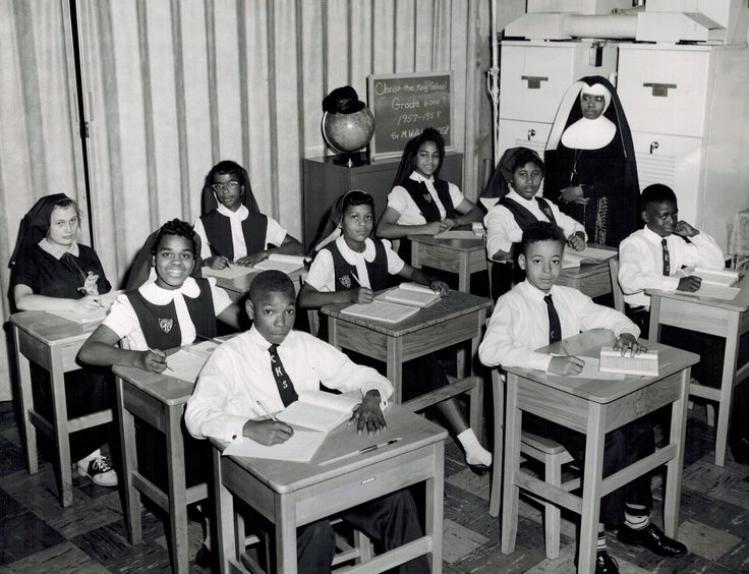
In Lucas’s book, as in the others that I consider here, the parochial school’s appeal for Black families is contrasted against that of the public school, which is seen as an underresourced, less desirable alternative. Lucas’s first parish church as a child was All Saints in Harlem, which had a predominantly Irish Catholic congregation. Although the All Saints School was located “directly across the street from where we lived,” Lucas noted, it did not accept Black students when his two older brothers were starting elementary school. Their earliest formal education took place in public schools, where Lucas himself attended grade school for two years. Ironically, the development that leads to All Saints School’s desegregation is not enlightened self-interest but rather white flight, “the exodus of white Catholics [that] began to leave All Saints [Parish] with empty places.” (Lucas’s younger sister, Patricia, was the first Black student to attend All Saints School, in 1942; five more Black children, including the three Lucas boys, would join her in 1945.) Only when Lucas begins third grade does his mother succeed in enrolling her boys at St. Mark’s, an all-Black school located “an eleven-block walk” from their home. It was a relatively long way to go for an education administered by Sisters of the Blessed Sacrament, who, Lucas writes, “were part of the system that reinforced [the] belief” that whiteness accrued more benefits than anything else.
Because of the central role education plays in sustaining American social hierarchies, Lucas focuses on the parochial school at the outset of his analysis. While his mother believes the Catholic school system exists to “function in conjunction with the Church’s mission of making real the message and presence of Christ,” Lucas sees something different: an alienating educational system that further stratifies the world along racial and class lines. For Lucas, Catholic schooling rewards not only those middle-class Black families that can afford the rising costs of tuition, but also those willing to accept bans on “the dashiki and the Afro” when they come into vogue during the 1960s. The parochial school is more of a white institution than it is a Catholic one, Lucas argues, notwithstanding the occasional presence of Black nuns and, even more rarely, priests. This gap between the ideal of Christian education and the reality of its daily administration is “one of the main reasons why the Catholic school system has failed to play a relevant role in the social aspect of the education of black children.”
The anxieties Lucas articulates about Catholic education are not confined to social analysis. They also surface in fiction. In one of the short stories of Edward P. Jones, arguably the most prominent Black American Catholic writer besides Toni Morrison, we see a clear illustration of the parochial school’s potentially damaging effects on Black children. Although Jones is not especially religious, he has publicly identified as Catholic. He is best known for his Pulitzer Prize–winning novel The Known World (2003) and his short stories about Black life in his native Washington D.C. His third and most recent book, All Aunt Hagar’s Children (2006), features stories about the dubious effects of religious education on Black Catholic youth. One of them, “Spanish in the Morning,” seems to speak directly to a problem Lucas observed in his own book: the tendency of disciplinarian Catholic educators to mark Black students as “problem children” or “trouble-makers” and then to “simply throw the brat out,” as Lucas wrote, “right into the public school.”
“Spanish in the Morning” begins with the unnamed protagonist remembering herself as a young Black girl, approaching her first day of kindergarten. School hadn’t meant much to her previously, but the “idea now stepped before [her] and for a moment seemed to blot just about everything out of [her] head, the whole summer, all the playing, [her] happy life.” As the eldest of three girls, the protagonist arrives at the day when she must “go out beyond their gate that kept the world at bay and begin school,” at Holy Redeemer, “a Catholic school that was down L Street where [they] lived, up 1st Street, and all the way down Pierce Street to the corner of New Jersey Avenue.” Jones, like Lucas, emphasizes the distance between the Black child’s home and the Catholic school, which seems as far away as a foreign country. It is notably inconvenient to reach, at least in comparison to Walker-Jones Elementary, the public school the girl’s father wants her to attend, which “would have been almost like never going beyond the small world of [her] yard.”
For the girl’s Catholic mother, however, proximity is not reason enough to forgo the promise of a proper education. Because the mother’s family has been Catholic for generations, her desire to have her children “educated by nuns and priests all dressed in black” wins out. The girl’s father implies that her mother is “too impressed with the fact that the nuns had taught her Spanish.” In fact, every day before noon, the mother addresses her family in Spanish, though no one can speak it in return. It was as though, Jones writes, she was “staying sharp for that day some woman from Mexico, lost and without a word of English, might knock on her door and ask for help.” No Spanish seems to be spoken in the girl’s kindergarten class, which has only Black students and a Black lay teacher. On the first day of school, after one of the boys cries for the duration of class, a nun, “a white woman encased in her habit, appeared and took him away.” The boy never returns to the school.
Jones orbits specific themes in many of his short stories: education, self-sacrifice, social and economic mobility, and thwarted dreams. His characters know their street names—how to navigate the meticulously plotted grid of Washington D.C.—but they rarely know what tomorrow will bring, even if Jones sometimes tells the reader outright. For the children in his stories, often the decisions that will influence the course of their lives are made for them. In “Spanish in the Morning,” the Spanish language that the mother imagines nuns teach at Holy Redeemer is practically useless in the girl’s social circle. More than anything, it represents her mother’s attempt to hold on to the promise of a future for her daughter beyond their limited world.
It becomes clear midway through the story that the girl is only enrolled in kindergarten at Holy Redeemer for three weeks. One day, as she waits for her mother to pick her up, a priest arranges for her to wait in the first-grade classroom of Sr. Mary Frances Moriarty, a white nun who oversees a classroom full of Black students. As the class recites the alphabet, the nun singles out the young girl, who has clearly already learned it. Weeks later, to her mother’s delight, the girl has been promoted to the first grade and is given a seat that “had once belonged to a boy who was gone now.” Every time we expect something terrible to happen to the girl, we learn that, in fact, something bad happens to other kids; what makes the difference is how the girl metabolizes her education—not only what she learns in the classroom, but what she observes of other people and the consequences of their actions.
In the story’s climactic moment, Sr. Mary Frances and the school’s principal, Mother Superior, remove a young girl named Regina and the boy who is clearly her “boyfriend” from the classroom:
After a long, long bit of time we heard a slap, then silence. There was another slap, and there quickly followed a wail from Regina. They all returned shortly, the boy quiet and Regina crying, and Sister took up where we were before Mother Superior had opened the door.
This event instills fear in the girl, though she knows Sr. Mary Frances sees a level of promise in her that she does not see in Regina. The girl continues to perform well in class even as she has nightmares about the school (“I went there in my dreams, but the door was always locked”). When the girl’s grandfather senses that she is disturbed by something that happened with the nun, he says she has a choice: she can go across the street to Walker-Jones “and be safe and happy as you would be in that front yard.” The girl is comforted by the thought. “It was only a few steps away,” as Jones reminds us, “while Holy Redeemer was way out in the world.” In the end, however, the girl is back in her first-grade classroom, noticing how her class “was down to nine boys.”
The conclusion that Lucas reaches in Black Priest/White Church—that Catholic schools prefer to “make sin impossible rather than to prepare the child to make rational Christian choices”—is affirmed in Jones’s story. Even before young Blacks can be successfully evangelized and brought into the fold of the Church, parochial schools hemorrhage Black students. The problem isn’t that they disappear from the classroom, as if through a mysterious rapture; it is that they are violently subtracted from it by gatekeepers of the faith.
In lesser-known works, too, the close relationship between Black people’s presence in Catholic schools and churches is central to a broader argument about the Church’s systemic failures to serve and retain Black faithful. One such book is Shirley Harris-Slaughter’s Our Lady of Victory: The Saga of an African-American Catholic Community (2005). Like Lucas’s book, Our Lady of Victory opens with autobiography, though it is less of a traditional memoir than a commemoration of some of Detroit’s lost Black Catholic communities. It is also an indictment of Church leadership, as represented by the Archdiocese of Detroit, in which Our Lady of Victory (OLV) Church, a historically Black parish, was located.
Harris-Slaughter and some of her siblings first attend George Washington Carver Elementary before their mother learns that the OLV church nearby has opened a new school by the early 1950s. When Shirley’s mother sees a young boy in a crisp uniform walk past their home (its own “kind of evangelization,” the author writes), she is “so impressed with his appearance that she just had to find out where he was going.” After seeking out the church to learn more, Shirley’s parents begin taking religious-education classes so that they can send their children to the school. “Mother was doing just what the other parents were doing,” Shirley writes, “looking for a good education for her children.” Her father is never baptized, however, and the parents eventually separate. But with financial help from a godmother, Shirley’s mom is able to keep her seven children in parochial education through high school.
In Harris-Slaughter’s story, unlike those of Lucas and Jones, the figure of the teacher-nun is an ideal model rather than a solely terrifying authority. This may be because the OLV school is staffed by a Black order from Baltimore, the Oblate Sisters of Providence, who at the time were the only Black nuns serving in the Detroit archdiocese. They, too, are “stern disciplinarians,” but they do not make the children feel shame about their race. In fact, Harris-Slaughter remains largely insulated from blatant expressions of racism as a child because neither her parents nor her teachers discuss it. Most of the people the author sees on a daily basis are Black. “We didn’t know anything about the race problem in our little corner of the world,” she writes. This is despite the fact that, before starting at OLV, Harris-Slaughter had been bussed to a different Catholic school across town, the only one at the time that would accept Black children. Both Lucas and Harris-Slaughter express ambivalence about their own helplessness as children and the fact that their parents chose where they would go, whether they liked it or not. Who is to say that the little girl in “Spanish in the Morning” chose to return to Holy Redeemer when it could very well have been her mother’s decision? As Harris-Slaughter writes, “I guess our parents were so desperate for us to get a good education that they were willing to sacrifice us to get it.”
Despite this ambivalence, access to the parochial school and its implied promise of social mobility was, for many Black families, worth the steep price of admission. “The church body grew around the school,” Harris-Slaughter writes. “All the catechism instructions, all the baptisms, all the faithful Mass attendance, all the fund-raising was to get your children into Our Lady of Victory School.” It is hard to say whether Harris-Slaughter is overstating the point—not allowing enough room for the genuine faithfulness of many Black Catholics—but she observed that when the OLV school closed in 1970, along with other Catholic schools throughout the Detroit archdiocese, “it killed the spirit of the church.” Harris-Slaughter identifies a number of reasons why Black parishes and schools have often suffered: a scarcity of pathways toward Black pastoral leadership, including failures to promote Black priests; a lack of cultural alignment and sensitivity to the needs of parishioners and students; the feeling that Black Catholic communities are treated like foreign “missions”; Black men facing rejections from seminaries or dropping out once they are in them; warmer welcomes from Protestant denominations; closures and mergers affecting less-resourced churches and schools; and the process of urban “renewal,” which disproportionately uproots Black communities.
What is a Church divorced from the rest of life and the needs of its people? Perhaps nothing worthy of representation in literature. I was looking for an ideal—a novel about a Black Catholic church—and the absence of it was telling me something about what Black Catholic authors have chosen to narrativize in their work instead. Stories about Black Catholic education encompass far more than formal instruction. They are often framed within larger stories about the implicit lessons Black people learn from social mores, rituals, and interactions in the world, some of them quite painful. There is an abiding concern across these works with identity formation and ensuing identity crises. Who deals with these issues more acutely than impressionable children? And in which institutions do children spend most of their time?
The writer John Keene, winner of a National Book Award and a MacArthur Fellowship, wrote an exceptional book about a Black Catholic upbringing with his unusual debut, Annotations (1995). Keene, born in 1965, was raised in a Black Catholic household in St. Louis. Marketed upon publication as fiction, Annotations blurs the line between fiction and autobiography. The book renders an impressionistic portrait of Black adolescence after the civil-rights period, amid the rebellious years of the 1960s and ’70s, as some young Black folks are embracing African names, suburbanization and white flight are in full swing, and the Vietnam War and Watergate are just two more events that dissolve into the background crackle of a home television. The book considers “the fires of history” through the intimate daily encounters of a queer Black boy, a skilled writer and visual artist who closely resembles Keene.
Annotations shows how Black children learn to live and desire in the world, through such things as youthful games with one another, affirmations and admonishments by adults, the examples set by figures of authority, and improvisation—living life on a whim. For the protagonist’s family, their Catholic church and school are among the clearest examples of spaces that reinforce predetermined behaviors and patterns (in this way, they are so unlike the public park, where children haphazardly fly kites and “the nuns never chanced to set habit”). The boy lives among Black Catholic families who “interact in rhythms common to their faith and class, leaving abstract yet indelible imprints on the etching-plate of others.” Keene’s view of Catholicism in Annotations is that it proposes “games of truth” and certitude that are in tension with the fluid, experimental diversions of childhood.
There are strict rules the boy learns to follow, as is appropriate for someone of his faith and class background: no sneering at the excommunicated or the divorced, no catching the spirit like Pentecostals during service. The lessons imparted by frowning nuns and the homilies of their priest “engraved these messages into our callow youth,” Keene writes. Certain signs, however, point to something more ambiguous about the words of Catholic authority figures: their effects may not be permanent. In the “sepia book of saints” that Keene’s protagonist consults, he is “drawn to the visage of St. Martin de Porres,” a popular Black saint from Peru. By the end of the 1967 summer rebellion in Detroit, Black youth are adopting “completely new names” and consciously shedding the constrictive parts of their childhood, including “Sunday-school lessons and softly spoken psalms.” Even the protagonist’s parochial school is “rechristened” after James Healy, the first Black American Catholic bishop.
But naming, “while powerful, never proves enough.” Keene is suspicious of but ultimately sympathetic toward the impulse of Black people to choose new names for themselves and search for ideals on which to model their lives. Given how difficult it is to create and sustain a coherent identity at all, it is no wonder that the Black laity in his church “repainted the walls so that the saints resembled their families.” Identity is little else but an agreed-upon ritual, and while it is tempting for Black Catholic children to follow rules set in the classroom by nuns or monks, their liberation can only begin with skepticism. Keene’s protagonist realizes, at one point, that the monks teaching the Black boys Latin grammar and referring to their souls as “the assembly plants from which all passions emanate” have no real authority to define what passion or the soul really are. A healthy “spirit of ridicule” helps the protagonist see that his teachers have “no theory to explain [his] thirst for theories,” no legitimate claim to understand who he is. They will not determine his direction in the world. Keene does not berate the Church in his novel—he understands that it is a source of beauty and meaning for people—but he suggests that many Black people, starting at a young age, have had to claw their way out of its institutions, or at least from under its leadership, before they could experience any degree of real freedom.
Why, then, does so much Black Catholic writing dwell on the school rather than the church? In an essay on Black Catholic life-writing, the historian Cecilia Moore observes that for much of the twentieth century, the purpose of Black Catholic testimony was evangelization: explaining to a skeptical or curious public why a Black person would choose this faith. When I spoke with Moore, she elaborated on the pattern: when Black Catholics were writing during the Black Catholic Movement of the 1960s and ’70s, they were producing theology, liturgy, catechesis—“not stories about why one is Catholic” but assertions that “we are Catholic, and here are the ways we are imbuing our faith with our culture.” The creative and intellectual energy that might have gone into storytelling went instead into the slow, institutional work of inculturation: defining a distinct Black Catholic presence within a tradition that had so often excluded them. This was activist work, focused on claiming the Church.
The Black Catholic narrative tradition, tending toward conflict and ambiguity, found its subject elsewhere. Salius’s Sacraments of Memory helped me understand why that might be the case. “The school is where the discipline happens,” she told me, “where the rituals are learned, where the language is learned even if belief never fully follows.” Catholicism in Black American fiction therefore tends to appear in “ambiguous, estranged ways rather than as a stable identity”—less a destination reached than a site of ongoing tension. “There’s a difference between being Catholic and being formed by Catholicism,” Salius said, “and I think that difference shows up very clearly in the literature.”
Catholic education gives people a grammar for thinking about faith, suffering, guilt, ritual, and authority. One can leave the Church and still keep that grammar. Perhaps that is why institutional Catholicism persists in these texts in such a strange, half-visible way. The Church may not be a secure home, but rather the place where certain indelible lessons are learned. Instead of a novel about a thriving Black Catholic parish, I found a literature of the threshold: children at the school door, parents weighing sacrifice against dignity, gatekeepers deciding who belongs. The “Great Black American Catholic Novel” may not exist because the institutional stability it would require has so often been deferred—by closures, prejudice, and structural neglect. What does exist is a literary record of who Black Catholics were made to become, and who they became anyway.
We welcome your comments about this article. Please send your response to [email protected].