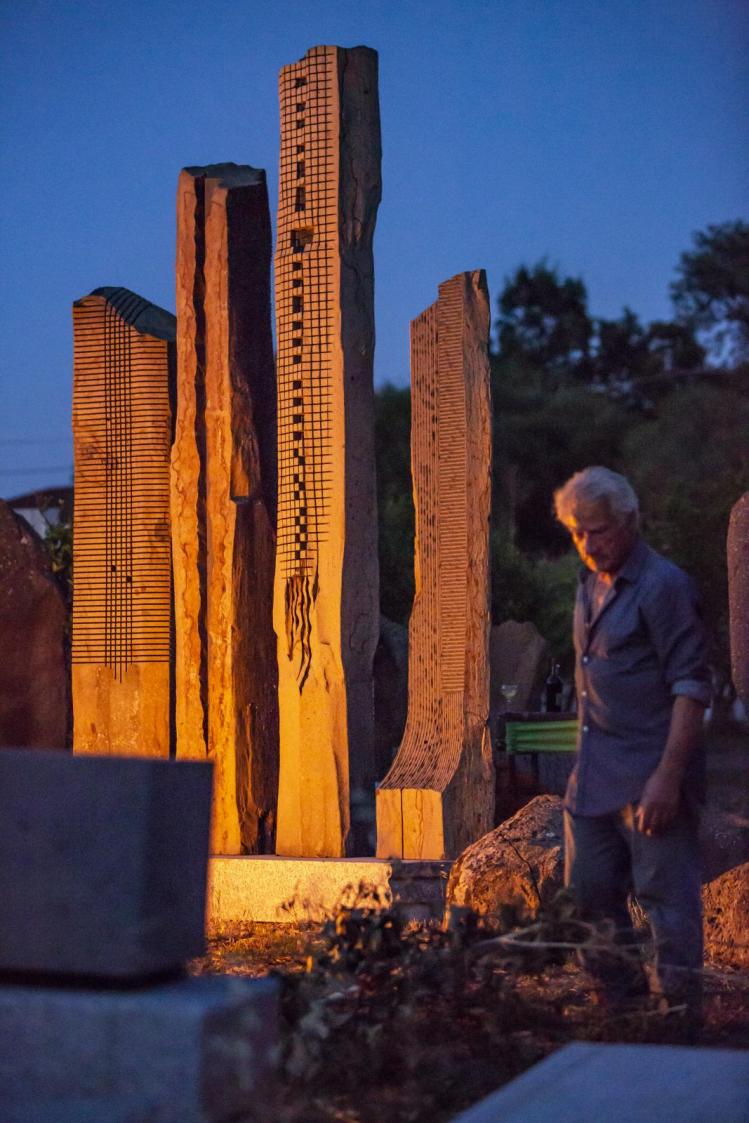
In Pinuccio Sciola’s garden, in the Sardinian village of San Sperate, the stones sing—but not for everyone. On a morning in late spring, I reach two fingers toward a tall block of basalt, scored from top to bottom with fine vertical cuts, and stroke it the way I’ve been told to. Nothing happens. I try again: silence. Beside me, a man who grew up among these sculptures lays his hand on the same stone, almost without looking, and draws out a long, glassy note that seems to rise from deep in the rock and from somewhere far back in time.
Sciola—everyone here called him tziu Peppe, Uncle Peppe—insisted that stone is not mute, and he built a life on the claim. He was born in 1942 in a village that until a few decades ago was entirely brown: houses of raw earth, bricks of straw and clay. He liked to say he had trained at “the University of Nature,” which was half true. At seventeen, he won a scholarship and enrolled at the art institute in Cagliari. Then came Salzburg and the international academy, the years working alongside Oskar Kokoschka and Fritz Wotruba, the travels that took him to Henry Moore and to the Mexican muralists—as far as David Alfaro Siqueiros, with whom he worked in Mexico City. But the real apprenticeship, he said, was looking at the matter of his own island—Sardinia, “one of the very first lands to emerge,” the oldest sculpture in the Mediterranean.
In 1968, while the rest of the world was burning, he came home and whitewashed the village’s mud walls to offer them as canvases. A town-museum was born, a small capital of muralism that still draws artists from around the world. But Sciola’s life’s work is the Sound Garden. To build it, he inverted a myth: Medusa petrified people, taking away their speech; he did the opposite. With a diamond blade he scored blocks of basalt with dense parallel cuts until the stone could flex and vibrate, and out of the vibration came sound. To produce the sound, you don’t strike the stone, you caress it. Strike it and all you hear is the blow.
Not all stones have the same voice. Carrara marble, I learn, is nearly mute beside the Jurassic Sardinian limestone, which is 150 million years old: the older the stone, the more it has to say. A musician, Andrea Granitzio, wrote a doctoral thesis “for orchestra and stones” and ran into the paradox that a stone cannot be tuned—so you have to detune the instruments instead. It is a Zen garden in reverse: the Japanese karesansui is made for silence; this one is made for song.
My own failure with the basalt, I came to understand, was the lesson. Mere physical contact is not enough. What is required is a kind of relationship, one that takes time. I think of Pauline Oliveros, the composer who turned listening into a discipline—her Deep Listening distinguishes hearing, which is automatic, from listening, which is a choice, an attention that has to be trained. Sciola’s stone asks for exactly that. We live in a world busy dematerializing, where everything happens “remotely” and to think a thing is nearly to consider it done. The garden is a counterculture in miniature: instead of racing toward the disembodied, in it you return to the hand, to the Stone Age. Art was born in caves. In Stanisław Barańczak and Clare Cavanagh’s translation of Wisława Szymborska’s poem “Conversation with a Stone,” the poet knocks to be let in and is told, “I don’t have a door”; what she lacks, the stone says, is “the sense of taking part.” At San Sperate you learn that sense with two fingers.
There is an incident that people in the village still talk about. The blood donors’ association asked Sciola for a stela. “Give me a free hand,” he answered, “and I’ll give you the blood of the stone.” He had watched an oxyacetylene flame cut iron like butter; he ran it along the basalt’s incisions until the rock glowed and began to run. He said he had seen the stone weep blood, and drew a vertiginous conclusion: if it bleeds, it is alive; if it is alive, it vibrates; if it vibrates, it sings. Geology, in the end, agreed with him. Basalt is cooled lava; it has a fire inside. Seamus Heaney once turned a cold, wet stone in his hand on a northern beach and imagined it “a stone from Phlegethon, / bloodied on the bed of hell’s hot river,” the saltwater making his hand smoke. Sciola needed no metaphor: he set the fire loose and let the stone bleed. Blowtorch in hand at the basalt, he was something like Heaney’s blacksmith at the anvil in “The Forge”—“an altar where he expends himself in shape and music.”
Sciola was not alone in looking for life in the most inert matter. As a child, the Jesuit paleontologist Pierre Teilhard de Chardin hunted for something that “shone,” and believed he had found his “God of Iron” in the linchpin of a plough. When he discovered that iron rusts, he turned instead to quartz crystals. The Serbian-American poet Charles Simic, a poet laureate of the United States, wrote of going inside a stone—“Go inside a stone / That would be my way”—and found there, by a faint interior moonlight, “the star-charts / On the inner walls.” Sciola swore he had actually seen them—“pieces of stars,” he said, lodged in the rock at the birth of the universe. A century earlier, Gerard Manley Hopkins had coined a word, inscape, for the inner, unrepeatable form that makes each thing itself and presses it to speak. In his sonnet “As Kingfishers Catch Fire,” stones dropped in a well “ring,” and each created thing “finds tongue to fling out broad its name,” crying, “What I do is me: for that I came.” Stone might seem like an exception—indifferent, self-sufficient, “independent as the Sun,” like the happy little stone in Emily Dickinson that “rambles in the Road alone” and “doesn’t care about Careers.” Sciola spent his life proving that stone too, under the right hand, can “fling out broad its name.”
Sciola is not the only great artist to have discovered hidden possibilities of stone or metal. Antoni Gaudí made with the Sagrada Família a forest of stone that prays without words, and in Park Güell he scattered a hundred and fifty spheres, one for each bead of the rosary. Bill Fontana, a student of John Cage, amplified the inner vibrations of St. Peter’s great bell for a Vatican jubilee, with the bronze still breathing after the bell seemed to have fallen silent. But Sciola did something different: he did not amplify, he entered the stone and released its sound, the way Michelangelo’s Prisoners strain to climb out of the marble. Two weeks before he died, Sciola set his stones before Michelangelo’s Moses in the Church of San Pietro in Vincoli; the encounter was called “The Voice of the Stone,” and to that Moses, who by legend cannot speak, the stones offered an answer. In summer 2025, Sciola’s sculptures sang at the Osaka Expo beside Sardinian tenores and launeddas, under a banner that read: “The Voice of the Stone. The Voice of Man.”
There was a film Sciola kept returning to, Fellini’s La Strada. In it, the Fool picks up a pebble and tells Gelsomina that everything is good for something: if this little stone is useless, then everything is useless, “even the stars.” It is, more or less, the garden’s minimal theology. And it is, after all, the Gospel that denies that stone is a dead end for the living: John the Baptist warns that “God can raise up children of Abraham from these stones.” From the most apparently inert matter, a life.
Sciola died in 2016. The whole village of San Sperate dressed in white. Eight thousand people came to the funeral, and many of them promised that his house would not become a tomb. Promises, in these parts, are made of stone until someone caresses them. On May 29, the door on the Via Marongiu opened again: the house is now a museum that has not stopped being a house—the record player is still there, the books annotated in the margins, the ash in the grate. Sciola’s last dream had the dimensions of an entire island: to turn the state highway that crosses Sardinia into an open-air museum, with sculptures at every kilometer instead of billboards. He managed to set down two of them before his death. I stand a moment with my hand on a piece of basalt still warm from the sun, and this time I do not ask it to sing.
We welcome your comments about this article. Please send your response to [email protected].