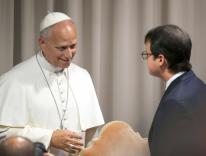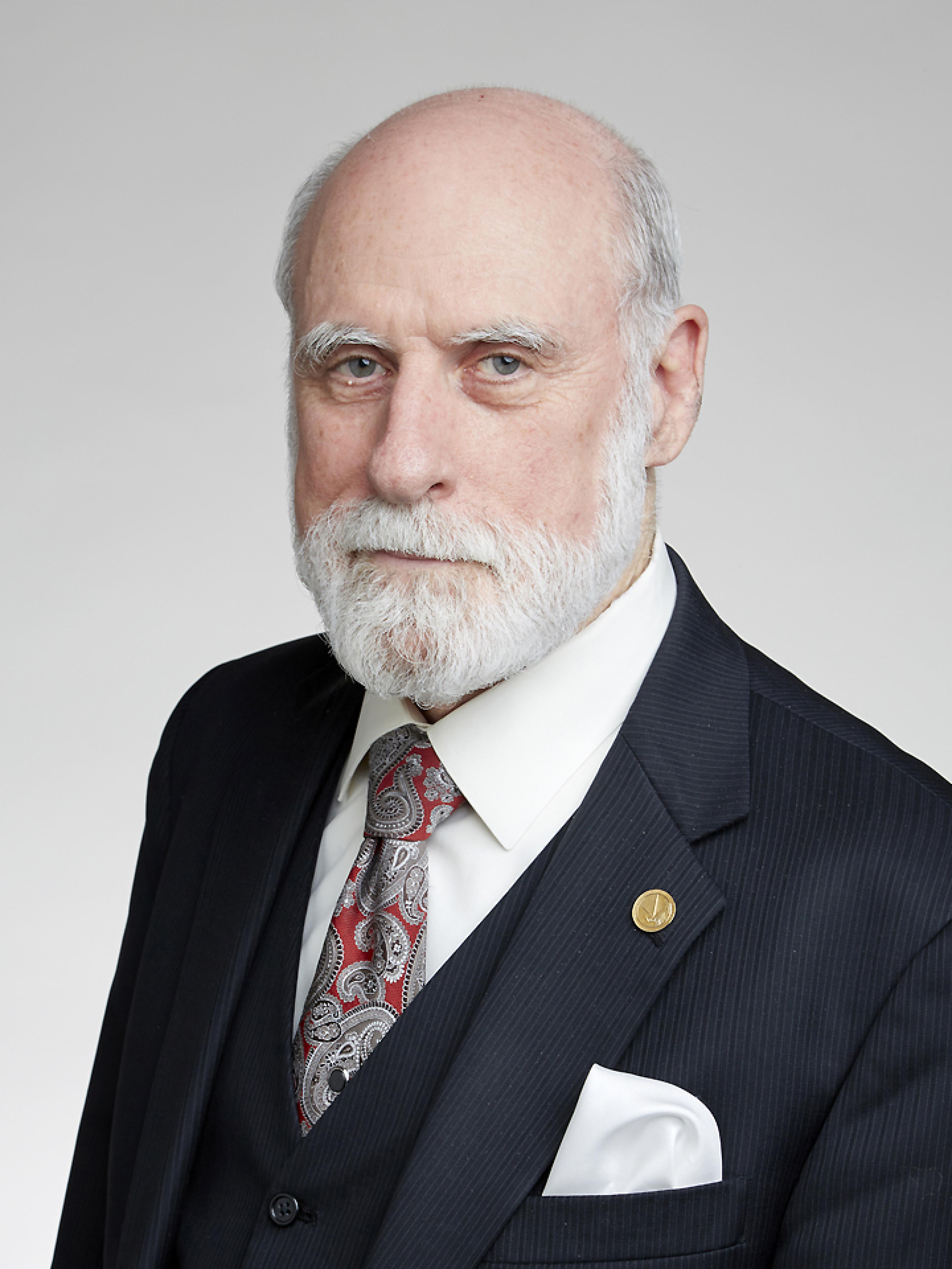
I first met Vinton Gray Cerf in February 2014, during a Google event titled “The Internet as God’s Gift.” At dinner, I was struck by his measured courtesy. At one point, in the calm tone of someone who knows how to weigh words, he said something about Pope Francis: “The fact that one man can so profoundly revitalize the ancient institution of the Catholic Church tells us something about his ability to channel energies that go beyond normal human capacities.” From that evening on, we stayed in touch.
With his impeccable suits and the elegance of a diplomat from another century, Cerf does not come across as a tech nerd. And yet he is one of the architects of our age: together with Robert Kahn, he invented the TCP/IP protocol, the language that allowed computers to talk to each other and the internet to be born. At eighty-two, he remains one of the most lucid voices on the digital future. Today, as we produce data at dizzying speed, he reminds us of the fragility of all that we have entrusted to the “cloud.” To describe the problem, he coined a powerful image: digital vellum. Just as medieval vellum—calfskin or sheepskin prepared to last for centuries—has preserved texts and miniatures down to us, so too must the digital learn to write across time. But how, when a thirty-year-old floppy disk is already a museum piece?
There is something monastic about Vint Cerf: a sense that safeguarding memory is not a technological luxury but a moral task. Last year, I spoke with him about the future of memory, the moral responsibilities of preserving it, and the pitfalls of a world where machines do not merely record but learn and interpret in our place.
Antonio Spadaro: Human memory is shaped in flesh and consciousness. Today, however, we are surrounded by digital supports that risk becoming unreadable within a few decades. How can we preserve our humanity, which is founded on duration, interiorization, and transmission across generations?
Vint Cerf: It is a serious problem. We risk a digital Dark Age. Some medieval codices have lasted a thousand years. Digital data, on the other hand, may remain intact but become incomprehensible: software updates, machines disappear. I myself have old hard drives perfectly preserved that I can no longer open: updated software is incompatible, the machines to interpret them have vanished. It is like having a library without anyone who can still read the alphabet it is written in. It is not enough to save the bits: we must also preserve the contexts that render them interpretable—operating systems, programs, hardware architectures. Only then will the future not find itself before a wall of silence.
AS: From St. Augustine to Paul Ricœur, the Western tradition has linked memory both to personal identity and collective identity. But in a world where everything can be archived, memory risks becoming a meaningless accumulation. How do we decide what truly deserves to be remembered?
VC: The numbers are staggering. In 2025, we are generating about 463 exabytes of data every day. Even preserving just one percent would be a colossal undertaking. Clearly not everything can be saved. So, the question becomes: What is worth remembering? Security alone isn’t enough. We need metadata—information that establishes provenance, integrity, and the placement of content. Only then does digital memory become selective, legible, meaningful. Of course, selection entails an ethical responsibility. Who decides what remains and what is lost? Historians? Cultural institutions? Algorithms? Likely a mixture of all three. But we cannot abdicate discernment. Memory is not a neutral warehouse; it is a civilizational choice.
AS: Could we imagine a “philosophy of forgetting” as an antidote to the digital compulsion to preserve everything? And what is the human cost of never forgetting anything?
VC: Actually, we mentally reconstruct much of what we think we “remember,” and, of course, we forget a great deal—just read an old diary to be reminded how selective human memory is. In a curious way, large-language models “remember” by means of generative reconstruction. It’s astonishing how much an LLM can regenerate at a level of detail human beings might wish they had. But we will not succeed in artificially remembering everything we record. It’s economically impossible.
AS: But what happens when our memory is no longer mediated by living bodies, but by machines?
VC: Entrusting collective memory to technological systems created by a few—perhaps driven solely by the market—risks losing control of our own narratives. That’s why the project insists on decentralization. No single archive, no monopolistic entity; rather a constellation of interoperable archives, able to sustain and replace one another in case of failure. It’s the opposite of a technological empire: a distributed ecosystem. And there is also a guiding principle I call “benevolent intentionality”: those who preserve must do so with the aim of making content accessible and valuable for future generations. That is the ethical compass distinguishing memory as a service to society from memory as a market product.
AS: Can you give me some examples?
VC: The Internet Archive, founded by Brewster Kahle, has since 1996 captured and preserved web pages, books, and software. GitHub buried in the Svalbard permafrost the Arctic World Archive, a capsule of memory designed to last centuries. These experiments show that digital memory can be a common good, not private property.
AS: But who today bears the moral responsibility to decide what must be remembered and what may be forgotten?
VC: No single subject. Universities, libraries, and national archives have already shown they can safeguard. I also think of the Catholic Church, with its two thousand years of memory. But there is a problem: the economic model. Without sustainability, no archive can endure.
AS: I believe we must also reflect on the role of AI: If it becomes capable of interpreting documents, texts, and memories, who guarantees the authenticity of meaning?
VC: Indeed, it is a crucial question. Today, artificial intelligence models can read, summarize, paraphrase. But who assures us they will not distort meaning? This is why some propose treating AI agents as fiduciaries: entities that not only provide an answer but also record the process by which they reached it. This would allow humans to verify and critique their work. Yet, in my view, one fixed point remains: authentic interpretation must remain human. We cannot delegate it. Cultural institutions, scientific communities, and civil society must retain the final word on the meaning of texts and events. AI can support, never replace, never.
AS: Earlier you referred to the Church, which has long been custodian of tradition. How can it continue to play that role in a world where tradition itself is digitized, fragmented, and dematerialized?
VC: I do not think digitization necessarily destroys tradition—though it may transform it, like the shift from orality to writing or from simple mathematics to quantum mathematics. If anything, digitization may allow us to live new traditions and to relive ancient ones in new ways. My experience of text has been transformed by digitization. Searching is easier; AI assists in composition; virtual and augmented reality provide a basis for new experiences and new traditions. Some aspects of digitization are allowing us to better understand the evolution of tradition. Think of reconstructing the sequence of ancient writings that lead to our modern Bible. Digitization should not be considered alien to tradition, nor inherently capable of eroding it.
AS: Is it possible to safeguard a space for transcendence in a world where everything is malleable and reproducible?
VC: Here we come to a critical question about artifact and reality. In what do they differ? Why should an artifact be considered less real? What is natural? Is not the “natural” the result of physical, chemical, or biological processes? In what way are these less real than the products of digital processes? Are digital processes somehow less genuine than so-called natural ones? If anything, digital artifacts can help us understand the transcendent better than we could without their aid. Models and simulations can give us a deeper understanding of natural processes.
AS: In the digital world, truth risks being reduced to pure logical coherence. How can we ensure that artificial intelligence remains at the service of wisdom and never seeks to replace it?
VC: The AIs available today are notoriously unreliable. Still, they can awaken desire and help us in our search for truth—even for wisdom. But this is something we ourselves must manage. They are powerful tools, not omniscient ones, and it is important to remember that when we use them.
An Italian translation of this interview appeared in la Repubblica.