In Venice Observed, her cultural history of that enchanting city, Mary McCarthy quotes a sixteenth-century German prince’s assessment of the Venetian character. Venetians were “conspiring the ruin of everyone,” the prince complained, and he urged resistance to “the insatiable cupidity of the Venetians and their thirst for domination.” Venice was, of course, not just a city of wealthy art patrons, but first an avaricious commercial empire. Venetians were “religious about being worldly,” according to Garry Wills (Venice: Lion City).
McCarthy elaborated on the paradox of Venice’s worldliness. “A commercial people who lived solely for gain—how could they create a city of fantasy, lovely as a dream or a fairy tale,” she wrote.
There is no contradiction, once you stop to think what images of beauty arise from fairy tales. They are images of money. Gold, caskets of gold, caskets of silver, the miller’s daughter spinning gold all night long, thanks to Rumpelstiltskin, the cave of Ali Baba stored with stolen gold and silver…. A wholly materialist city is nothing but a dream incarnate. Venice is the world’s unconscious: a miser’s glittering hoard, guarded by a Beast…. The Venetian mind, interested only in the immediate and the solid, leaves behind it for our minds, clear, dawn-fresh images of fairy tales.
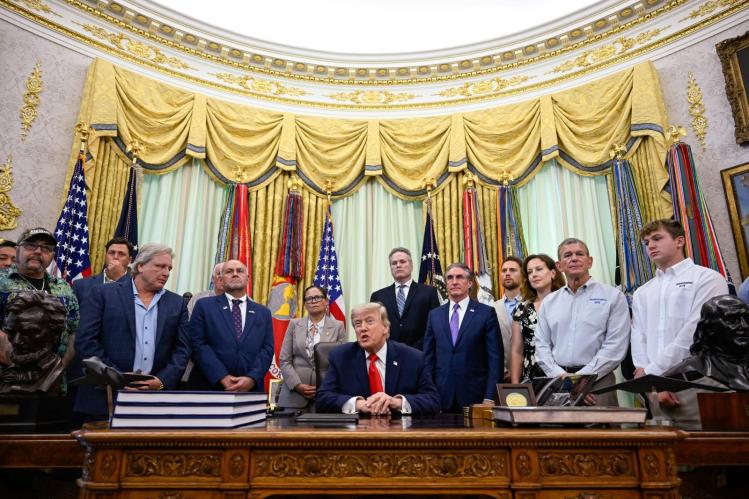
In the midst of President Donald Trump’s most recent smash-and-grab exploitation of the presidency, I was reading a picture-book version of Rumpelstiltskin to my three-year-old grandson. Spinning straw into gold reminded me of how Trump has gilded nearly every surface in the Oval Office, from picture and door frames to the row of tacky “gold” trophies on the mantel of the fireplace. And, of course, the fabric on the chairs and couches virtually shouts “Gold!” Trump is the sort of miser you come across in some especially ghoulish fairy tale.
Whether his political career will end with the kind of moral reckoning fairy tales usually offer remains to be seen. Rumpelstiltskin, for example, depicts a baldly transactional world that is much like Trump’s approach to governance and all other aspects of life. The poor miller wants his daughter to marry up, to marry the king. In pursuit of that aim he lies, bragging that his daughter can spin straw into gold. The king, whose eye is on the bottom line, is only interested in the beautiful young woman if she can produce the gold. If she fails, she will be killed. Thanks to the fear he and his base instill in Republicans, Trump is in the business of doing the same thing with the straw of crypto, bitcoin, presidential pardons, tariffs, and much more.
Locked in a roomful of straw, the miller’s daughter collapses in despair. Rumpelstiltskin then makes his mysterious appearance, promising to spin the straw into gold if the young woman will barter away her necklace. “Whir! Whir! Whir!” goes the spinning wheel, Rumpelstiltskin then disappears and the miller’s daughter presents the gold he spun to the king. Predictably, this only inflames the king’s greed, and he locks her in a larger room under with the same assignment—and the same threat. In the extortionist economy of the fairy tale, she must now offer the greedy little gnome her ring. Rumpelstiltskin spins away and when the king sees the result, he reasons that he could “not find a richer wife in all the world” and demands that she pull off the trick once more. But this time, the miller’s daughter has nothing she can offer Rumpelstiltskin. Having maneuvered her into a seemingly impossible situation, Rumpelstiltskin demands she surrender her firstborn child. Seeing no alternative, she agrees. She is young and only dimly perceives the consequences of her promise. When Rumpelstiltskin eventually comes to claim her princeling son—she is now the queen—he gives her one last chance to avoid handing over the child. If she can guess his name, she can keep the baby.
You might like: Paul Baumann on Evelyn Waugh's warning
Maria Tatar, a scholar of children’s literature, writes that the plot of Rumpelstiltskin is about deception and greed. Like Trump, the daughter, the father, and the king “all seem rash, irresponsible, and recklessly opportunistic.” After ferreting out Rumpelstiltskin’s name, the queen enjoys tormenting him by initially proposing a number of false names. Naming games are an especially intriguing aspect of fairy tales. Folklorists tell us that being able to name someone is a form of control and an expression of dominance. One is reminded of Trump’s talent for ridiculing his critics and rivals by coining crude nicknames such as Little Marco, Sleepy Joe, Low Energy Jeb, Ron DeSanctimonious, and on and on. Those monikers are not very different from Beastyribs, Leg O’Ram, and Stringbones, some of the names used by the queen to taunt Rumpelstiltskin.
“Everything in Venice is an illusion,” McCarthy wrote near the end of her book. Trump’s presidency is also a kind of illusion, although not for the many people he has hurt or extorted. Like children in fairy tales, Trump is grasping and impetuous, unable to delay gratification. He wants his appetites—for wealth, power, or hamburgers—satisfied now. But unlike the moral development of children depicted in fairy tales, he seems never to have learned that mastering one’s impulses is the only way to come to grips with reality. “What redeems us as human beings and restores us to our humanity,” Bruno Bettelheim wrote in The Uses of Enchantment: The Meaning and Importance of Fairy Tales, “is solicitude for those whom we love…. Integration of the disparate aspect of our personality can be gained only after the asocial, destructive, and unjust [aspects] have been done away with; and this cannot be achieved until we have reached full maturity.” As McCarthy wrote of Venice’s veneer of gold, Trump’s “wholly materialistic world is nothing but a dream…[a] miser’s glittering hoard, guarded by a Beast.” Like all fairy tales, it will end badly for those who are heedless, grasping, and greedy. But when?
We welcome your comments about this article. Please send your response to [email protected].