President Donald Trump is determined to put his name on everything within his grasp, his face on every screen, and his overbearing demands forever in our ears: “Quiet, Piggy!” Unless one is living the life of a hermit—perhaps an enviable vocation now—it is almost impossible to tune him out.
In trying to make sense of Trump’s preposterous and perilous ascendency, I have at last come to the realization that it bears an uncanny resemblance to the career of Rex Mottram, the ambitious businessman, playboy, and opportunistic British politician in Evelyn Waugh’s 1945 novel Brideshead Revisited. Mottram’s political cynicism, like Trump’s, recalls Henry Adams’s famous description of democratic politics as “the systematic organization of hatreds.”
Mottram, a transplanted Canadian, was thought to be “a pushful young cad” by England’s pre–World War II ruling class—like a man from the outer boroughs trying to make it in Manhattan. “His social position was unique; it had an air of mystery, even of crime, about it; people said Rex went about armed,” according to Charles Ryder, the novel’s narrator and protagonist. Mottram possessed the “unmistakable chic—the flavour of ‘Max’ and ‘F.E.’ and the Prince of Wales, of the big table in the Sporting Club, the second magnum and the fourth cigar, of the chauffeur kept waiting hour after hour without compunction.” Think of Trump’s obsession with the tabloid press, his reality-TV profile, expensive golf resorts, private jets, and admiration for Mafia bosses. Think of his gold-encrusted penthouse, Atlantic City casinos, and the recent Gatsby-themed party at Mar-a-Lago.
In one of the novel’s brilliantly realized scenes, Ryder selects a Parisian restaurant whose unpretentious excellence is unknown to Mottram. Like Trump, Mottram only likes to be seen at the glitziest venues, but hesitantly agrees to meet the younger man there. Ryder, a painter with honest artistic aspirations and little patience for Mottram’s slick importuning, tries his best to concentrate on the pleasures of the food. He wants to drown out Mottram’s monologue about money and determination to marry Julia Flyte, the daughter of the wealthy aristocratic Catholic family Ryder is entangled with. Ryder tells us:
I closed my mind to him as best I could and gave myself to the food before me, but sentences came breaking in on my happiness, recalling me to the harsh, acquisitive world which Rex inhabited. He wanted a woman; he wanted the best on the market, and he wanted her cheap; that was what it amounted to.
Trump, of course, wants everything both cheap and the best on the market, whether it’s women, Greenland, Venezuelan oil, or the Nobel Peace Prize.
At the end of the meal, Mottram refuses a small snifter, insisting that his cognac be served in “a balloon the size of his head.” In his world, as in Trump’s, bigger is always better. “We’re gonna win so much, you may even get tired of winning,” Trump famously promised voters. “I’m really rich,” was, he told us, the reason he deserved to be in the White House. “I’m the most successful person ever to run for the presidency, by far. Nobody’s ever been more successful than me.” This is also how Mottram understands his political qualifications and marriage prospects.
In a way, Mottram’s cognac balloon is just a miniature version of Trump destroying the East Wing of the White House and replacing it with a gilded ninety-thousand-square-foot ballroom. “Oh, Rex’s parties!” Julia complains of Rex’s friends, sounding as if she’d spent too many nights at Mar-a-Lago. “Politics and money. They can’t do anything except for money.” Trump’s exploitation of the presidency, like his assault on every moral and political norm, has reputedly garnered his family more than $3 billion during the first year of his second term. He can’t do anything, even lead the world’s oldest democracy, except for money. He can’t understand any other motivation.
Earlier in the novel, Mottram presents Julia with a “slightly obscene” Christmas present, a live tortoise with her initials set in diamonds in the shell. Maybe Trump would have had the shell gold-leafed instead. In Mottram’s world, as in Trump’s, it is the cost of things, not their value or innate dignity, that matters. Contemplating the well-aged wine served with the meal he endured with Mottram, Ryder is reminded “that the world was an older and better place than Rex knew, that mankind in its long passion had learned another wisdom than his.”
Have we? Many Americans admire Trump’s disdain for the sort of traditional values Ryder aspires to. Like Mottram and Trump, we want what we want, and we want it now. As Trump strives to recreate the world in his own image, no matter the cost to others, we should remember that there is a reality that will ultimately assert itself beyond the manipulations of the rich and powerful. Hubris comes with a cost, as does complicity in evil.
“Anglo-American democracy doesn’t exist in a vacuum. It’s embedded in an inherited wider culture of decency,” writes Andrew Sullivan. Like Waugh, Sullivan is a conservative English Catholic who understands that our freedoms rest on the bedrock of certain moral and religious beliefs.
Attack that decency in favor of insult and cruelty, and you are directly assaulting the foundations of democracy. That is why Trump remains an insidious threat to our way of life and to free people across the globe. Indecency is always an indispensable prologue to tyranny.
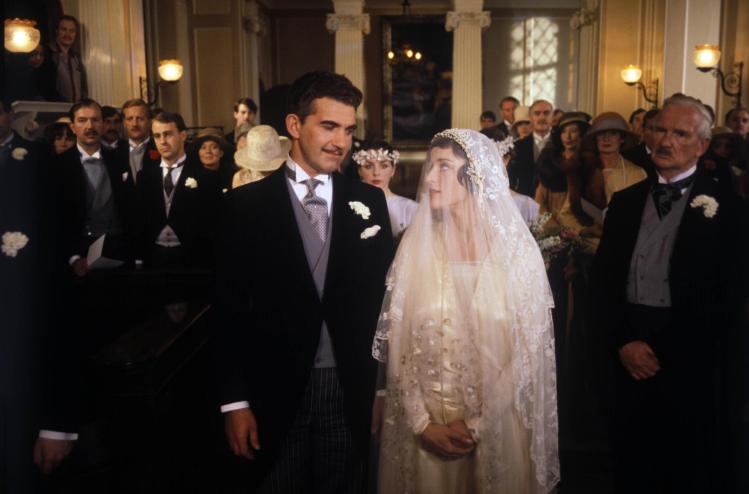
I have an unhealthy obsession with Brideshead Revisited. I’ve pored over countless critical assessments. I’ve watched the 1981 British television version—starring a young Jeremy Irons and an old Laurence Olivier—more times than my wife and grown children care to remember. The novel became a bestseller in the United States, selected for the Book-of-the-Month Club in 1946. It was taken up enthusiastically by the country’s Catholics, who at the time were making their way from a fortress-like subculture into the nation’s expanding middle class. Waugh’s “Catholic tract,” as many critics called it, was eagerly embraced by Waugh’s coreligionists, who welcomed the book’s explicit theological concerns. As Waugh put it, the novel depicts the “operation of divine grace on a group of diverse but closely connected characters,” although there is not a conventionally happy ending for any of them.
In his snobbish and misanthropic way, Waugh initially considered his book’s success in America to be evidence of its shortcomings. He disdained this country’s democratic egalitarianism and crude materialism. But Brideshead’s success here ultimately made him rich and, predictably, this softened his anti-Americanism. In rendering his controversial theme—Edmund Wilson, an admirer of Waugh’s earlier novels, found Brideshead’s religious dimension “extravagantly absurd”—Waugh again demonstrated his talent for biting satirical portraiture. Mottram is an especially vivid and recognizable creation in a long line of pointedly deluded fictional characters. The Flyte family tragedy, in which Mottram’s cupidity is instrumental, plays out against the background of the extravagant country estate that gives the novel its title, and whose eventual defacement mirrors our own political moment.
You can hear Mottram’s clueless self-aggrandizing voice and moral obtuseness in nearly everything Trump says, especially his disingenuous speculations about deficiencies in his own moral character. “I don’t think there’s anything that’s going to get me in heaven. I think I’m not maybe heaven-bound,” Trump has said. “I’m not sure I’m going to be able to make heaven, but I’ve made life a lot better for a lot of people.”
Rex Mottram has a similar take on Judgment Day and Christianity more broadly. Like Trump, he believes religion is a “crack-brained” joke and a game he can exploit. Told that he must convert to Catholicism to marry Julia, he approaches religious instruction as if it were just another business deal. He submits to it with grim determination, if little interest. His only real interest is in the social status and political advantage marriage to a Flyte will confer. Like Trump, he’s not heaven-bound, and is unfazed by that prospect. “I shall be dead long before Rex is a Catholic,” Mottram’s Jesuit catechist reports to Julia’s mother. “He was exceptionally docile, said he accepted everything I told him, remembered bits of it, asked no questions. I wasn’t happy about him. He seemed to have no sense of reality.”
When the revelation of Mottram’s earlier marriage and divorce prevents his Catholic marriage to Julia, he sounds exactly like Trump in thinking that every problem has a financial solution. “All right then, I’ll get an annulment,” he declares. “What does it cost? Who do I get it from?”
“You know Father Mowbray hit on the truth about Rex at once, that it took me a year of marriage to see,” Julia tells Ryder.
He simply wasn’t all there. He wasn’t a complete human being at all. He was a tiny bit of one, unnaturally developed; something in a bottle, an organ kept alive in a laboratory. I thought he was a sort of primitive savage, but he was something absolutely modern and up-to-date that only this ghastly age could produce. A tiny bit of a man pretending he was the whole.
And now his doppelganger sits in the White House, counting his gold, gilding his walls, and subjecting the rest of us to his stunted vision of the world.
Like all great novelists, Waugh saw clearly an aspect of the future hidden from most of his contemporaries. Eighty years ago, in a moment of great triumph for liberal democracy, he understood the dangers of casting aside the past and every traditional moral sentiment in pursuit of fame and fortune. He warned about a future where every difficult question will be answered with a snort: “Quiet, Piggy!” He warned us not to give the Rex Mottrams of the world our attention, or our votes.